


MLB, players union reignite salary cap debate as labor stoppage looms
With the current labor deal nearing its end, owners and players trade public warnings, and a potential lockout in 2027 moves back into focus.
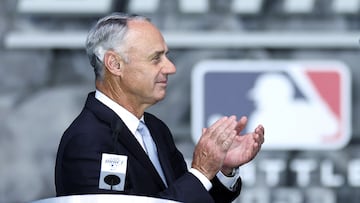

Major League Baseball and the MLB Players Association have reopened a familiar and combustible debate, one that could once again push the sport toward a labor stoppage. Even with the season still months away, early signals from both sides suggest that the road to the next collective bargaining agreement will be tense, with a salary cap once again at the center of the fight.
While star free agents like Cody Bellinger and Kyle Tucker remain on the offseason chessboard, the most consequential movement in baseball right now is happening off the field. With just over two months until the start of the 2026 season, communication between the commissioner’s office and the players union is beginning to sketch out a scenario fans know all too well, uneasy, public and edged with confrontation.
Manfred reveals continuing salary cap debate
Commissioner Rob Manfred brought the issue into the open last week during a radio interview in New York. Asked whether a salary cap would be a defining issue in the next round of collective bargaining, Manfred deflected attention toward the union and its leadership. He argued that refusing to discuss certain topics before negotiations even begin is a difficult way to start any labor process.
Manfred leaned on his background in labor relations to defend the idea that all options should remain on the table, including structural changes to baseball’s economic system.
Rob Manfred breaks down his thoughts on the potential benefits of a free agency deadline in MLB's offseason:@craigcartonlive @CMacWFAN pic.twitter.com/IFya6M0HQw
— WFAN Sports Radio (@WFAN660) January 8, 2026
Union response swift and pointed
The players union wasted little time responding. The MLBPA reiterated a position it has held for decades, grounding its argument firmly in baseball’s recent history. Players and fans, the union said, want full, competitive seasons, and the last time a salary cap style system was pushed, the sport paid an enormous price.
“Players and fans want a full season of competitive baseball,” the union, led by executive director Tony Clark, told The Athletic. “The league and owners say they want to avoid missing games but at the same time they appear to be dead-set on trying to force players into a system that, the last time they proposed it, led to the most missed games ever and a cancelled World Series.”
The current labor agreement expires in December, and formal talks typically begin in the spring, often no later than May. Manfred has insisted it is premature to outline specific proposals, even as he has repeatedly pointed to the NBA, NFL and NHL, leagues that operate with salary caps paired with mandatory spending floors.
Push for a spending floor
That comparison resurfaced when Manfred was asked how MLB might encourage low-spending teams to invest more aggressively. His answer returned to the idea of a required minimum payroll, a feature common in other major North American sports, but one that would likely be linked to a cap as well.
“The incentive issue is really important,” Manfred said last week. “The other three sports have addressed it with a rule: you have to spend. Everyone talks about the maximum. That maximum comes with a spending requirement. And I think requiring a certain level of spending commitment in the right economic system can be positive.”
Lessons from baseball’s past
The memories of 1994 and 1995 still hang over the sport. That strike lasted 232 days and left lasting scars, including the cancellation of the World Series. More recently, the 2021-22 lockout pushed negotiations to the brink but ultimately preserved a full regular season.
Today’s environment is different. The pitch clock has energized the game, improved pace of play and boosted fan engagement, an upswing Manfred has repeatedly cited as a major asset.
That momentum, however, exists alongside structural challenges. Regional sports network blackouts and concerns about competitive balance in certain markets remain unresolved. Traditional RSN revenues are declining as streaming platforms grow in influence. MLB is exploring a model that would more fully integrate national and local media rights starting in 2029, a shift that would require complex agreements and major concessions.
Manfred has argued that small-market teams are not always unwilling to spend, but often unable to do so under the current system.
Offseason lockout a possibility
On the players’ side, Clark has maintained a steady and cautious tone. The union prepares for each negotiation cycle as soon as the previous one ends and says no formal or informal talks have begun. Its stated goal remains a fair and equitable agreement.
The Basic Agreement expires Dec. 1, 2026, and this will be the final round of negotiations led by Manfred before his planned retirement in January 2029. The union expects difficult talks and is openly preparing for the possibility of an offseason lockout, a scenario MLB experienced only a few years ago without losing regular-season games.
Clark has emphasized that no one enters negotiations hoping to cancel games, even if baseball’s history suggests otherwise. Communication channels remain open, and any progress will be shared with players, according to the union.
Still, the word lockout is beginning to hover over the 2026 season.
Owners, votes and market power
Owners have floated the idea of both a salary cap and a salary floor, similar to other professional leagues, arguing that such a system would promote competitive balance. The union remains firmly opposed.
“Knowing there are teams that can compete but choose not to, how does that help the industry?” Clark asked.
Any major change requires approval from 75 percent of the league’s 30 owners, making a fair redistribution of regional television revenue highly unlikely. Large-market teams with their own networks or lucrative TV deals have the numbers to block it. The New York Yankees, New York Mets, Boston Red Sox, Los Angeles Dodgers, Chicago Cubs, Chicago White Sox, Baltimore Orioles, Washington Nationals and San Francisco Giants sit at the center of that power structure.
If owners enter negotiations once again trying to impose a cap system, a lockout appears likely, potentially a long one that could stretch into the 2027 season. That would mark the first time since the 1994 players strike that both sides lose regular-season games, a shutdown that wiped out 948 games, the playoffs and the World Series.
In that scenario, owners lose revenue and players lose pay. Players are paid only from Opening Day through the final regular-season game, not during stoppages. History suggests the standoff becomes a test of who blinks first, and historically, that has been ownership.
“We’re not entering these conversations trying to harm the game,” Clark said. “Especially when the game is in such a good place. We should be celebrating our players, the sport and what we’re seeing. Our guys are delivering night after night.”
MLB commissioner Rob Manfred, who plans to step down in January 2029, spoke about the future of baseball on WFAN.
— Nick Foster (@nickfostermedia) January 9, 2026
He highlighted his desire to further incentivize teams to spend over adding a salary cap. Also insisted that MLB will avoid a lockout in 2027.
(H/T: @DanBartels2) pic.twitter.com/ij4HbJpols
A profitable sport, and rising stakes
MLB is making more money than ever. The league set a record last season with $2 billion in team sponsorship revenue. The Los Angeles Dodgers, two-time defending World Series champions, drew more than 4 million fans to Dodger Stadium for the first time and surpassed $1 billion in local revenue.
“The dollar figures are higher than they’ve ever been, and the organization has been preparing to put players in a position of flexibility to do what they want,” Clark said.
The clock keeps ticking. And once again, a lockout is no longer a distant idea, but a looming possibility.
Related stories
Get your game on! Whether you’re into NFL touchdowns, NBA buzzer-beaters, world-class soccer goals, or MLB home runs, our app has it all.
Dive into live coverage, expert insights, breaking news, exclusive videos, and more – plus, stay updated on the latest in current affairs and entertainment. Download now for all-access coverage, right at your fingertips – anytime, anywhere.
Complete your personal details to comment