


Before the snap: The deaf QB whose innovation became football’s most famous formation
Over a century ago, a football player at a Washington, D.C. university became the “father of the huddle”.
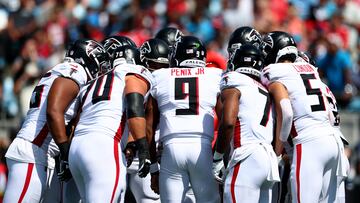

In today’s NFL, the sight of teams crouching down together into a huddle - whether to talk strategy or simply gee each other up - is as much a part of the football fabric as the pre-game rendition of the national anthem.
What’s more, the huddle is ubiquitous in many other team sports. For example, Scottish soccer club Celtic FC has established the practice as an iconic part of its routine in the moments before each kick-off.
But who pioneered the use of the huddle in modern sport?
Origins in 19th-century college football
According to a major university in Washington, D.C., it was a member of its college football team who came up with the idea, just over 130 years ago.
Gallaudet University, a 161-year-old college for students who are deaf or hard of hearing, credits the quarterback Paul Hubbard with conceiving the huddle during a Gallaudet Bison game in 1894.
How did Paul Hubbard pioneer the huddle?
“The Gallaudet football team was playing against another deaf team,” the university says. Hubbard “didn’t want to risk the other team seeing him use American Sign Language (ASL) to explain the play to his teammates, so he asked them to form a tight circle formation, now known as a huddle.”
Hubbard’s quick-thinking to keep his tactical instructions under wraps appears to have been a characteristically savvy ploy. Writing in the Smithsonian Magazine, the journalist Scott Nover notes that the quarterback was nicknamed “the Eel” for his knack of conjuring up “canny maneuvers”.
Nover also reveals that the huddle did not prove universally popular among spectators as it began to take hold in the sporting world. “From Gallaudet’s Washington campus, the huddle spread fast across American football,” he recalls.
“By the 1920s, the formation had become common enough at college games that it even drew complaints from some fans who lamented that it slowed play.”
“Definitely a sense of pride”
After leaving Gallaudet University - where he was later inducted into the Hall of Fame - Hubbard spent 43 years teaching and coaching at the Kansas School for the Deaf (KSD) in Olathe, an institution he had also attended as a child.
Like Gallaudet, KSD revels in Hubbard’s apparent status as the “father of the huddle”. “There’s definitely a sense of pride,” the KSD Museum’s David Westerman told local media outlet KSHB this month.
During Hubbard’s lifetime, Westerman says, his significant sporting legacy was not properly acknowledged. “It was once he had already passed [in 1946 that] they started to recognize his contributions and started to honor him,” he explained.
However, Westerman says it’s understandable if the origin story of an action as routine as forming the huddle has remained unknown to many throughout the decades.
“I played football myself and we used the huddle,” he told KSHB. “It was just what we did […]. I never had thought about it like that.”
Related stories
Get your game on! Whether you’re into NFL touchdowns, NBA buzzer-beaters, world-class soccer goals, or MLB home runs, our app has it all.
Dive into live coverage, expert insights, breaking news, exclusive videos, and more – plus, stay updated on the latest in current affairs and entertainment. Download now for all-access coverage, right at your fingertips – anytime, anywhere.
Complete your personal details to comment