


An American baller in Barcelona: The story of Marquie Smith
Far away from the NBA arenas of the USA, the man known to many as “Kobe” has made a name for himself across the pond in Europe.
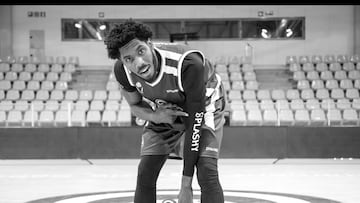

It doesn’t take long to notice that what Mr. Smith lacks in size, he makes up for in character and, above all, flight time. Indeed, it would be fair to say that this is one player who has racked up a whole lot of air miles, a fact one can see plainly when watching him ‘fly’ to the ring.
The following is a one-on-one interview with former professional basketball player Marquie Smith, conducted by Paul Rudder:
Q: Why don’t you tell us a little bit about yourself, which is to say, exactly who are you and what drives you?
A: “My name is Marquie Smith. I am 30 years old and a professional vibe enhancer [laughs]. No, I’m an ex-pro athlete. I train about four hours a day. I start with an early session, and later, depending on whether I’m in season or not, I’ll have an afternoon training. My diet includes no fast food, no drinks from concentrate—everything must be 100% juice—and no pork, but a lot of that is just a personal decision. When it comes to sleep, I make sure to get at least eight hours a day. Mentally pushing through can be a hassle sometimes, especially when you spend so much time in isolation with just you and your goal. Preparation-wise, it often looks like a lot of frustration. I try to make sure that all of my routines are similar, and I do small things to refocus when I feel unmotivated. I also meditate. I don’t play a lot of video games, and I don’t have a lot of friends. I do speak to my parents and other family members from time to time.”
Interestingly, despite the obvious discipline and focus, Smith admits that it’s not all about rigor and routines. “While I love the game, it’s not what drives me anymore. The thing that pushes me most is my love for the sport and the love of creation as an art form. I’ve received a lot of criticism in my life, but none more than from my father growing up. My parents were both very hard on me, so it’s difficult for me to take criticism personally. I’ve learned to translate it into motivation.”
Q: Where do you live today and what effect has that change of scenery had on you?
A: “I live in Barcelona, and I believe it has changed me for the better. Growing up as a military brat, I’ve always had a fascination with different cultures and backgrounds, and this has given me a deep respect for people from all walks of life. However, living here and being influenced by European culture has humbled me. The cuisine is healthier than what I’m used to, the climate is amazing, and in the digital age, you have access to all kinds of music, so that hasn’t changed. I’ve also learned that there is a genuine respect for sexuality here that’s less boxed in, and this affects the way people communicate and the environment when I’m out. I think it’s made me more human.
“I can tell I’ve changed because whenever I meet people from America, I see and feel what Europeans notice about us. There’s a mix of positives and negatives. On the positive side, I see strength in our culture, especially Black culture, and how it permeates globally. On the negative side, well, it’s not really negative; it’s just a new awareness. Sometimes, when you’re in something, it’s hard to see what’s wrong with it until you take a step back. But recognizing those flaws helps me stay humble.” Continuing, he explained how his view has become more global. “I’m happy with this self-awareness because I think, coming from America, I might have developed a sense of ethnocentrism without realizing it. In today’s world, it’s important to understand that just because you have some answers doesn’t mean you’re closed off to learning more or gaining better perspectives.”
Q: OK, we’ve got an idea of where you are now, but why don’t you explain where you’ve come from?
A: “I was born in Heidelberg, Germany. My mother was in the Army, and my father was in the Navy, so I grew up constantly moving and forming new relationships, then ending them, and starting fresh. This lifestyle created in me a balance where I never felt fully anchored to a place but was always able to adapt. To me, today’s canvas is not tomorrow’s canvas. I think this adaptability is important for understanding people and the human psyche. In my life, basketball became just another canvas, another opportunity to create. But tied to that was a passion for competition, which I didn’t initially understand. One of my first fascinations as a kid was with basketball shoes. My mother said I always had a basketball in my hand and would get super excited when I saw Jordan commercials. My dad had a huge collection of basketball shoes and matching outfits, and I thought that as an adult, it was important for people to see me as a cool basketball player.
“Basketball was a goal, a vehicle for expression. I was a smart student, graduating with a 4.25 GPA, accepted to Harvard, and in the top percentile of my class in high school. But the love for competition and basketball motivated me to excel academically as well. This was driven by both my mother and father.”

Q: What about pain? We all feel it and so, I imagine you’re no different. How has it shaped you?
A: “I can’t fully explain it, but I don’t experience pain the way most people do. I’m not saying I don’t feel pain, but it doesn’t leave a lasting impression on me. I’ve trained my mind to believe that pain isn’t real—that it’s just settings and environments that make us think we feel a certain way. It’s both a blessing and a curse because it helps me push through tough moments, but it has also made me more detached. I don’t know how this mentality was created, but I know I live with it, and I do make an effort to grow from it."
Q: From your upbringing to your relocation and the pain you’ve felt along the way, it’s clear that you’ve been shaped by several things. Can you describe that process?
A: “I can see the impact of my upbringing on my family as well. I had strong role models—my parents were a strong Black woman and a strong Black man—who showed me that it’s possible to have a supportive family. Constantly moving and changing my friend groups taught me that outliers are just as important as insiders. I’ve learned to greet people warmly because you never know what someone is going through, and sometimes, you only have one moment to show kindness.
“In school, I struggled because I wasn’t challenged, and that’s why I now make sure to treat every day as a challenge. Even if I just take one step toward being better than I was yesterday, it’s worth it. I always say that as long as I’m having fun, I’ll keep going. When I’m not, I’ll stop. The skills I’ve gained—communication, finding the silver lining, staying positive, relentless dedication, focus, and the ability to be present—are invaluable.”
Q: This one is cliché, but I’m still curious. What advice would you give to the younger generation when it comes to the struggles of life?
A: “My advice for someone struggling in their environment is to put yourself in situations where you can test your skills without direct responsibility. Volunteer for a local basketball team, join a church or book club—put yourself in a position where you’re responsible for something bigger than just yourself. We live in a big world, and just because you’re in one place doesn’t mean you’ll be there forever. It won’t be easy, but I firmly believe in Yoda’s saying: ‘Do or do not, there is no try.’ If you want to do something, then, in the words of Nike, ‘just do it.’ You’ll always benefit from respecting people and their cultures. I think that’s part of the law of the land.
“Success, peace, clarity, and happiness are the most important pillars to strive for in life. Just because you develop certain skills doesn’t mean you’ll reach those pillars, but the journey is often more important than the destination. Along the way, you meet amazing people and do amazing things, and you might find you’re closer to your goals than you thought.”
Q: So, what’s next for Marquie ‘Kobe’ Smith? When your career in sports ends, what will you do?
A: “Clearly, basketball won’t last forever, but I hope that with what I’ve learned, I can become a philanthropist, give back to my community, and inspire others. Basketball is just entertainment — it’s not really about bouncing a ball. It’s about the skills we’ve talked about. I see my talents being applied to a creative agency, nonprofit, or some other platform that lets me create, connect, and inspire. Since the moment I started playing basketball, I’ve been preparing for this moment. Opportunities like this allow me to share my spirit and energy, and I believe that will connect me with the right people and tribe to achieve what my heart desires.”
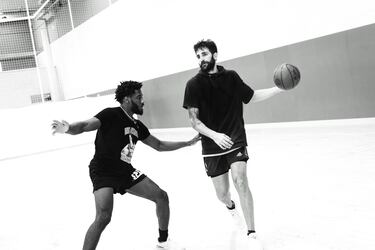
Q: You mention that you’ve been preparing for that moment. Does that mean you’ve already started down the philanthropic path and are already working with brands to achieve that dream?
A: “Absolutely. I’ve had the privilege of working on projects that blend basketball entertainment with meaningful causes. As a pro athlete, I’ve used my platform to push important conversations, like when I joined a EuroLeague table talk to discuss racism and advocate for social justice.
“Beyond that, I’ve had the honor of being an ambassador for my big bro Ricky Rubio’s foundation, which focuses on lung cancer research and providing sports-related resources to children in vulnerable situations—backed by NBA Cares, Ricky’s family, and an incredible support system. Every year, I also take part in #BasketEsVida, an initiative supported by Liga Endesa, and the Burgos Christmas Edition, which combines basketball, entertainment, and charity through an annual toy drive.
“Most recently, through the Ricky Rubio Foundation, I helped kick off the latest National Unified Basketball Tournament for Special Olympics Spain, which was an unforgettable experience. And on a more personal level, I mentor six or seven incredibly bright young athletes, something I’ve been doing for over a decade. But for me, this is just the beginning. The goal is to elevate everything—expand my reach, connect deeper, spread more love, and create more opportunities. If I can help others step into their best selves, then I’m doing exactly what I was meant to do.”
To learn more about Marquie Smith’s journey you can check him out on Instagram, where you can see his work with a number of recognized brands, including:
Related stories
Get your game on! Whether you’re into NFL touchdowns, NBA buzzer-beaters, world-class soccer goals, or MLB home runs, our app has it all.
Dive into live coverage, expert insights, breaking news, exclusive videos, and more – plus, stay updated on the latest in current affairs and entertainment. Download now for all-access coverage, right at your fingertips – anytime, anywhere.
Complete your personal details to comment