


Chinese scientists build a magnet 700,000 times more powerful than Earth’s magnetic field
The 35.6-tesla magnet dwarfs hospital MRI machines and opens new frontiers in materials science and life sciences research.
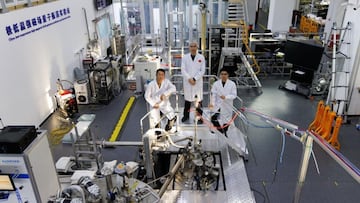
Chinese scientists have set a new global benchmark in high-field magnet technology, unveiling the most powerful fully superconducting research magnet ever built. The Chinese Academy of Sciences announced that the device achieved a central magnetic field of 35.6 teslas at a national experimental facility in Beijing.
The achievement marks a major milestone in extreme-conditions research and places China among the world’s leaders in high-temperature superconductor technology. The magnet is designed for shared scientific use, giving researchers access to magnetic fields far beyond what has previously been available.
A record-breaking research tool
The experiment was conducted at the Synergetic Extreme Condition User Facility, a national platform created to host visiting scientists. According to the Academy, the magnet’s performance establishes a new world record for fully superconducting magnets used in open scientific research.
Unlike hybrid systems, the new device is entirely superconducting, meaning it relies exclusively on superconducting materials to generate intense magnetic fields with minimal energy loss. The magnet features a usable bore measuring about 1.4 inches in diameter, allowing experiments to be carried out directly inside the field.
Its maximum strength is roughly 12 to 24 times greater than that of a typical hospital MRI scanner, pushing well beyond the limits of conventional medical imaging technology.
More than 700,000 times Earth’s magnetic field
At full power, the magnet generates a field more than 700,000 times stronger than Earth’s natural magnetic field. The system is already open to both domestic and international researchers and is intended as a shared research platform for disciplines ranging from materials science to life sciences.
The project was the result of close collaboration among multiple institutes within the Chinese Academy of Sciences. The Institute of Electrical Engineering led the overall design and system integration, while the Institute of Physics focused on solving technical challenges related to precision monitoring and measurement.
Built for stability and long experiments
One of the system’s standout features is its operational stability. Jianlin Luo, a researcher at the Institute of Physics, said the magnet can maintain its peak magnetic field continuously for more than 200 hours. It can also be combined with other extreme conditions, such as ultra-low temperatures, to expand experimental possibilities.
The magnet is housed within China’s national extreme-conditions research infrastructure at Huairou Science City in Beijing. The complex brings together high magnetic fields, extreme temperatures and other advanced systems in a single location, with the goal of supporting world-class research and attracting international scientific collaboration.
Related stories
Get your game on! Whether you’re into NFL touchdowns, NBA buzzer-beaters, world-class soccer goals, or MLB home runs, our app has it all.
Dive into live coverage, expert insights, breaking news, exclusive videos, and more – plus, stay updated on the latest in current affairs and entertainment. Download now for all-access coverage, right at your fingertips – anytime, anywhere.
Complete your personal details to comment