


Nadal: “I’m figuring out what I want to be when I grow up”
Just over a year ago, Nadal called time on the game of tennis. Now, at the ripe age of 39, he claims to have returned to the “real world” which he discusses with AS.
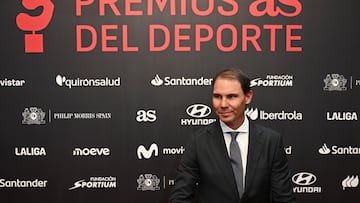
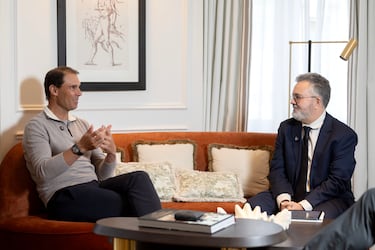
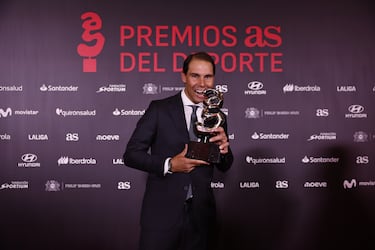
Tennis great Rafa Nadal made time for us when he was in Madrid to receive the 2025 AS Legend Prize. We spoke in his room at the Hotel Palace in Madrid, where an unforgettable gala was held to honor one of the greatest of all time. The 22-time Grand Slam champion spoke candidly about what his life is like now, about tennis, of course, fatherhood and even politics. Like anyone who has excelled at their job and brought enjoyment to millions, he has earned the right to talk about whatever he wants.
How do you feel, and how is life treating Rafael Nadal the citizen now that you are no longer Rafael Nadal the tennis player?
Good. I’d say just as good. It’s a change of life, but it hasn’t hit me that hard. I always thought I’d do well afterward in my day-to-day life, which is what matters most, and that I’d find personal happiness in this new stage. And honestly, that’s how it’s been. It’s true that only a year has passed, and I haven’t really stopped. I’ve done quite a lot of things. But there hasn’t been a problem at any point. I’ve fully accepted this new life and I’m enjoying it.
In reality, you’re always a tennis player in some way. Like the president of the United States, who is always “the president,” even after leaving office…
No, I don’t feel it that way. I don’t live thinking that I am or was a tennis player. That chapter is closed. Obviously, we’re here because of that, not because I did something else. That’s clear, so it will always be there in the memory. But I don’t live my day-to-day life thinking about tennis, beyond specific moments when I feel like watching something or, of course, at the Academy, where I’m closer to it on a daily basis, but from a completely different perspective.
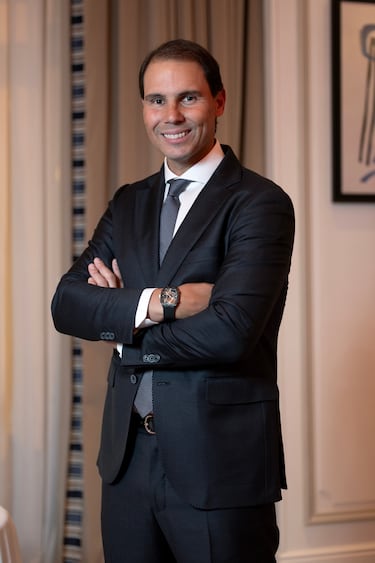
In that sense, have you kept any routines, or has your day changed completely?
Yes, I don’t keep any fixed routine. My life is a bit more random than before. Before, my work was A, B, C: get up at a certain time, train, do physical work. Everything was practically the same every day. Now I work on my own things. I have meetings many mornings, work trips, and I usually try to keep afternoons freer to be with my family.
“That chapter is completely closed; I don’t live thinking about my time as a tennis player.”
Presente
On the days you’ve trained a bit, hasn’t that thought crossed your mind of “if I were healthy… with what I still have…”?
No, because I wasn’t healthy anymore. Thankfully, that chapter is completely closed, and well closed. I’ve never been one of those people who thinks “if only I could…”. I told Marc López that when he was retired and we trained, he thought that if he came back, maybe he could still do something. And I told him, “That chapter is closed, my friend.” Now the body gives what it gives, and I think the mind does too. There comes a moment, once you’ve stopped the routine, when you can’t latch back on. It’s very complicated. I’ve trained a couple of times with girls from the Academy, with Alina Korneeva and Alex Eala, purely as a sparring partner, honestly. With no intention beyond having a good time hitting the ball, supporting them and letting them enjoy it. That’s how it was, and that’s how I take it: with no interest or expectation of anything else.
And what do you feel when you watch a match? Are you one of those who gestures a lot, or do you watch calmly?
No, calmly. Obviously there’s a bit of professional instinct, analyzing what’s happening, what one or the other should have done. But I’m totally relaxed. And really, when I watch tennis, which hasn’t been much, just a few matches I felt like watching, I enjoy it as a spectator, although inevitably I analyze a bit as a tennis player. It’s impossible not to.
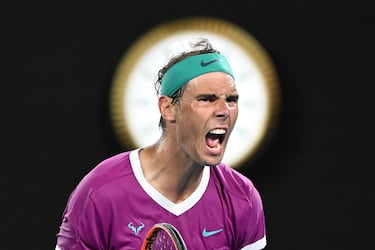
And do you like what you see?
Sometimes yes, sometimes no, which is only logical. Just like when I was playing. Sometimes I liked my rivals’ tennis, sometimes less. I’ve watched few matches. Some I didn’t like, others I did. Like everything, there are moments for everything.
In a conversation with AS, Joan Balcells said Sinner bores him and that he prefers Alcaraz for the variety. You don’t need to be that explicit, but which style do you identify with more?
I don’t identify with either. They’re different players from what I was. I think Carlos is more random. He makes more errors, hits more spectacular shots, sometimes doesn’t have such a defined game pattern, which makes him unpredictable and fun for spectators. Jannik is more methodical, focused, with a more defined pattern, and he keeps adding things little by little. That’s why he’s so solid and loses very few matches. Sometimes Carlos seems more scattered, but when you look at the results, he’s had an incredibly consistent and solid year in all the big tournaments. That’s why it makes me laugh when I hear that he’s scattered. The results say the opposite. That’s my view.
🎄✨ BON NADAL, MERRY CHRISTMAS & FELIZ NAVIDAD from all of us at the Rafa Nadal Academy! 💙🎾 pic.twitter.com/Qr5k0Vv1sk
— Rafa Nadal Academy (@rnadalacademy) December 24, 2025
You said the other day on the show “Universo Valdano” that the adrenaline of competition can’t be found anywhere else outside sport. Would you like to compete again someday, for example with Federer, on a tour or something like that?
I think it would never be the same, and I don’t intend it to be. But in the future, who knows? If it’s fun, if we can do something that makes sense and we feel like it, why not? There’s no door completely closed to picking up a racket again, but I’d have to prepare properly. When you go out to play, you want to be ready, and right now I’m not. I’d need a reasonable amount of time.
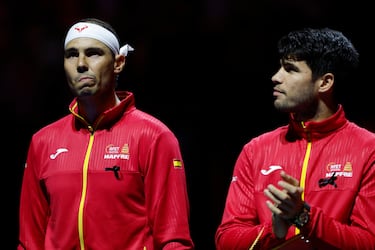
We know what you think about coaching. You don’t see it right now, but do you see yourself in the future as a Davis Cup captain or Laver Cup captain?
I’ve always had the utmost respect for what the future may bring, because what you feel today isn’t what you’ll feel after some time. Life changes, especially when you have young children. You see life one way, a few years pass, and it changes. Traveling continuously? I don’t see it. Being a coach would imply that, and right now it doesn’t fit my life. Being Davis Cup captain someday? Why not? I might enjoy it, or not. I’ve just retired. It’s far too early to be thinking about that. I respect life’s processes and adaptation. Right now, it’s not the time to think about it.
This question couldn’t be asked when you were playing for tactical reasons, but did you have any secret, any play that worked for you and that you couldn’t reveal back then?
I wish I’d been good enough to hide things. We spent so many years seeing each other that there wasn’t much to hide. I gave what I had, with no secrets. I tried to find solutions in every moment. If something worked, I tried to repeat it. If it didn’t, I tried to change it. I don’t have anything hidden that I’ve never said. I’d like to tell you something, but it would be a lie.
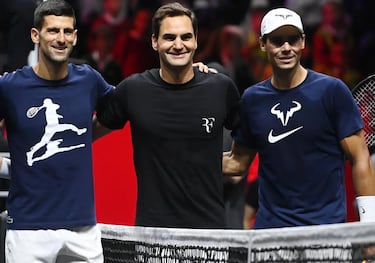
But with Djokovic and Federer, didn’t you have a specific plan?
With Federer, the plan was clear, especially at the beginning. Hammer his backhand with high balls many times, until he became more stationary waiting for the next shot, and then I could change to his forehand. That was something that required mental effort from me, because many times I saw the shot to the other side, but I knew that repeating to the backhand generated mental fatigue for him. I didn’t always feel like applying that tactic, but it was the most feasible.
And with Djokovic?
With Novak it was more random. On clay I changed things a bit more than on hard courts. On hard, in the last years, when my body no longer allowed certain efforts, it was much harder for me. To have options, I needed my physical condition to respond, and it didn’t. I had to shorten points, and beating Novak in two or three shots was very difficult. I sometimes tried to be more aggressive on serve, but it didn’t work. On clay I did find solutions, and on grass I also had chances, although I ended up losing those semifinals, at Wimbledon 2018 in five sets. I felt my options were greater on clay or grass than on hard courts, especially in my final years.
The AS Legend Prize. It’s a powerful word. Even if you’ve seen it all, does it still feel unbelievable?
When they call you a legend, you start to be pretty screwed. (laughs)
But in this case, it’s for good reasons…
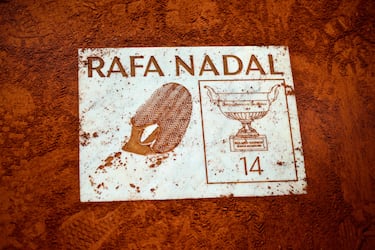
I’ve had a very long career and I’ve been very happy. Obviously there are results that are there and that are hard to imagine. They still are for me. I don’t think about them regularly, but when I think that I’ve won 14 Roland Garros titles, it’s something very difficult to grasp. Or 12 times in Barcelona, or that I spent I don’t know how many consecutive years in the top 10, 912 weeks, despite so many injuries and months sidelined. That’s a record I’m proud of. It speaks to perseverance and continuity. It was worth it.
And all of that without changing too much. How do you manage so much fame and success?
Normally. Without really noticing. Over the years, you naturally close yourself off a bit. I’ve tried not to, but you get tired of certain things. I was lucky that when I went home, I lived a normal life. Living in Mallorca, in Porto Cristo, was key. There I could act with complete freedom: go out partying, go to the beach, the supermarket, the movies. What anyone does. At tournaments, in big cities, it was more complicated. That combination allowed me to maintain balance between my life as a public figure and my real life. You keep your roots: lifelong friends, family. You always return to reality. The other world is unreal and temporary. It lasted many years, but you know it ends.
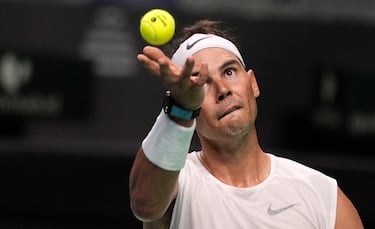
You’ve always aimed for excellence in everything. How do you see yourself now as a businessman, in that other role?
I don’t think it was excellence. I’ve always tried to give my best version. Now I’m learning what I can, trying to understand what I like more and what I like less in this new stage. I’m fortunate that I can dedicate more time to what I enjoy. I’m in a phase of discovering what I’d like to be “when I grow up.” The world of academies appeals to me, that’s why I spend time on it. Education too, at the Academy and at the university, UAX. Tourism as well, yes. I come from Mallorca, so it interests me. I try to learn, to be around people who help me evolve. And then there are other things I keep doing that sometimes I enjoy more and sometimes less. Little by little, the path will take shape.
And as a father? Have your expectations already been surpassed with two children?
I don’t have any expectations. It’s something everyone does, better or worse. I suppose I’ll be a normal father: not very bad, not very good. I’ve always liked children a lot and I’ve had a good connection with them. With my youngest, who is just over three months old, the connection is still limited. With the three-year-old, I have a great time. I try to educate him with the values I believe are right. I hope to be one of those parents who can see when their children do things well or badly, and detect things coherently, without thinking they do everything right just because they’re yours.
Has the older one picked up a racket? No pressure, of course…
He’s also picked up a golf club, a soccer ball. He seems to have a knack for it, but he’s a three-year-old who has fun, goes to school and enjoys each day as much as possible.
“It would be good to return to rationality, for politicians to not insult each other, to think about the common good.”
Nadal on politics
Last one. Politics. Has anyone tried to tempt you to be a city councilor or take on any public office?
No. They know I wouldn’t have many chances of succeeding. I don’t think this is a pleasant time to get into politics. Everything is very polarized.
It doesn’t really appeal to you, then?
No. I think there’s too much polarization. It would be good to return to rationality, to stop insulting each other, to think about the common good. Politicians have a significant impact on our lives. We should return to a calmer state, get things back on track and have more respect among themselves. So that it doesn’t all feel like a soccer match. The common good is in what is done, but also in how it’s done. And what is usually conveyed is far too much polarization.
One year ago today... One of the most special moments of my career! ☺️
— Rafa Nadal (@RafaelNadal) July 26, 2025
Thanks again, @Olympics & @Paris2024! pic.twitter.com/UreaQz8Nlh
Related stories
Get your game on! Whether you’re into NFL touchdowns, NBA buzzer-beaters, world-class soccer goals, or MLB home runs, our app has it all.
Dive into live coverage, expert insights, breaking news, exclusive videos, and more – plus, stay updated on the latest in current affairs and entertainment. Download now for all-access coverage, right at your fingertips – anytime, anywhere.
Complete your personal details to comment