


DRS at the Las Vegas Grand Prix: How Drag Reduction Systems work and where can they be used in Formula 1
Fans can learn how DRS boosts overtaking at the Las Vegas Grand Prix and where drivers can activate it this weekend.
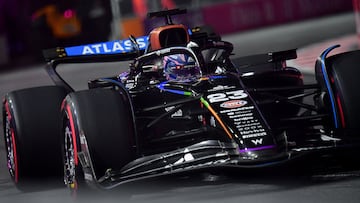

Formula 1 returns to the United States this weekend for the Las Vegas Grand Prix, running from Nov. 20 to 22.
The main Grand Prix will take place on Saturday, but fans can also enjoy practice sessions on Thursday and Friday as well as qualifying before the actual race on Saturday,
In both the Sprint and the full-length Grand Prix, the circuit’s Drag Reduction System (DRS) detection zones could play a major role in determining race results.
What is DRS?
DRS is a driver-controlled device designed to aid overtaking and increase wheel-to-wheel racing opportunities on the F1 circuit.
Simply put, DRS works by opening a flap in the rear wing of the car, which reduces aerodynamic drag and increases straight-line speed. This allows drivers to close the gap on the car ahead faster than they normally could.
An actuator controls the flap in the middle of the rear wing. Drivers can open it with a button on the steering wheel, reducing drag and rapidly boosting the car’s velocity.
When can DRS be used?
Drivers can only activate DRS in designated parts of the track called DRS detection zones. The system is only available when the trailing car is within one second of the car in front, including lapped cars.
Electronic timing loops embedded in the track measure the distance between cars. When the trailing car is less than one second behind, a signal is sent to the driver, who can then manually activate DRS. Dashboard lights indicate when the system is ready, while the leading driver is usually informed by radio that a rival is close.
DRS can be used during practice, qualifying, the Sprint, and the Grand Prix, but only within the specified activation zones.
🏁 Las Vegas GP Track Analysis – Everything You Need to Know! 🎰✨
— Formula Neon F1 (@formulaneonf1) November 20, 2025
Keywords:
[Las Vegas GP, Vegas Grand Prix, LVGP, Las Vegas Strip Circuit, Formula 1, F1, Track Analysis, Race Strategy, DRS Zones, Elevation, George Russell Pole, F1 2025, Turn 1 Vegas, Vegas Strip, Motorsport]… pic.twitter.com/PXvO5D4UYa
When DRS can’t be used
DRS cannot be activated during the first two laps of a race or immediately after standing or rolling restarts following a safety car or red flag period.
FIA race officials can also temporarily disable DRS at their discretion if conditions are unsafe, such as in wet weather or if a car goes off track. Debris on the circuit may also trigger a temporary deactivation of DRS in specific zones.
OVERVIEW OF THE LAS VEGAS STRIP CIRCUIT #LasVegasGP 🇺🇸
— F1 by Data (@f1bydata) November 21, 2025
This track is an aerodynamic and thermal nightmare, forcing teams into the ultimate setup gamble. It is an extremely fast street circuit, running anti-clockwise, and holds the distinction of being the coldest race of the… pic.twitter.com/rkMwtblbqf
DRS zones at the Las Vegas Grand Prix
There are 2 DRS zones on the Las Vegas F1 circuit.
One of these is on the short Koval straight between turns 4 and 5. The other one is on the second half of the long run along the Vegas strip, between turns 13 and 14.
Related stories


Get your game on! Whether you’re into NFL touchdowns, NBA buzzer-beaters, world-class soccer goals, or MLB home runs, our app has it all.
Dive into live coverage, expert insights, breaking news, exclusive videos, and more – plus, stay updated on the latest in current affairs and entertainment. Download now for all-access coverage, right at your fingertips – anytime, anywhere.
Complete your personal details to comment