


Real Madrid's plan remains unchanged: 'Thiagos' and big sales
Real Madrid are very clear about their academy philosophy, almost the opposite of Barcelona’s. They will continue to balance prioritizing revenue with producing gems for the first team. All of it guided by a distinctive set of principles for scouts and coaches.
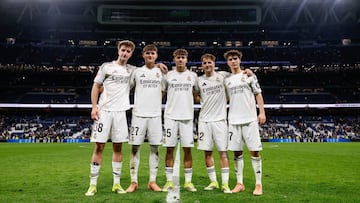
They are two different philosophies. At times, almost opposites. Regardless of preference, neither has proven better than the other. Both have been more than effective. In the ongoing comparison between Barcelona and Real Madrid’s academy models, you could say Barcelona’s La Masia slow-cooks players, especially midfielders, to win titles with a defined style of play. Meanwhile, Real Madrid’s La Fábrica turns up the heat and sometimes goes to the grill, favoring a variety of styles to win not just trophies, but also generate income.
The emergence of Thiago Pitarch and the class he leads is celebrated because improving the first team is an obsession. But stability is non-negotiable. That is why, at Valdebebas, there is little concern when the academy model is questioned, described as cyclical, or accused of letting talent slip away. Something that, by contrast, stings daily at Barcelona. Just look at Dro (Pedro Fernández, who left for PSG in January 2026). The fact that Madrid have brought in more than €500 million this century from selling prospects is not only a source of pride, but a key strategic pillar. “Selling is important to keep progressing, and what really matters is developing players who reach Castilla, experience professional soccer, and can then be sold so the system keeps running. If one of them breaks through and establishes himself in the first team, even better, but that’s not easy. The best players in the world are already there in every position.”
Booming budget at Madrid’s academy
Madrid’s academy budget is €42.6 million this season, up from €37.2 million last year. Revenue from sales is projected to reach €60 million in the 2025–26 campaign. The club celebrates the reserve team as a gold mine, having generated more than €40 million since the summer of 2025 through transfers including Miguel Gutiérrez (€7m to Napoli), Chema Andrés (€5m to Stuttgart), Víctor Muñoz (€5m to Osasuna), Obrador (€5m to Benfica), Yusi (€3m to Alavés), Javi Hernández (€3m to Al Arabi), Jacobo Ramón (€3m to Como), Álvaro Rodríguez (€2m to Elche), Marvel (€0.8m to Leganés) and Álex Jiménez (€8m to Bournemouth). Profitability and balance are key. And just as some professional clubs restrict agents and scouts from accessing their facilities, Madrid welcome the attention, with dozens of requests to closely watch players who are on the verge of moving on. As many as 10 Serie A clubs monitor these prospects every two weeks, joined by scouts from other major leagues. In fact, as AS reported, Madrid could sell nearly half of the squad coached by Julián López de Lerma right now to top-flight, second-division or international teams. Loan and transfer offers continue to pile up.
Within this model, it is essential that both scouts and coaches are given freedom to develop top players, rather than focusing solely on producing profiles tailored to the first team. As those inside the club explain, this avoids a tendency to prioritize rugged center backs, lightning-fast fullbacks, or traditional No. 9 strikers as a fallback plan, based on the mistaken belief that other positions are blocked at the elite level by star signings.
Ask around Valdebebas about the rise of Thiago Pitarch, and the explanation of how midfielders are developed sums up the entire plan. It is a system that continues regardless of results, largely because it works. At Barcelona, Bernal’s academy structure focuses on maximizing small-sided (7-a-side) development, with a roadmap designed by Marc Serra and built around a “mental map” philosophy. At Madrid, the approach is very different. “There is more freedom and, therefore, more diversity,” insiders emphasize.
A clear philosophy of developing soccer talent
To begin with, Madrid’s scouts do not follow a fixed template, unlike at Barcelona, where profile, 360-degree awareness and positional play are key. While there is a need to find variety among holding midfielders, interiors and attacking midfielders, there is no standard checklist. Each player’s attributes are matched to positions, physical traits are important in line with a preference for a more French-style profile, but beyond that there are few strict guidelines. If anything, talent remains the priority. There is no formal manual. The idea is that good players will always have a place, regardless of the first team’s playing style. Thiago, brought back from Atlético, arrived under this logic. That is how it is justified in scouting reports, and how decisions are defended when leadership demands strong reasoning behind investments.

Once those talents arrive, coaches also operate with clarity. While they are responsible for instilling the club’s values - on that there is no flexibility - they are given autonomy in tactical and technical matters. Each team plays with its own system, designed by its coaching staff, which may have little to do with what Álvaro Arbeloa is currently implementing. If it aligns, all the better. But there is no imposition. This diversity of approaches is seen as a strength, clearly reflecting Madrid’s intent: players must be able to adapt to any style of play, and any potential buyer, anywhere in the world. It is also used as a subtle critique of Barcelona, where many academy graduates struggle outside a system built on possession, positional play and structured patterns.
At Madrid, individual development often takes priority over the collective. The club has a Performance Unit at Valdebebas dedicated to refining strengths and correcting weaknesses. From the youngest age groups through the youth teams, players take part in specialized, position-based training sessions alongside their regular weekly work. These sessions, which bring together players from different age groups, are led by various in-house coaches. Every academy player passes through this system at some point during the season, and new faces continue to emerge.
According to multiple sources, Madrid refreshes its squads with between 50 and 60 new signings per season across its 11-a-side youth teams. The turnover is even greater at the younger levels, where there are more trials, commitments and fewer certainties. “It’s like a business; if what you have works, you stick to the plan and promote players, and if not, you change pieces as needed,” several coaches who came through the system explain. At Barcelona, by contrast, it is much harder to release players. Signings at the 11-a-side level are limited, often counted on one hand. A couple of years ago, for example, there were 10, and four or five were from Catalonia. It is a model that requires far more continuity.
They are two different ways of thinking. At Barcelona, despite constant praise for producing players in the mold of Guardiola, mistakes or flaws in the pipeline are heavily scrutinized. That was the case when Cesc Fàbregas, Thiago, Dani Olmo or Nico left, or when countless prospects such as Jonathan, Oriol Romeu, Carles Aleñà, Denis Suárez, Gumbau or Riqui Puig failed to establish themselves. All of this despite producing Gabri, Xavi, Iván de la Peña, Andrés Iniesta, Sergio Busquets, Sergi Roberto, Rafinha, Gavi, Casadó, Fermín and Bernal. Every unfinished project is felt as a setback.
At Madrid, player movement is viewed far more naturally. In fact, players such as Esteban Granero, Rubén de la Red, Dani Parejo, Martin Ødegaard, Javi García, Antonio Blanco, Torró, Mascarell or even Atlético’s Marcos Llorente, who brought in €40 million, are still considered part of the family, even if they built their careers elsewhere. That is why a common phrase at Valdebebas sums up the philosophy: “Thiago Pitarch is very good, and hopefully he stays in the first team forever. But Manuel Ángel and César Palacios are just as good or better. Keeping some and selling others is what gives the club and its academy meaning, balance and profitability.” What remains to be seen is who will make their career at the Bernabéu, and who will do so elsewhere.
Related stories
Get closer to the game! Whether you like your soccer of the European variety or that on this side of the pond, our AS USA app has it all. Dive into live coverage, expert insights, breaking news, exclusive videos, and more. Plus, stay updated on NFL, NBA and all other big sports stories as well as the latest in current affairs and entertainment. Download now for all-access coverage, right at your fingertips – anytime, anywhere.
And there’s more: check out our TikTok and Instagram reels for bite-sized visual takes on all the biggest soccer news and insights.
Complete your personal details to comment