


Sport has stopped pretending that everything is fine
Impossible schedules, social media and constant pressure have created a new emotional landscape for athletes, one that is affecting their stability.
For decades, the professional athlete was portrayed as a machine: strong, resilient and immune to pain. Talent was visible, suffering was not. In locker rooms, players learned to stay silent and keep competing even when their minds were telling them to stop. But something has changed, and today the testimonies are multiplying. Soccer players, gymnasts, tennis players and track athletes are speaking openly about anxiety, depression, panic attacks and exhaustion. The question is no longer whether the problem exists, but why we are seeing it more clearly now: are things getting worse, or has sport simply stopped hiding it?
Araújo and the moment to raise his hand
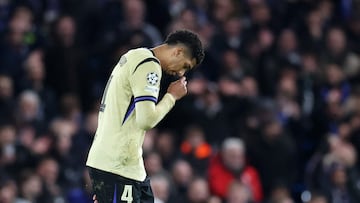
“I had been dealing with anxiety for a year and a half, and it turned into depression.” The words of Barcelona defender Ronald Araújo landed like a jolt of reality in modern soccer just a few months ago. The Uruguayan center back explained that he tried to push through for a time until he realized he needed to stop and ask for help. “I had to raise my hand and say something was happening to me so I could recover.”
For Andrés París, a sports pedagogue specializing in high performance with more than five years of experience in the AFE’s Mens Sana program and currently a coach in Levante’s women’s soccer team, that “click” often comes too late. “When the click happens, it usually means the athlete is already at the limit and needs to stop.” That is why he insists on prevention: giving athletes the tools before the body keeps going and the mind can no longer keep up.
Barcelona coach Hansi Flick asked for respect when confirming it was a personal matter. Araújo himself delivered one of the lines that explains why the debate can no longer stay confined to locker rooms. “It’s not all money and fame. We’re people beyond being soccer players.”
The end of the taboo: from “be strong” to “ask for help”
Professional sports have long lived under the same culture: emotional strength was synonymous with silence. Asking for help was seen as weakness. In Spain, that shift began slowly. In the early 1990s, coach Benito Floro pushed for the inclusion of one of the first psychologists on a technical staff, a decision ahead of its time. Emilio Cidad broke new ground, later followed by Emilio Lamparero.
París believes part of the problem comes from cultural inheritance. “In sports, suffering was confused with character.” But that idea, he says, has done damage. “Suffering does not build character. It produces suffering.” Real change, he argues, lies in learning to manage frustration, disappointment and pressure without turning it into a silent battle.
Rayo Vallecano player Isi Palazón described how his anxiety became physical. “If you don’t know what’s happening to you, you think something is seriously wrong.” He defended seeking professional help as “an act of courage, not weakness.”
His teammate Sergio Camello has described what for years was punished inside locker rooms. “If you cry, people joke that you’re a crybaby,” he said, admitting he has been in therapy for some time to learn how to manage that pressure.
When success offers no protection
The story repeats itself even at the very top. Success does not provide immunity. Some of the biggest names in sports have shown that.
Andrés Iniesta admitted he went through a dark period after the death of Dani Jarque. “When I was battling depression, the best moment of the day was taking my pills before going to bed. I had lost the will to live.” Years later, he turned the experience into a clear message: mental health problems “can affect anyone,” even someone who has won everything. Lionel Messi also admitted he knew he needed psychological help, though taking that step was difficult.
In basketball, Ricky Rubio stepped away from the game to prioritize his emotional well-being. “I have decided to stop my professional activity to take care of my mental health,” he said, acknowledging that “the player had consumed the person.” Simone Biles withdrew from competition during the Olympic Games to protect herself. “I have to do what’s right for me and focus on my mental health.” In tennis, Naomi Osaka sparked a global debate when she withdrew from the French Open, revealing she had been dealing with depression for years and that press conferences were affecting her emotional stability.
One of the most raw testimonies in recent months has come from Álvaro Morata. The striker spoke openly about depression, panic attacks and self-destructive thoughts. “I was afraid of everything.” That internal battle was compounded by the boos and insults he received, to the point that he questioned whether it was worth continuing with Spain’s national team. “Is it worth going just to be insulted and booed? It’s not worth it.”
Athletes speaking out is not a sign of weakness but of maturity, because it opens the door for others who may be going through similar situations. What has changed is not necessarily the pain, but the willingness to talk about it. In breaking that silence, sport has begun to transform from within.
Are things actually getting worse?
More testimonies do not always mean more cases. Rafa Mateos, a sports psychologist at TYM Psicología, urges caution before drawing conclusions. “With the information and studies currently available, it would not be correct to state categorically that anxiety disorders are more common among elite athletes than in the general population.” He adds an important nuance: for years there may have been cases that were never recorded simply because they were never reported.
He also points out that even defining “mental health” is not straightforward. Some understand it as the absence of disorder, while others link it to psychological and social well-being beyond a diagnosis. For that reason, he warns that comparing different eras requires methodological caution.
Today’s pressure is a competition that never stops
If the past was defined by silence, the present is defined by exposure. París summarizes it with an image that fits modern soccer. “For decades we trained the body, but silenced the mind.” An emotional injury, he says, can be just as debilitating as a physical one, with one key difference: “You can’t see it.”
That invisibility exists within a context of ever more demanding schedules and an environment that leaves little room to breathe. Raphaël Varane surprised many when he announced the end of his international career in 2023 at the age of 30. The French defender explained that the expanding calendar and relentless demands made him feel that “the player was consuming the man.” After his decision, Varane acknowledged the need to step back and spend more time with his family, while also warning about the emotional cost facing the next generation. “Young players starting out will have to make huge sacrifices if they want to stay at the top for ten years. It’s tougher than what I experienced.”
FIFPRO, the global players’ union, has already warned about the prevalence of depressive symptoms in professional soccer.
Social media: the new endless grandstand
Today’s athletes live with a permanent crowd in their pocket. Every mistake can become a global trend within minutes. Too often, “sports analysis” turns into direct personal attacks.
Sergio Camello exposed the reality in stark terms. One of the messages he shared publicly read: “I hope you get cancer and drop dead on the field, you piece of trash.”
It is not an isolated case. Olympic badminton champion Carolina Marín recently stepped away from social media after admitting she had “collapsed,” choosing to protect herself emotionally and regain balance away from the digital spotlight.
París describes it as “permanent scrutiny, 24/7,” and notes that the impact varies from person to person. “Some people are deeply affected by even a small amount of criticism.” That is why he stresses the importance of separating the real world from digital noise. “Online reality can never replace reality. If you’re not prepared, it’s better not to engage.”
Mateos also urges restraint before drawing conclusions. With the evidence currently available, he explains, it cannot be definitively said that social media “causes” mental health problems. In clinical practice he sees that excessive use can affect some athletes, but distinguishing personal impact from scientific causality remains essential.
Mental health as part of performance
The biggest difference compared with previous generations is that sports are beginning to face the issue directly. París frames it in purely performance terms. “A player who is emotionally overwhelmed cannot make good decisions.” His final point is striking: competing at the highest level means “paying a psychological toll,” not as a sentence, but as a process of developing the tools needed to live with pressure.
Mateos places the issue within professional ethics. “You must always consider the well-being of the person, not just performance.” The goal is not to perform at any cost. The goal is to sustain the individual.
Breaking the silence is also part of competing
Perhaps the real question is not whether athletes are worse off than before. Perhaps the true revolution is that they now dare to say so. As Andrés París puts it: “The greatest mental fragility is refusing to acknowledge your mental fragility.” For him, athletes speaking out is not weakness but maturity. Because high performance is not played only with the body. It is also played in the mind.
If you or someone you know is struggling with mental health issues in the United States, confidential help is available. You can call or text 988, the Suicide & Crisis Lifeline, to reach trained counselors 24 hours a day, seven days a week. The service is free and available in English and Spanish. If you or someone else is in immediate danger, call 911 or go to the nearest emergency room.
More from AS USA
Related stories
Get closer to the game! Whether you like your soccer of the European variety or that on this side of the pond, our AS USA app has it all. Dive into live coverage, expert insights, breaking news, exclusive videos, and more. Plus, stay updated on NFL, NBA and all other big sports stories as well as the latest in current affairs and entertainment. Download now for all-access coverage, right at your fingertips – anytime, anywhere.
And there’s more: check out our TikTok and Instagram reels for bite-sized visual takes on all the biggest soccer news and insights.
Complete your personal details to comment