


The new stadium of the club where Messi plays will be called Nu Stadium and will be located in the heart of Miami Freedom Park.

Strategic stadium agreement confirmed for Inter Miami in MLS

Nubank and Inter Miami have reached a long-term agreement that makes the financial company the principal partner of the reigning MLS Cup champion. The club’s new stadium will officially be called Nu Stadium and will sit at the center of Miami Freedom Park, one of the most ambitious sports and entertainment projects currently underway in the United States. The venue is scheduled to open on April 4, 2026.
Designed for year-round use, the 26,700-seat stadium will serve not only as the home of Lionel Messi’s team but also as a multipurpose gathering place for fans, families, and the wider community. Nubank and Inter Miami plan to develop immersive experiences for fans and customers through exclusive programming and differentiated access.
Beyond the stadium naming rights, the agreement includes several brand activation opportunities. Nu’s logo will appear on the back of Inter Miami’s jersey – one of the best-selling shirts in global soccer – as part of a new league feature set to debut in August 2026. The bank will also host two exclusive areas within Nu Stadium and Miami Freedom Park: the Nu Club, a premium hospitality lounge for 770 guests offering a glass-tunnel view of players walking from the locker rooms to the field, and Nu Plaza, a community hub designed with social spaces, a giant screen, and relaxation areas that will create a lively public gathering point within the district.
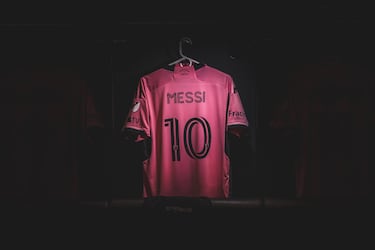
Naming rights: a long-standing US tradition
The sale of naming rights for Inter Miami’s stadium follows a well-established trend in the United States, a pioneer in this type of commercial agreement. The practice dates back to the 1970s. The first recorded deal took place in 1973, when Rich Products Corporation added its brand to Buffalo Memorial Auditorium – later demolished in 2009 – renaming it “Rich Stadium.”
The facility was a multipurpose venue in Buffalo, New York, that hosted both the Buffalo Bills of the NFL and the Buffalo Sabres of the NHL, as well as college basketball games, concerts and wrestling events.
More recently, the FIFA Club World Cup held earlier this year drew attention because the vast majority of US venues carried corporate names. In fact, 11 of the 12 stadiums used during the tournament had some form of naming-rights sponsorship.
“The consolidation of naming rights is spreading across Europe and the United States and is becoming a reference point for Brazil,” said Anderson Nunes, business director at Casa de Apostas, which has acquired naming rights for two World Cup stadiums. “The model goes beyond massive commercial deals with clubs and venues – it also generates activation opportunities and public engagement.”
Rare in England and Spain
Despite its popularity in the US, naming rights remain relatively uncommon in some of the world’s most valuable soccer leagues, particularly in England and Spain. In the Premier League, only five of the 20 clubs have stadium naming-rights agreements, while in LaLiga the number drops to just two out of 20 teams.
In England, the stadiums with naming-rights partnerships include Emirates Airline with Arsenal, Vitality Stadium with Bournemouth, Gtech Gray Technology Limited with Brentford, American Express Stadium with Brighton and Etihad Airways Stadium with Manchester City. In Spain, the agreements are held by Riyadh Air with Atlético de Madrid and Spotify Camp Nou with Barcelona.
“The profile of the fan is changing and will change completely,” said Thiago Freitas, chief operating officer of Roc Nation Sports in Brazil. “The future relationship between club brands and supporters will increasingly depend on how teams collaborate with entertainment brands, especially music.”
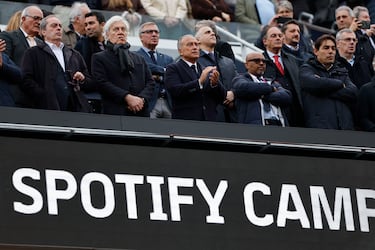
Europe slowly adopting the model
Other European leagues are gradually embracing the concept. In Italy’s Serie A, six of the 20 stadiums carry naming-rights deals, including Unipol Domus for Cagliari and Allianz Stadium for Juventus. In France, four venues operate under similar agreements, such as Groupama Stadium in Lyon and Allianz Riviera in Nice.
Portugal currently has no stadium with naming rights, although Benfica is negotiating with several brands regarding Estádio da Luz. Braga previously held an agreement with AXA for Estádio Municipal de Braga, which was not renewed.
Germany’s Bundesliga comes closest to the American model. Only three of the league’s 18 clubs do not have naming-rights deals, meaning the vast majority of stadiums carry corporate names.
Brazil follows the US example
Brazil has increasingly adopted the same approach. At least 10 of the country’s major stadiums now operate under naming-rights agreements, including Allianz Parque (Palmeiras), Neo Química Arena (Corinthians), Arena MRV (Atlético Mineiro) and Arena Fonte Nova.
Altogether, these deals have generated more than €500 million in contracts – roughly about $545 million – although the figures still fall short of the scale seen in the United States. By comparison, the naming-rights agreement for MetLife Stadium alone reached €550 million, or roughly $600 million.
Brazil’s first naming-rights deal came relatively late, in 2005, when the Japanese technology company Kyocera acquired the rights to the stadium of Athletico Paranaense. The venue was later renamed again following a deal with telecom operator Ligga Telecom.
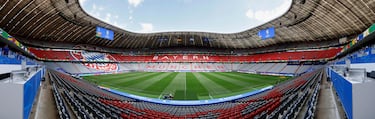
Beyond a soccer game: the modern stadium experience
For Sergio Schildt, president of Recoma and vice president of Abriesp, modern stadiums have transformed the matchday experience into something much broader than simply watching a soccer game.
“With modernization, going to the stadium is no longer limited to seeing a game,” he said. “Today’s venues offer restaurants, modern VIP suites, beauty treatment stores and frequently host concerts, which increases the value of the brand that holds the naming rights.”
Technology has also become central to the modern stadium experience. Facial-recognition systems now allow fans to enter venues using only their faces, eliminating physical tickets or cards and completing validation in less than a second.
“This technology provides faster and more convenient access,” explained Tironi Paz Ortiz, CEO and founder of Imply. “It delivers comfort, speed and security for clubs, fans and stadiums alike.”
A growing global marketing strategy
Experts say naming rights are attractive to brands primarily because of the visibility they provide. Companies can activate their presence through VIP boxes, exclusive fan experiences, special promotions and personalized services.
“The commercial possibilities derived from partnerships are enormous,” said Joaquim Lo Prete, country manager of Absolut Sport in Brazil. “Clubs are increasingly willing to explore these opportunities, and there is less resistance to changing stadium names for commercial purposes.”
In the United States, around 80% of stadiums have naming-rights agreements, according to data from the Heatmap agency. The number rises to roughly 90% in the NFL. In the NBA, every arena carries a corporate name except Madison Square Garden.
The US naming-rights market is estimated to generate more than €2.5 billion annually – about $2.7 billion – with contracts typically lasting decades, opening the door to long-term sponsorship and marketing opportunities.
Marketing beyond the name
Marketing specialists emphasize that simply owning the naming rights is not enough. Brands must activate the partnership through fan engagement, promotions and experiences that extend beyond game days.
“Activation is just as important as the investment itself,” said Thales Rangel Mafia, marketing manager at Multimarcas Consórcios. “Companies need to create actions that connect with the public both inside and outside the stadium so the new name becomes part of everyday conversation among fans.”
According to sports marketing professor Ivan Martinho, stadiums are valuable assets for clubs, and naming rights now represent a significant revenue stream. Investment in sports helps develop fan experiences while strengthening the relationship between companies and consumers.
Related stories
Get closer to the game! Whether you like your soccer of the European variety or that on this side of the pond, our AS USA app has it all. Dive into live coverage, expert insights, breaking news, exclusive videos, and more. Plus, stay updated on NFL, NBA and all other big sports stories as well as the latest in current affairs and entertainment. Download now for all-access coverage, right at your fingertips – anytime, anywhere.
And there’s more: check out our TikTok and Instagram reels for bite-sized visual takes on all the biggest soccer news and insights.
Complete your personal details to comment