



The president took office in 2016, despite not being favorite, aiming to “return football to the center of everything FIFA does.”

Ten years of the Infantino era in soccer

Gianni Infantino passed through LaLiga in his drive to understand every possible arena on his climb to the top of world soccer. He then moved on to UEFA between 2000 and 2016, making his mark both as a commanding presence and an administrator. He became the public face of European competition draws, championed the expansion of the European Championship to 24 teams and launched the Nations League, while also implementing financial fair play regulations.
A decade ago, on February 26, 2016, he was elected FIFA president in a second round of voting in which he had not been the favorite. From the outset, he was clear about his goal: to “put football back at the center of everything FIFA does.” He disliked the idea that FIFA surfaced only every four years for the World Cup. Today, FIFA is defined by its constant activity and global reach.
Along that path, and in keeping with that promise, the game now features a broader World Cup with 48 teams – with Cape Verde, Curaçao, Jordan and Uzbekistan among those debuting after making full use of development programs – alongside Under-17 World Cups for both men and women, the men’s tournament also expanded to 48 teams. Each year brings a World Cup staged across three countries, and in 2030 there will be six co-hosts, in addition to a revamped Club World Cup.
Business in the modern soccer landscape has gravitated toward the Arab world and the United States. Clubs have followed that trend, and so has FIFA. Infantino found a formula to coexist with controversy in certain moments and with the influence of Donald Trump, who remains a central figure through next summer.
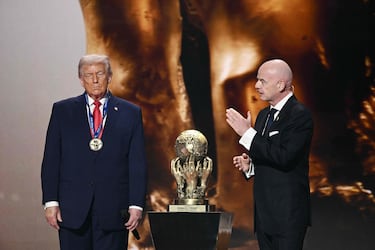
He has remained steadfast in pursuing his objectives, regardless of criticism, with the Club World Cup as the clearest example. The competition emerged despite opposition from UEFA president Aleksander Ceferin and LaLiga chief Javier Tebas, yet it enjoyed firm backing from Real Madrid and Florentino Pérez. The next edition will take place in Morocco and is expected to feature 48 teams.
Soccer development and the FIFA Forward program
Earlier, we mentioned the assistance provided to member associations through the FIFA Forward program, which has allocated more than $5.4 billion to soccer development across FIFA’s 211 member associations since 2016 – seven times the level of funding distributed before that year. The aim was to reinvest soccer’s revenues back into the sport itself, with particular support for federations with fewer resources.
FIFA has also launched the Talent Development Scheme, led by Arsène Wenger, designed to give every talented player the chance to develop anywhere in the world. The initiative plans to establish 75 FIFA Talent Academies by the end of 2027. Wenger has served as Infantino’s sporting ally, while legends of the game have also been given prominent roles within the broader project.

Growth of women’s football
Over the past decade, FIFA has fundamentally reshaped the governance, scale and ambition of women’s soccer, making it a strategic priority throughout the organization. The first 32-team Women’s World Cup, held in Australia and New Zealand in 2023, clearly justified the expansion, with $152 million in prize money distributed. By 2031, the Women’s World Cup will expand to 48 national teams. New competitions have also been introduced, including the FIFA Women’s Club World Cup, the FIFA Women’s Futsal World Cup and the FIFA Women’s Champions Cup.
Technology and the modern game
FIFA committed to the use of VAR and has continued to build on it. The next step was the introduction of semi-automated offside technology to further strengthen video review. To make technology accessible to lower levels of the game, FIFA approved Football Video Support, a more affordable replay system aimed at modest competitions.
Reforms and governance after FIFA-gate
The 2015 FIFA-gate scandal marked a turning point for the organization. FIFA underwent a sweeping transformation, shifting from a toxic institution to what it now presents as a respected and reliable governing body. This was achieved through deep reforms in governance and financial management, with a clear emphasis on transparency.
The overhaul has been recognized by the United States Department of Justice, which awarded $200 million to the FIFA Foundation as compensation for losses suffered due to decades of corruption in soccer. During the COVID-19 pandemic, FIFA distributed $1.5 billion to support the global game.
FIFA has also reformed the transfer system, including the introduction of the FIFA Clearing House, through which $540 million in training compensation has been allocated and more than $315 million distributed to 7,000 clubs worldwide.
Social impact and the fight against discrimination
Combating discrimination has been another core priority. Anti-racism protocols have been implemented during games to protect players, and FIFA launched its Social Media Protection Service to tackle online abuse.
In Infantino’s decade at the helm, the governing body has sought not only to expand competitions and revenues but to reshape its public identity and its role within the sport.
Related stories
Get closer to the game! Whether you like your soccer of the European variety or that on this side of the pond, our AS USA app has it all. Dive into live coverage, expert insights, breaking news, exclusive videos, and more. Plus, stay updated on NFL, NBA and all other big sports stories as well as the latest in current affairs and entertainment. Download now for all-access coverage, right at your fingertips – anytime, anywhere.
And there’s more: check out our TikTok and Instagram reels for bite-sized visual takes on all the biggest soccer news and insights.
Complete your personal details to comment