


300-year-old shipwreck discovered near Madagascar: It held treasure for the Portuguese crown
Researchers at the Center for Historic Shipwreck Preservation say they believe they’ve identified the resting place of a famous 18th-century treasure ship.
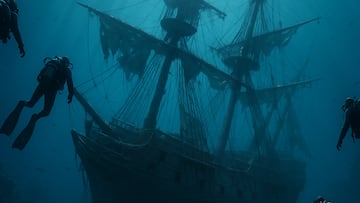

Researchers from the U.S. say they may have identified the wreckage of an 18th-century treasure ship that fell victim to one of history’s most famous pirate takeovers.
A Portuguese warship-turned-cargo vessel, the Nossa Senhora do Cabo was seized in the Indian Ocean in 1721, by the French pirate Olivier Levasseur and his English accomplice, John Taylor.
“One of the richest pirate heists”
Travelling from Goa, an area in southwestern India that was a Portuguese territory at the time, the ship was carrying a sizeable cargo of valuables - including gold, silver and gemstones - to Portugal’s capital, Lisbon.
Levasseur and Taylor captured the Nossa Senhora do Cabo near Réunion Island, where the vessel had put down anchor after being damaged in a storm.
Brandon A. Clifford and Mark R. Agostini, archaeologists for the Center for Historic Shipwreck Preservation in Massachusetts, have described the ship’s capture as “one of the richest pirate heists” on record.
“Gold and silver bars, coins, silks, religious artifacts, and an extraordinary array of precious stones (110 diamonds, 250 emeralds, 20 rubies, 20 sapphires) are recorded as having been taken from the ship’s cargo,” they explain. The vessel is also believed to have been carrying some 200 slaves.
Archaeologists think a shipwreck off Madagascar is the Nossa Senhora do Cabo, a Portuguese ship carrying cargo from India that was attacked and seized by pirates, among them the notorious pirate captain Olivier "The Buzzard" Levasseur. https://t.co/UMMVlZNbV1
— Ticia Verveer (@ticiaverveer) July 11, 2025
Shipwrecked off Madagascan east coast?
In an article published on the Center for Historic Shipwreck Preservation’s website, Clifford and Agostini outline their claim to having potentially pinpointed the wreckage of the three-century-old Nossa Senhora do Cabo.
They contend that the vessel ended up at a shipwreck site close to Ilôt Madame, a small island off the coast of Sainte-Marie Island, just east of Madagascar.
Per Clifford and Agostini’s account, the ship was finally burned and sunk by Levasseur - and Saint-Marie is the “prime candidate” as the location of this event. This contradicts other historical narratives, which maintain that the vessel was in fact wrecked at Cape Amber, off the north coast of Madagascar.
“Underwater excavations at the [Ilôt Madame] site reveal a complex stratigraphy with overlapping ballast piles, structural timbers, and artifact assemblages including porcelain, glass, and metal objects,” the researchers say. “These findings suggest a multicultural cargo consistent with Indian Ocean trade vessels of the early eighteenth century.
“Notably, religious artifacts, precious metals, and gemstones described in historical accounts [about the Nossa Senhora do Cabo] show a meaningful degree of correspondence to artifacts recovered at the archaeological shipwreck site.”
Artifacts point to particular Nossa Senhora do Cabo passengers
The Center for Historic Shipwreck Preservation has recovered more than 3,000 objects since it began its probe of the site over two decades ago. They include, for example, an ivory religious inscription, a Madonna statue and a partial crucifix.
Such items, Clifford and Agostini say, are consistent with the identity of two known passengers on the Nossa Senhora do Cabo.
“These devotional artifacts, often carried by high-ranking clergy or nobility, strongly align with the undisputed historical accounts that the Nossa Senhora do Cabo was transporting the former Viceroy of Goa and the Archbishop [of Goa] at the time of capture,” the researchers explain.
“Limitations remain”
Clifford and Agostini say their findings strongly support a discovery that would represent “a unique archaeologically confirmed pirate-captured treasure ship from the Golden Age of Piracy”.
However, they concede that “limitations remain” in their hypothesis, adding that further investigation is necessary.
“No definitive hull inscriptions, armament engravings, or nameplates have been recovered,” Clifford and Agostini acknowledge. “Environmental disturbance and overlapping wreck features introduce some ambiguity, and full species identification of timber remains [...] still pending.”
Related stories
Get your game on! Whether you’re into NFL touchdowns, NBA buzzer-beaters, world-class soccer goals, or MLB home runs, our app has it all.
Dive into live coverage, expert insights, breaking news, exclusive videos, and more – plus, stay updated on the latest in current affairs and entertainment. Download now for all-access coverage, right at your fingertips – anytime, anywhere.
Complete your personal details to comment