


We spoke exclusively with one of the men in the GUR (Ukrainian Intelligence Unit), who shared insights into the conflict’s future and changes in opinion.

Akiles, military contractor: “One day in Ukraine, with 120 impacts falling on your position, is not worth $3,000”
The oldest language of war is survival and completing the mission. “Not everyone can go there,” Akiles says calmly during a lengthy conversation with Laura Martin Sanjuan at AS. This is unusual, because he does not usually grant interviews.
He spent 10 years in the Spanish Army; two years in Ukraine in two units – the International Legion and assault groups of the GUR, the military intelligence service – and has worked as a professional contractor in the Gulf of Guinea, Nigeria, Syria and Lebanon. Ten countries, four continents. He is also an instructor in tactical medicine, CQB – close-quarters battle – and VCQB – vehicle close-quarters battle. He knows what he is talking about, even if it makes people uncomfortable. He still misses Ukraine, but for now he will not return.
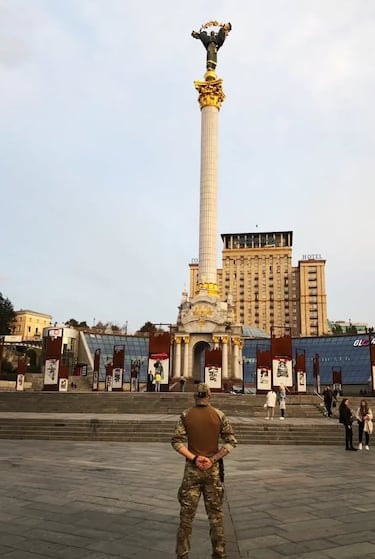
Akiles, how would you describe the real experience on the front line?
When bullets start flying and artillery is coming down, you are not thinking about politics. You are thinking about staying alive, completing the mission and protecting the man next to you. Theory, ideology – all of that disappears with the first impact. Everything comes down to discipline, a cool head and teamwork. During my first year – I was already there in March 2022 – I moved between training courses, aid deliveries and instructing Ukrainian units. That is when I developed relationships with senior Ukrainian commanders. You listened to how they think, what they see.
More than 7,000 Ukrainian service members have been trained in Spain as part of the European mission EUMAM UA, coordinated from the Toledo Training Coordination Centre and expanded into advanced modules – close air support, maritime demining and international humanitarian law – over these years. I served in the International Legion and carried out operations with GUR assault groups. In those early months there were already senior NATO commanders in Kyiv. I saw them, I recognized them. And it was the same NATO discipline I had learned that saved my life.
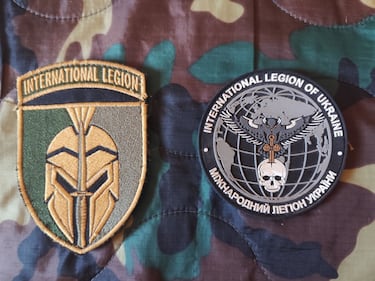
What kind of profiles arrive in Ukraine as contractors?
Many people think just anyone turns up here, and that is not true. The first Spanish group that arrived in 2023 was seven professionals, all former military, highly prepared. But I have also seen Spaniards who should never have come – without proper training, without experience. In this war you cannot improvise. Ukraine is not Lebanon. This is a high-intensity war against a military power.
It is said that many Europeans go for the money. What do you think?
That is false. Europeans are not going to Ukraine to make money. A European would be foolish to go there for money. You go out of conviction, out of principles, or because you feel a responsibility. Anyone who goes only for money does not last.
So what really drives a European contractor to go?
Calling. It is in our blood. And there is also the sense that if you do nothing, evil advances. I offer my skills to a people who need them. And when you commit, when you understand that this war is yours as well, you fight differently. For evil to triumph it is enough that good people do nothing. I offer my skills to a people who need them. But I will also tell you: it is impossible to recreate in training what awaits you under drones and artillery.
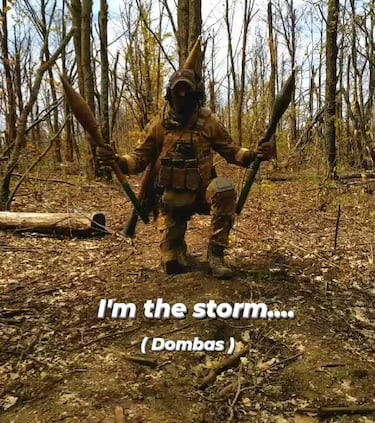
In Spain there are still those who use the word “mercenary.” What is your response?
Anyone who keeps calling us mercenaries is illiterate in this sector. A mercenary is someone without a contract, without regulation, without rules of engagement, without professional ethics. A military contractor works with contracts, with ROE, under international standards such as the Montreux Document or ISO 18788. People confuse the two. A professional studies, keeps up to date and knows the limits of the job so as not to cross lines. Ethics are part of the kit.
Note:
His explanation aligns with the international legal framework governing private military and security companies.
- The Montreux Document of 2008 compiles states’ obligations under international humanitarian and human rights law and outlines good practices for contracting and oversight.
- The International Code of Conduct and its oversight association, ICoCA, provide certification, monitoring and complaint mechanisms.
- ISO 18788, adopted in 2015, establishes management standards for security operations, requiring legal compliance, traceability and respect for human rights.
- Rules of Engagement (ROE) define when, where and how force may be used under competent authority and within the relevant legal framework.
Let’s talk about money. What are the real figures in this sector?
No one ever says this. I will. South Americans earn about $2,700 a month. They are cheap labor for very basic roles. Europeans earn between $8,700 and $10,900 a month. They are profiles with military experience, language skills and NATO standards. The British make around $16,300 a month. They are in high demand because of their background in specialized units and previous deployments. Americans earn close to $21,800 a month. They are the most sought after because of their qualifications, certifications and doctrine. But I will tell you something: it is not worth it. One day in a position in Ukraine, with 120 impacts falling over your head, is not worth $3,000. No amount of money is worth that.
Q - What role do drones play now?
If a drone spots you, you are dead. Ukraine is a pioneer. They have certifications, official schools, training programs. The battlefield is now far broader, more controlled and more lethal. Drones change everything. In 2024 the government launched a project to certify UAV pilot schools, and the Ministry of Defense accredits centers and issues certificates assigning military specialties. The Ukrainians are pioneers. The best. They run courses for civilians, there are certifications, and my drone pilot colleagues operate there. They are the future of war, without a doubt.
Q – In your view, where is modern warfare heading?
Toward private military companies, without question. The future of war is PMC, because forcing a citizen to die for a flag is increasingly unacceptable. Western societies do not accept that cost; politically it is hard. Contractors, by contrast, are trained, voluntary and professional. We are not gunmen. We are specialists.
Would you go back?
I miss it. There is not a day I do not think about Ukraine. It was a before and after in my life. If I did not have a family – who knows. But for now, I would not return. Four years of conflict take you from the beginning of a conventional war to a fully technological one. For everyone’s sake, the war should end. Ukrainians are natural fighters, but I do think they should look for a solution. After four years, people are divided – those who want to continue and those who want it to end now.
-----------------------------------------------------
Akiles does not attempt to beautify anything. He speaks from a place where theory collapses and only survival, duty and the protection of the person beside you remain. For him, war – especially a high-intensity conflict such as Ukraine – is not an ideological chessboard but a terrain where only discipline, experience and composure endure. His account does not offer epic heroics. It points instead to a global trend: the external professionalization of war, the specialization of combatants and the impossibility of understanding the front line from the comfort of an office.
The future will be uneasy, hybrid and increasingly dependent on professionals operating where regular armies cannot go or where the political cost cannot be borne. It may not be the “privatization of war,” but rather the regulated outsourcing of peripheral or complementary functions, where veteran experience makes the difference. As Colonel Jeff Cooper once suggested, there are two types of warrior: the one motivated to do the job and the one who does it and wants it over quickly. “I have been both,” he says. And as he puts it, “it is your war too.”
Ukraine’s moral and geopolitical proximity to Europe turns the defense of its sovereignty into an existential question for European security. When the explosions fade, what remains is the silence of professional conscience. On the frontier between the present and the future of war, experience remains decisive.
Related stories
Get your game on! Whether you’re into NFL touchdowns, NBA buzzer-beaters, world-class soccer goals, or MLB home runs, our app has it all.
Dive into live coverage, expert insights, breaking news, exclusive videos, and more – plus, stay updated on the latest in current affairs and entertainment. Download now for all-access coverage, right at your fingertips – anytime, anywhere.
Complete your personal details to comment