


Antonio Pampliega, 18 years as a war correspondent: “This is no longer World War II. Now you have to choose sides”
The journalist and writer presents his new novel, “Cowboys in Hell,” where fiction and reality blend together.

Cowboys en el Infierno ya está en preventa...
— Antonio Pampliega (@APampliega) May 16, 2025
Y hoy se presenta en Chiclana ❤️. pic.twitter.com/bZB5oqc5Hq
Q – Is this really a goodbye, or just a break?
It’s a goodbye to freelancing and being a freelance war correspondent. I started in 2008, at 25. I’m 43 now—that’s 18 years. That’s a lot. Maybe when my daughter grows up… But you learn to step back, to retrain. I was happy covering wars—truly happy, despite everything I went through. Before, I told stories in conflict zones. Now I tell them here, in my own country, where I had never worked before. And I’m happy. Very, very happy.
Q – Don’t you sometimes get the itch to grab your passport again?
I would have loved to cover the war in Gaza, not from Jerusalem but on the ground. Or to go to Ukraine. But I’ve been banned for 10 years.
Q – What happened in Ukraine?
In 2014, I went with José Manuel López and Ángel Sastre to cover the war. We went to Donbas, to a town called Pervomaisk. The Ukrainians started bombing the area we were in. We did a piece for Al Jazeera—text, photos, video. When it was published, Ukraine accused us of lying, saying they weren’t targeting civilians. But it’s all in the video—we were in a soup kitchen when the bombing started. People had to flee and hide in shelters. After that, they banned me until 2024.
Q – What other countries have banned you?
Turkey sanctioned me twice for illegally entering Syria. Syria blocked me from entering via Damascus because I embedded with rebel forces. Iran also banned me.
Q – Have we made war narratives too black-and-white—good guys vs. bad guys—with no room for nuance?
Absolutely. In modern wars—Afghanistan, Ukraine, Syria—journalists can only embed with one side.
In Afghanistan, it was NATO, because the Taliban would kidnap you. In Syria, you either went with the rebels or with the regime—never both. Same in Ukraine. If you go with the Russians, forget about the Ukrainians. So, you end up swallowing the narrative. Because you only see one side. But the other half of the story also needs to be told. And they won’t let you.
It’s not like WWII, where reporters moved between fronts. That time is gone—and it’s tragic. I went to Syria 12 times, and never once could I report from Damascus. I wanted to. People there were also dying—killed by rebel shelling. The rebels were no saints. But at that moment, the side suffering the regime’s repression was the one that had to be covered. So yes, we’ve consumed that narrative. And others. Journalism ethics matter—and they’re under pressure.
Q – Are we in a good place now?
No. When the Arab Spring began—especially in Syria—citizen journalism emerged. Activists could cover conflicts themselves. So people started asking, “Why do we need you?” And now, with AI, it’s terrifying. Soon, you’ll be able to write about war from your couch with a few prompts.
Sure, great writers have reported on war without ever leaving a hotel. But that’s not journalism. In the first Gulf War, in ’91, some people “covered” it from Jerusalem—while the bombs fell in Baghdad.
Q – Is that why your book is a novel?
Q – You smile when you talk about that time.A – Because I was happy—even in the middle of a war.
I was lucky to meet people who became family. Despite what we saw, I’d go back to those years in a heartbeat. When you love something—especially a profession like ours, which is pure vocation—you smile. When the smile fades, it’s time to ask yourself why. I stopped smiling doing what I loved most.
I also have the right to a family, a home, a car, a vacation. But I’d do those 18 years all over again—no regrets. Not even the kidnapping.
Q – Did you sense something was wrong that day?
Yes. The fixer asked me strange questions—like how much our cameras were worth. Then he said, “Antonio, I’m just going to look after you.” Hours later, a van blocked the road, men jumped out. I saw no insignia. Jihadists. In 2015 Aleppo, where you had ISIS, Al Qaeda, and Salafist factions, our greatest fear was being captured by ISIS. We knew what that meant.
Q – Was that the conflict that changed you most?
Yes. There’s a before and after. I trained in Afghanistan, my first war—I went eight times. But I became a war correspondent in Syria. That’s where I truly understood what war is.
Aleppo was pure devastation. You’d see dead children, destroyed families, people screaming in hospital corridors. It changes you—not just as a journalist, but as a person. You can’t lose perspective: we are human beings working with human pain.
We’re not prepared for what we saw. You might be ready to see a dead loved one, maybe from illness or an accident—but not a child torn apart by a bomb.
October 4, 2012. The regime bombed a school at 4:30 p.m. Kids were playing. One lost a leg. That was just one day. Every day it was a school, a bakery, a market. I have a video of a boy—maybe my daughter’s age—with his intestines hanging out after a sniper hit him. That was our job: document, film, continue. Over and over again.
Eventually, PTSD hits. We don’t talk about our own pain enough. I suffer from PTSD. I see a psychologist every week, a psychiatrist once a month. I’m medicated. Because of what I saw. And because of the kidnapping.
Only Guillermo Altares from El País ever asked me how I was doing. That’s why this book took so long—I couldn’t even look at the images again. They’re stored on my hard drives. That’s where they’ll stay.
Q – Soldiers say the dead stay with you. Do they?
Not all of them. But the first one does. For me, it was a boy in southern Afghanistan. He was 12. He’d stepped on a mine. I was riding in a Medevac helicopter. He died in flight. That’s my first death. I always mention him in talks.
I remember another boy in Syria, maybe 17 or 18. One sniper bullet to the heart. I photographed him lying alone in a mosque. Later, his two older brothers came to hug him. I just heard the sound of my camera clicking. At some point, they looked at me—and I knew it was time to go. They didn’t say a word. But I felt like I was stealing something sacred.
They understood our role. I wouldn’t let anyone photograph me hugging my daughter or mother in that moment. But they let us in. They understood journalism.
Q – What role does hope play in war?
Hope is everything. When you lose hope, you pick up a weapon, or join a jihadist group. Syrians let us into their homes because they hoped the world would listen. That’s why they gave us their stories.
In a hospital, after an attack, I once offered to help. They said: “You’re not a doctor. You’re here to photograph. Do your job—or leave.”
Q – Syria is back in the headlines. President Ahmed al-Charaa is welcomed by Western leaders.
When the regime fell, I won’t lie—it was a happy day. The war had killed over half a million people. I saw hope. But I also warned: if ethnic cleansing started, it would be disastrous. And now, the man in charge—the very man who orchestrated our kidnapping—has trimmed his beard, wears a suit, and shakes Trump’s hand. This is the man who’s going to bring peace?
It breaks my heart. Syrians aren’t returning home. Why would they? There’s no stability. And I doubt this man will provide it.
Q – What did you think when you saw him with Macron in Paris?
As my grandmother would say, it made my blood boil. For 13 years, no Western power lifted a finger. In the early years, when it was Syrians fighting—not jihadists—no one intervened. Now they’re shaking hands with a war criminal in a suit.
You let half a million die. You displaced millions. And now you roll out the red carpet?
And let’s not even talk about Israel. Everyone’s seeing the images. Israel has killed over 17,000 children. Babies. And nothing is done. At what number will it be too many? 20,000? 60,000? It’s genocide. And the world watches.
Q – Is there a story you couldn’t tell?
The fall of the Syrian regime. I would have loved to tell that story.
Q – In your novel, do you think we’ll ever again see a group of journalists so connected?
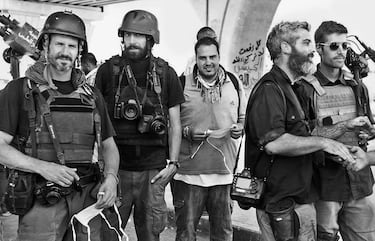
I hope so. What we were—more than Cowboys—were blood brothers. I think it’ll happen again. Real journalists will always find each other, especially freelancers. It’s a job that requires teamwork.
Thinking about those friends makes me smile. They’re still in my life. I love them. It reminds me of what others did in the Balkan wars—Manu Gil, Gervasio Sánchez, Pérez-Reverte…
Q – Do we need to keep telling stories?
Absolutely. People want to hear stories. Read them. Watch them. That’s why platforms like Netflix and HBO invest in storytelling. A good story captivates—someone might spend 234 minutes reading because it struck a chord.
Related stories

We need to keep telling stories—especially the ones that matter. That’s journalism. That’s what it will always be.
Get your game on! Whether you’re into NFL touchdowns, NBA buzzer-beaters, world-class soccer goals, or MLB home runs, our app has it all. Dive into live coverage, expert insights, breaking news, exclusive videos, and more – plus, stay updated on the latest in current affairs and entertainment. Download now for all-access coverage, right at your fingertips – anytime, anywhere.
Complete your personal details to comment