


China tests hydrogen engine in flight, marking a new step beyond jet fuel
The test offers fresh evidence that hydrogen can power aircraft in real conditions, putting China among the leaders exploring alternatives to traditional aviation fuel.
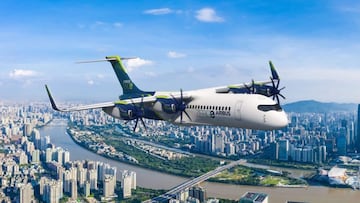
While global commercial aviation still runs almost entirely on oil, China has taken a step toward a possible alternative. The country has successfully completed a test flight of an aircraft powered by a liquid hydrogen engine, a system sometimes described as a “water engine” but more accurately understood as one of the most ambitious efforts to move aviation away from fossil fuels. The test took place on April 4, 2026, in the city of Zhuzhou and has been reported by several international outlets focused on aerospace innovation.
The aircraft, a 7.5-ton unmanned cargo vehicle, took off, climbed to 300 meters, and remained airborne for 16 minutes, covering 36 kilometers at a speed of 220 km/h. The engine used was the AEP100, developed by the Aero Engine Corporation of China, a key player in China’s industrial strategy.
Unlike many Western efforts, the AEP100 burns liquid hydrogen directly in a turbine, in a similar way to how current engines burn kerosene. This produces no carbon emissions during flight, with water vapor as the main byproduct. The advance lies not in “using water as fuel,” but in using hydrogen derived from water as a direct energy source, removing the need for petroleum-based fuels.
Fuel cells vs liquid hydrogen for aviation
This approach does not place China on a completely different technological path from Western manufacturers. Companies such as Airbus have been exploring both hydrogen combustion and hydrogen fuel cells for several years under their ZEROe program, testing multiple propulsion concepts before recently prioritizing fuel cells as the most viable long-term solution.
At the same time, hydrogen combustion remains an active area of development in Europe. Rolls-Royce, in partnership with easyJet, has already run a modern aero engine on hydrogen in ground tests, demonstrating that the technology can deliver power in a format similar to today’s turbines.
Engine makers across the industry, including U.S. players such as Boeing and major propulsion groups, continue to study hydrogen as a long-term alternative, although they have generally emphasized the significant technical and infrastructure hurdles that remain before it can be deployed at scale.
What distinguishes the recent Chinese test is not a fundamentally different approach, but its emphasis on early flight demonstration of hydrogen combustion. While Western programs have focused heavily on ground testing and fuel-cell development, China has moved to validate a combustion-based system in a real aircraft environment, albeit at a small scale.
Energy and strategic context
The test comes at a time of global energy uncertainty, shaped by geopolitical tensions in the Middle East, pressure on key shipping routes, and continued volatility in oil prices. The International Energy Agency has recently confirmed the release of large volumes of strategic reserves, while Brent crude prices have risen again.
In that context, hydrogen propulsion is not only an environmental goal. It also aligns with China’s broader objective of reducing dependence on imported oil, with implications for its economic and industrial strategy as well as national security.
Related stories
Get closer to the game! Whether you like your soccer of the European variety or that on this side of the pond, our AS USA app has it all. Dive into live coverage, expert insights, breaking news, exclusive videos, and more. Plus, stay updated on NFL, NBA and all other big sports stories as well as the latest in current affairs and entertainment. Download now for all-access coverage, right at your fingertips – anytime, anywhere.
And there’s more: check out our TikTok and Instagram reels for bite-sized visual takes on all the biggest soccer news and insights.
Complete your personal details to comment