


China issues stark warning to U.S., though its military ignores tensions: direct hit and target sunk
The new missile system has put the western Pacific on alert after the sinking of a maritime target.
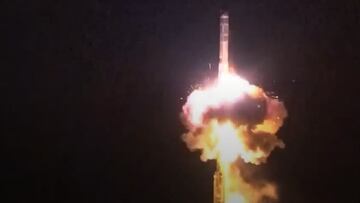
The deployment of the Typhoon Medium-Range Missile System has raised alarms in Beijing. China has previously warned that continued U.S. use of this weapon could heighten tensions between the two nations. For the U.S. military, however, the MRC missile system is considered a critical asset for offensive operations.
Last Tuesday, the U.S. Army announced a successful test of the system using a Standard Missile-6 (SM-6). The missile struck and sank an unspecified maritime target in the Pacific Ocean. While this isn’t the first time the U.S. has tested the weapon, it marks the first launch conducted from land, specifically west of the International Date Line.
In total, six firings were carried out using the MRC system. Colonel Wade Germann, commander of the Army’s 3rd Multi-Domain Task Force (MDTF), described the test as “another significant advancement in our ability to deploy, integrate, command, and control advanced maritime land-based strike capabilities,” according to Business Insider.
The United States will deploy its Typhon missile launchers, which can fire multi-purpose missiles up to thousands of kilometers, in the Philippines if Manila agrees to the deployment, a US defense official said. https://t.co/CcdJO53E5C pic.twitter.com/GgAHRzhLGP
— The Philippine Star (@PhilippineStar) June 14, 2025
What is the MRC and how does it work?
The MRC (Mid-Range Capability) missile system is a valuable tool for the U.S. Army, primarily due to its long-range capabilities and flexibility. It is designed to launch both the SM-6 and the Tomahawk land-attack missile. Prior to the Pacific test, the system was tested during a joint exercise with the Philippines last year.
Development of the MRC began in 2019 after President Donald Trump withdrew the United States from the 1987 Intermediate-Range Nuclear Forces (INF) Treaty. The treaty had previously banned the U.S. from developing or deploying ground-launched nuclear or conventional missiles with ranges between 500 and 5,000 kilometers.
Citing repeated violations by Russia, the Trump administration ended U.S. participation in the treaty. As a result, the development of systems like the MRC became possible, although the first live test wasn’t conducted until last year in the Philippines.
China responds to U.S. missile deployment
In response to the deployment, China quickly voiced its opposition. Lin Jian, spokesperson for China’s foreign armed forces, condemned the move in September last year, calling it “a maneuver to reverse history.”
Jian warned that the MRC “seriously threatens the security of regional countries, incites geopolitical confrontation, and has aroused great vigilance and concern among neighboring nations.” He added that Beijing firmly opposes the U.S. reinforcing its forward military presence “on China’s doorstep.”
In August of the same year, then–Philippine Foreign Secretary Enrique Manalo revealed that his Chinese counterpart, Wang Yi, had expressed concerns that the U.S. deployment could fracture regional ties and trigger a new arms race.
BREAKING:
— Visegrád 24 (@visegrad24) December 23, 2024
The Philippines announced today that they are buying the Typhon missile system from the US.
Firing modified SM-6 and Tomahawk missile, it had very long range and can hit targets in southern China.
China quickly condemned the US and the Philippines after the news.… pic.twitter.com/8FH1n4hVHX
Related stories


China itself maintains a vast arsenal of ballistic missiles, including systems comparable to the MRC, capable of countering U.S. forces and their regional allies—such as the Philippines. Beijing has accused Manila of prioritizing U.S. interests over its own. Nonetheless, Manalo has publicly acknowledged the strategic value of the MRC, describing it as a useful tool for national defense.
Get your game on! Whether you’re into NFL touchdowns, NBA buzzer-beaters, world-class soccer goals, or MLB home runs, our app has it all. Dive into live coverage, expert insights, breaking news, exclusive videos, and more – plus, stay updated on the latest in current affairs and entertainment. Download now for all-access coverage, right at your fingertips – anytime, anywhere.
Complete your personal details to comment