


‘Doomsday Clock’ is as close to midnight as ever before: what is it, why and what does it mean?
Life on Earth is facing the very real threats of war and climate change, among other factors, as scientists count down its demise.
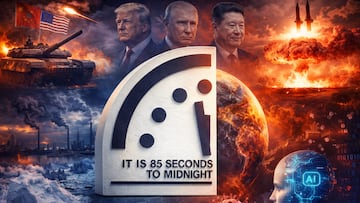

Quick! Do everything you wanted to do in life and do it really quickly. There’s just under a minute and a half till the end of the world. Wait, what? That’s just a relative timescale to see the lifespan of our planet through a different lens? Ah, then we can relax, no need to stockpile the tinned mango slices just yet. Take that silly hard hat off as well, you look ridiculous.
Well, don’t relax too much, say the atomic scientists that have set what is known as the ‘Doomsday Clock’ closer to midnight than ever before. On Tuesday they advised that threats of war, climate volatility and nuclear spending, all exacerbated by Russia, the USA, China, North Korea among others, as well as mentioning Israel’s continued attack on Palestinian civilians and even the development of AI.
The 2026 Doomsday Clock announcement, captured by photographer Jamie Christiani.
— Bulletin of the Atomic Scientists (@BulletinAtomic) January 27, 2026
IT IS 85 SECONDS TO MIDNIGHT.
Watch the 2026 Doomsday Clock announcement: https://t.co/KfwWsVAw1g pic.twitter.com/ru8KjaOAhl
What is the Doomsday Clock?
The ‘Doomsday Clock’ was created by the Bulletin of the Atomic Scientists to illustrate how close humanity has come to the end of the world. Midnight on this clock marks the theoretical point of annihilation. The clock’s hands are moved closer to or further away from midnight based on scientists’ reading of existential threats at a particular time.
The latest move has it at just 85 seconds to midnight, the closest it ever has been in history.
What factors influence the Doomsday Clock?
A Chicago-based non-profit organisation, the bulletin updates the clock’s time annually based on information regarding catastrophic risks to the planet and humanity. The organisation’s board of scientists and other experts in nuclear technology and climate science, including 13 Nobel Laureates, discuss world events and determine where to place the hands of the clock each year.
Apocalyptic threats reflected by the clock include politics, weapons, technology, climate change and pandemics. The clock had been set to 100 seconds to midnight in 2020, 90 seconds in 2023, and 89 seconds last year, each one moving us closer than ever to the brink. Among aspects cited, the board highlighted how global leaders are not acting responsibly to move the clock backwards.
Why has the Doomsday Clock moved closer to midnight?
The board pointed to accelerating global risks driven by failed leadership and intensifying great-power competition. Instead of reversing course, major powers including the United States, Russia, and China have become more nationalistic and confrontational, eroding international cooperation needed to manage existential threats.
Nuclear dangers worsened over the past year as three conflicts involving nuclear-armed states escalated: Russia’s war in Ukraine, clashes between India and Pakistan, and US and Israeli strikes on Iranian nuclear facilities. At the same time, a renewed arms race is underway, with expanding arsenals, modernization of delivery systems, looming expiration of the New START treaty, possible resumption of nuclear testing, and plans for space-based missile defense that could trigger further militarization.
The Doomsday Clock timeline explores every shift of the Clock—forward and backward— over the past 79 years.
— Bulletin of the Atomic Scientists (@BulletinAtomic) January 27, 2026
Visit the timeline: https://t.co/uD5CQBUWav pic.twitter.com/DTkFHeUZ9h
Climate risks also intensified. Carbon dioxide levels and global temperatures hit record highs, sea levels rose, and extreme weather caused widespread deaths, displacement, droughts, and flooding. International climate action stagnated, while US policy actively rolled back renewable energy and climate protections.
Emerging biological and technological threats added to the danger. Scientists warned that synthetic “mirror life” could pose an existential risk, but no global safeguards exist. AI advances raise the risk of engineered pathogens, while weakening public health systems and eroding biological weapons norms reduce preparedness. AI is also being rapidly integrated into military systems, including nuclear decision-making, despite safety concerns, and is worsening global misinformation.
These risks are compounded by the global rise of nationalist autocracy, which undermines diplomacy, accountability, and cooperation, increasing the likelihood that nuclear, climate, and technological threats spiral out of control.
Can anything be done to reverse the Doomsday Clock?
The Bulletin argues catastrophe is not inevitable. It urges renewed nuclear arms dialogue, restraint on missile defense and nuclear testing, international action to prevent dangerous biotech and AI misuse, strong climate policy focused on phasing out fossil fuels, and global rules for military AI.
Without urgent leadership and public pressure, though, the current trajectory remains unsustainable.
Did Einstein invent the Doomsday Clock?
A legend of the science world, Albert Einstein, was part of the group of atomic scientists that created the clock in 1947. They had also worked on the Manhattan Project to develop the world’s first nuclear weapons during World War Two. Back then, more than 75 years ago, it began ticking at seven minutes to midnight.
The clock was furthest from ‘doomsday’ in 1991, as the Cold War ended and the United States and Soviet Union signed a treaty that substantially reduced both countries’ nuclear weapons arsenals. Then it was at 17 minutes to midnight. Oh how different things look today.
Related stories
Get your game on! Whether you’re into NFL touchdowns, NBA buzzer-beaters, world-class soccer goals, or MLB home runs, our app has it all.
Dive into live coverage, expert insights, breaking news, exclusive videos, and more – plus, stay updated on the latest in current affairs and entertainment. Download now for all-access coverage, right at your fingertips – anytime, anywhere.
Complete your personal details to comment