


He paid $100 for a 95-million-year-old dinosaur tooth online: then discovered something incredible
How quirky interest in owning an ancient fossil led to an uncomfortable reality of what goes on behind.
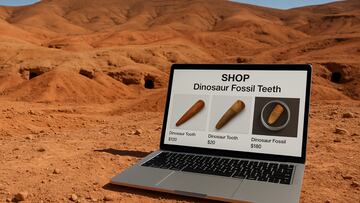

Have you ever scrolled past online fossil shops and felt the itch to own a prehistoric relic? Well, Jacopo Prisco, writing in CNN, didn’t just scroll – he clicked “buy.” And a few weeks later, a Spinosaurus tooth sat in a glass dome on his shelf, the kind of thing you might expect to cost thousands, yet it set him back only about a hundred bucks.
It looked real enough, but cracks in the enamel made him wonder if he’d been duped. So he took it to London’s Natural History Museum. That’s when the story took a very different turn.
How can you tell if a dinosaur fossil is real?
Paleontologist Susannah Maidment examined the specimen. Her verdict: yes, it was real, probably from a Spinosaurus – a 60-foot river-dwelling predator even bigger than T. rex. The relief didn’t last. Maidment pointed out the tooth was almost certainly excavated in Morocco’s Kem Kem fossil beds, and almost as certainly exported illegally.
As Prisco reports, Morocco requires permits for both excavation and export, and most sellers don’t have them. That means his $100 fossil sat in a legal gray zone.
Why is the fossil trade so controversial?
Part of the problem is perception. Blockbuster sales like the $44.6 million Stegosaurus skeleton “Apex” skew public opinion, making fossils seem rare treasures reserved for the mega-rich. In reality, dinosaurs shed teeth constantly, so individual specimens like Prisco’s are common, and sometimes patched together with glue to look more impressive.
The darker side is the human cost. Miners in Morocco often dig deep, dangerous tunnels with little protection, earning as little as $13 to $20 a day. Collapses and deaths are not uncommon. That reality makes it harder to look at a fossil on your bookshelf with the same unalloyed wonder.
Prisco’s full piece for CNN makes clear that what began as a playful impulse buy opened up questions that don’t have neat answers. Is it ethical to own a fragment of deep time? Should fossils belong in museums rather than private homes? And if you do buy one, how do you know it got to you legally?
For him, the 95-million-year-old tooth is now the oldest thing in his house by, oh, well over 94 million years. But it’s also a daily reminder that even something set in stone can come with complications.
Related stories
Get your game on! Whether you’re into NFL touchdowns, NBA buzzer-beaters, world-class soccer goals, or MLB home runs, our app has it all.
Dive into live coverage, expert insights, breaking news, exclusive videos, and more – plus, stay updated on the latest in current affairs and entertainment. Download now for all-access coverage, right at your fingertips – anytime, anywhere.
Complete your personal details to comment