


Mystery solved: An international research team discovers how dark patches persist on the Sun’s surface
Science continues to explain the mysteries of the universe, and now we know why sunspots exist.
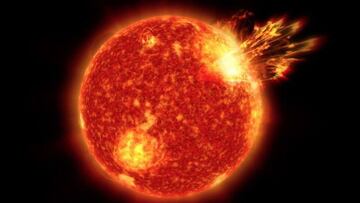

A ‘cool’ spot on the Sun isn’t like finding some shade in the park to put your picnic blanket down, it’s still about 3,000–4,500°C (compared to around 5,800°C elsewhere on the surface), but it’s certainly cool enough to have stumped scientists for years. Why do these dark spots appear, sometimes for weeks or even months, on the surface of our nearest star?
Well, it appears the mystery has finally been solved. On the rolling surface of the Sun—constantly in motion and ever-changing—why do these spots exist?
But first: what is a sunspot? Basically, it’s a cooler region on the Sun caused by intense magnetic activity. The findings, published in Astronomy & Astrophysics, say that modern models are “very simplified,” assuming the spots are static, have “symmetric magnetic fields,” and behave in perfect harmony. But surely that can’t be the case on such a frantic surface?
Exactly. So this group of scientists went much further than just “simplified.” Using the GREGOR solar telescope and advanced algorithms to see through dense atmospheric distortion, they captured measurements of sunspot magnetic fields with incredible accuracy.
Their findings showed that a sunspot’s magnetic field and plasma pressure—despite being from some of the most chaotic regions of the star—are arranged in a near-perfect balance, particularly around the circular boundary of the spot.
That balance is maintained thanks to the Lorentz force, which acts like magnetic tension, keeping the whole chaotic structure in check. To get nerdy, this all combines into what’s called magnetohydrostatic equilibrium, where the magnetic push (the Lorentz force) precisely cancels out gas pressure differences.
For over 400 years, ever since Galileo first observed sunspots, we have wondered how these cooler, dark patches could persist on the Sun’s roiling surface for days or even months.
— Erika (@ExploreCosmos_) July 18, 2025
A new study has finally resolved this mystery. An international team refined a method originally… pic.twitter.com/JG1GzeyLbl
Related stories


Because of this internal stability, sunspots can survive for many days—even while surrounded by the Sun’s boiling, turbulent plasma. I, for one, wouldn’t be sitting perfectly still.
Get your game on! Whether you’re into NFL touchdowns, NBA buzzer-beaters, world-class soccer goals, or MLB home runs, our app has it all. Dive into live coverage, expert insights, breaking news, exclusive videos, and more – plus, stay updated on the latest in current affairs and entertainment. Download now for all-access coverage, right at your fingertips – anytime, anywhere.
Complete your personal details to comment