


Nemo is getting smaller: Scientists explain why clownfish are shrinking
As if Disney didn’t have it in for Nemo already, now he’s shrinking.
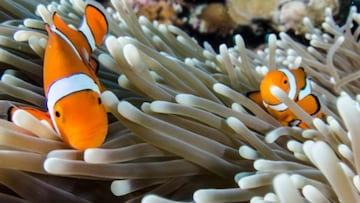

Once again, humankind’s actions are forcing the animal world to adapt or get left behind.
A recent study points to evidence that clownfish are in fact shrinking due to human-provoked temperature changes in the water.
A research team measured 134 clownfish along reefs in Papua New Guinea each month for five months; they also monitored water temperatures during a marine heatwave. The results were startling: the researchers found that some clownfish, (which only grow to around 3 inches long) shrank as the water’s temperature increased, a change that increased their chances of surviving the heat stress by as much as 78%.
‘When they shrink, it’s about one or 2% of their body size’
When taking a look at the results of her study, Melissa Versteeg, a Ph.D. student in marine science at Newcastle University and co-author of a paper recently published in the journal Science Advances, admitted she was shocked to see such a change.
Talking to news outlet Morning Edition, she said that “it’s usually assumed that growth is relatively one way, so it’s favorable to be a bit bigger. And we’ve not really seen before that they actually have this capacity or ability to shrink.”
“When they shrink, it’s about one or 2% of their body size,” Versteeg added. “And so really small length reductions of just like between one and two millimeters.”
Versteeg admitted that the exact reasons why shrinking aids survival rates is unknown. However, she speculates that it could be down to needing less food and having a lower metabolism. “Something about these shrinking fish was giving them a better opportunity to survive the heat wave compared to the ones that kept growing bigger in size." She confirmed that they returned to normal size once the water cooled.
It’s not the only case of animals adapting to our destruction of the planet and its natural creations: elephants are evolving to have smaller or even a complete lack of tusks, a direct consequence of poaching. Hunting gave elephants that didn’t grow tusks a biological advantage as they weren’t killed by illegal poachers, altering the population.
Related stories


One study in Kenya showed that on average, male elephants born after 1995 had tusks 21 percent smaller than the males from the 1960s.
Get your game on! Whether you’re into NFL touchdowns, NBA buzzer-beaters, world-class soccer goals, or MLB home runs, our app has it all. Dive into live coverage, expert insights, breaking news, exclusive videos, and more – plus, stay updated on the latest in current affairs and entertainment. Download now for all-access coverage, right at your fingertips – anytime, anywhere.
Complete your personal details to comment