


New images of interstellar object 3I/ATLAS show a giant ‘jet’ towards the Sun: it is ejecting gas and dust
NASA and other scientific teams are studying its behavior to better understand the interstellar visitor.
There are still many things about our planet that scientists continue to investigate, but our lack of knowledge is even greater when it comes to what lies beyond it. In early July, NASA discovered a comet that, according to some studies, may have originated in an unknown star system far beyond our own.
This comet, designated 3I/ATLAS, measures between 5 and 11 kilometers across. It is the largest interstellar object ever observed passing through our solar system, and it could also be the oldest—possibly dating back billions of years before the Sun was born.
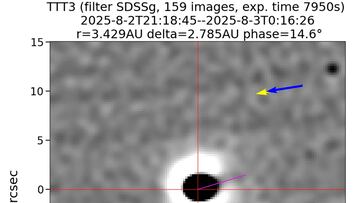
While a few voices have speculated that it might be a spacecraft sent to spy on us, the vast majority of scientists agree that 3I/ATLAS is simply a comet like any other. It was captured on August 2 by the Twin Two-Meter Telescope at the Teide Observatory in Tenerife, Spain.
Images from the observatory show the comet’s nucleus as a large black dot surrounded by a white glow. This image was shared by The Astronomer’s Telegram on October 15.
Miquel Serra-Ricart, an astrophysicist and director of science at the Teide Observatory’s Light Bridges research institution, told Live Science via email that comets are known for their bright tails of ionized gas, but their smaller cometary jets usually point toward the Sun. If there’s any concern about this phenomenon, Serra-Ricart explains, it’s entirely normal—a standard feature of cometary anatomy.
According to him, this behavior occurs because comets heat up unevenly as they approach the Sun. The side facing the Sun warms faster, and if a weak spot gets hot enough, it can release material thousands of kilometers into space, much like a geyser, in the Sun’s direction.
The interstellar object 3I/ATLAS will NOT collide with (or visit) Earth.
— Massimo (@Rainmaker1973) October 27, 2025
On December 19, it will only reach its closest approach, at about 268 million km.
In this clip, you can see its actual orbit crossing the Solar System.
[🎞️ OvniChile1]pic.twitter.com/NP7ahR3N13
Related stories


Currently, the comet continues its approach toward the Sun and is expected to reach its closest point on October 29. It won’t be visible from Earth again until mid-November, when scientists will have a chance to observe how much it has changed—especially how its jet and tail have evolved since this passage.
Get your game on! Whether you’re into NFL touchdowns, NBA buzzer-beaters, world-class soccer goals, or MLB home runs, our app has it all. Dive into live coverage, expert insights, breaking news, exclusive videos, and more – plus, stay updated on the latest in current affairs and entertainment. Download now for all-access coverage, right at your fingertips – anytime, anywhere.
Complete your personal details to comment