


Rachael Seidler, physiologist, explains how space affects the brain: “The people who went for a year showed the largest changes”
Astronauts’ brains change while they are in space, new research shows.
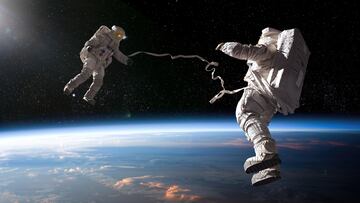

In space, no-one can hear you scream. Because your brain is being crushed by your skull. OK, that’s not true at all. But space does mess with your head.
New research shows that spending time in orbit does more than make astronauts’ muscles weaker and their bones thinner; it also pushes and moulds the brain itself inside the skull.
A recent study published in the Proceedings of the National Academy of Sciences looked at brain scans from astronauts before and after space missions and found that time spent in microgravity can subtly alter both the position and shape of the brain.
“We need to understand these changes to keep astronauts safe”
The team, led by researchers including applied physiologist Rachael Seidler, analysed MRI data from 26 astronauts alongside scans from 24 people who took part in a long-duration bed-rest experiment that mimics some effects of space travel.
The results were striking. After their missions, astronauts’ brains tended to shift upward and backward within the skull, and regions tied to movement and sensory processing showed the largest deformations. In simple terms, the brain appears to move slightly toward the top of the head and tilt back, changes that measure only a few millimetres, but which are significant in neurological terms.
Scientists think these shifts are mainly driven by the absence of gravity’s pull on bodily fluids. On Earth, gravity keeps fluid distributed in a familiar pattern from head to toe. In orbit, that fluid floats upward, pressing on tissues and redistributing pressure inside the skull. This fluid shift is also linked to other changes astronauts experience in space, such as puffy faces and thinner limbs.
Rachael Seidler, a professor in the department of applied physiology and kinesiology at the University of Florida and a co-author of the study, told NBC that “we need to understand these changes and their impacts to keep astronauts safe and healthy and protect their longevity.”
From low Earth orbit to the Moon, Mars, and beyond! 🌙🚀
— International Space Station (@Space_Station) September 30, 2025
The space station is humanity's launchpad to deep space where we refine our knowledge, advance technologies, and learn to thrive as we prepare to venture further into the cosmos. https://t.co/0ZrcIpE2KR pic.twitter.com/wZcsJbL2rv
Related stories


“The people who went for a year showed the largest changes,” she added. “There were still some changes evident in people who went for two weeks, but duration seems to be the driving factor. It’s on the order of a couple of millimetres, which doesn’t sound like a big number, but when you’re talking about brain movement, it really is. That kind of change is visible by eye.”
Get your game on! Whether you’re into NFL touchdowns, NBA buzzer-beaters, world-class soccer goals, or MLB home runs, our app has it all. Dive into live coverage, expert insights, breaking news, exclusive videos, and more – plus, stay updated on the latest in current affairs and entertainment. Download now for all-access coverage, right at your fingertips – anytime, anywhere.
Complete your personal details to comment