


They brought millions of bees to save the Sahara and ended up melting: the solution to stop the desert ended up being geometry
The Sahara has withstood numerous projects aimed at halting its expansion. A solution based on the shape of the land has yielded new results.
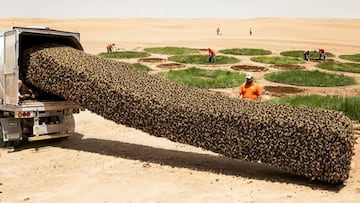
The Sahara Desert is one of the most extreme environments on the planet. Although lakes and vast water reserves exist beneath its surface, the nature of the sand makes it an almost impossible place for life to thrive. At certain times of the year, ground temperatures can exceed 158ºF, making survival difficult for living organisms and severely limiting any form of human intervention.
For years, projects aimed at halting desertification were launched, but most ended in failure. Large-scale tree planting, intended to form a green wall, proved ineffective because seedlings could not withstand the intense heat, rapid moisture loss and the harshness of the soil. Beehives introduced for ecological purposes also failed, as extreme temperatures melted the wax, destroyed the honeycombs and ultimately killed the bees.
These repeated failures led to a crucial conclusion. The core issue was not simply a lack of water, but the physical condition of the soil itself. After decades of intense sun exposure and overuse, the Sahara’s surface had become compacted and impermeable, preventing rainwater from penetrating the ground and accelerating erosion when runoff occurred.
In response, researchers and local communities turned to a simple technique shaped by the natural contours of the land. Crescent-shaped wells were dug and oriented against the slope, slowing rainwater, allowing it to collect, and breaking through the hardened surface layer. This, in turn, enabled moisture to filter into deeper soil levels.
Related stories


Within these cavities, temperatures are noticeably lower than on the exposed sand, reducing evaporation and helping retain water. Over time, this process has allowed the return of native grasses, insects, birds and trees that had long remained dormant.
Get your game on! Whether you’re into NFL touchdowns, NBA buzzer-beaters, world-class soccer goals, or MLB home runs, our app has it all. Dive into live coverage, expert insights, breaking news, exclusive videos, and more – plus, stay updated on the latest in current affairs and entertainment. Download now for all-access coverage, right at your fingertips – anytime, anywhere.
Complete your personal details to comment