


This 20-minute trick might help you crack your toughest challenge and unlock your genius
Stuck on a problem you can’t solve? Hitting the brick wall of ideas? Well, maybe these scientists can provide a solution.


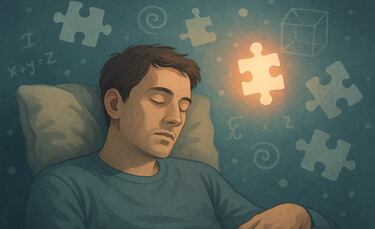
Sometimes, the harder you try to solve a problem, the worse your brain performs. I’ve felt it on many an occasion. You grind for hours, pushing through a block, and nothing happens. But researchers now think that stepping away from the grind and slipping into a shallow sleep – just long enough to catch the edge of a dream – might be the smarter move.
Some of history’s sharpest minds were onto this. Leonardo da Vinci reportedly snoozed for 20 minutes every four hours. Salvador Dalí took “micro-naps” in a chair, holding pencils that clattered to the ground as he dozed off. These weren’t lazy habits. You could say they were tactical resets.
With science catching up, a new study from the University of Hamburg, published in PLOS Biology, suggests that dropping briefly into N2 sleep – the name given to this early stage of slumber – may give you a better shot at a breakthrough.

What’s the science behind the genius nap?
Researchers asked 90 people to complete a screen-based pattern task. What they didn’t tell them was that after a certain point, there was a hidden shortcut. Some of the participants then took a 20-minute nap, while their brain activity was monitored via EEG.
The standout results came from those who reached N2 sleep, which typically begins around 15–20 minutes into a nap. A striking 85.7% of those participants figured out the shortcut. Compare that to just 63.6% of those who only hit N1 (a lighter sleep), and 55.5% of those who stayed awake.
Why does this happen? I hear you ask?
“The result is a brain that is more plastic and receptive to new ideas,” Anika Löwe, lead researcher, told our sister paper El País. She explained that N2 sleep may help the brain reprocess information and detect patterns that weren’t obvious while awake.
Why is this different from other sleep studies?
Unlike most sleep research that focuses on neat, rhythmic brain waves, this study zeroed in on what’s called aperiodic activity – irregular, background noise in the brain. According to Löwe, this unpredictable activity “reflects a more continuous dimension of sleep depth and brain flexibility.”
In other words, your neurons may be more willing to fire in new directions when the mind is in this not-quite-here, not-quite-there state.
Can you control when you hit N2 sleep?
You can try to control this yourself, but timing is key, and so is technique. The aforementioned Salvador Dalí had his own trick – holding pencils or a spoon while napping, which was designed to wake him up right as his brain dipped into N2. The researchers adapted this with objects designed to fall just as the body loses grip, signaling the napper to wake at the sweet spot.
I’ve tried a version of this when the brain just wouldn’t engage – slouched in a chair, keys in hand, quiet room. It sounds gimmicky, but the clarity afterward is real. Like rebooting a stuck computer.
Questions remain over napping process
The thing to note is that this doesn’t always work for everyone and some researchers, like Delphine Oudiette from the Paris Brain Institute, caution that it’s still unclear which precise part of the nap does the heavy lifting. “It is a challenge for specialists to discover the neural processes involved,” she told El País.
But even skeptics agree that these “creative naps” can offer benefits – especially in tasks that require flexible thinking. As Oudiette put it, “If you want to use a micro-nap in your life, it can help you in at least two types of creative tasks, even if you don’t know what stage [of sleep] you are in.”
Now to my killer closing paragraph. I’ll admit, I’m not feeling particularly inspired right now. Hmmm? Maybe I should just rest my eyes for a while...
Related stories


Get your game on! Whether you’re into NFL touchdowns, NBA buzzer-beaters, world-class soccer goals, or MLB home runs, our app has it all.
Dive into live coverage, expert insights, breaking news, exclusive videos, and more – plus, stay updated on the latest in current affairs and entertainment. Download now for all-access coverage, right at your fingertips – anytime, anywhere.
Complete your personal details to comment