


Trump threatens to invoke Insurrection Act over protests in Minneapolis: This is what would happen
Trump is once again raising the specter of invoking the 1807 Insurrection Act as protests in Minneapolis continue to escalate after another ICE shooting.
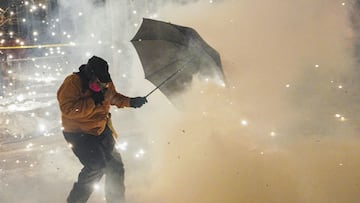
Tensions were already strained across the United States with the rollout of President Trump’s mass immigration raids as part of his largest deportation of immigrants in American history over the past year. However, sentiments were inflamed when an Immigration and Customs Enforcement agent fatally shot Renee Good in Minneapolis.
That not only sparked mass protests in that city but across the nation. The White House response was to call the victim a “domestic terrorist” and order a surge of agents into Minnesota creating further outrage.
A the shooting of a second person in Minneapolis by an ICE officer on Tuesday has sent even more people out onto the streets objecting to the presence of the immigration agents. This has prompted Trump to threaten invoking the 1807 Insurrection Act in Minnesota if state lawmakers don’t put an end to the anti-ICE protests.
“If the corrupt politicians of Minnesota don’t obey the law and stop the professional agitators and insurrectionists from attacking the Patriots of I.C.E., who are only trying to do their job, I will institute the INSURRECTION ACT, which many Presidents have done before me, and quickly put an end to the travesty that is taking place in that once great State,” he posted on Truth Social.
“If the corrupt politicians of Minnesota don’t obey the law & stop the professional agitators & insurrectionists from attacking the Patriots of I.C.E., who are only trying to do their job, I will institute the INSURRECTION ACT, which many Presidents have done…” - President Trump pic.twitter.com/d7XJMA7qUU
— The White House (@WhiteHouse) January 15, 2026
What is the Insurrection Act?
If the President were to invoke the Insurrection Act, the consequences would be both sweeping and historically charged. While the law grants extraordinary authority to one person, it is also dangerously vague. And in today’s uncertain world, its implications are deeply political.
The Brennan Center explains that the Insurrection Act is a dangerously out of date federal statute that allows a sitting president to mobilise U.S. military forces on domestic soil to restore order, enforce federal laws, or suppress rebellions.
Normally, the Posse Comitatus Act prohibits military involvement in civilian law enforcement; the Insurrection Act is the exception to that rule.
It contains several distinct provisions:
- Section 251: This is the simplest case. If a state’s legislature or its governor calls for help, the president may send troops to quell unrest.
- Section 252 and 253: Here, we may see the use of more aggressive tools. These allow deployment without state consent: if federal authorities judge that the situation has become so disorderly that standard law enforcement can’t cope, or if constitutional rights are being violated and the state won’t protect them.
Importantly, terms like “insurrection” and “domestic violence” are not clearly defined in the law itself, leaving it up to the president to interpret when the threshold has been met. Draw your own conclusions there.
Courts have historically declined to second-guess such calls, though they can review whether military forces have broken other laws or constitutional protections once deployed. Not that Trump pays any attention to law anyway.
Is the Insurrection Act the same as declaring martial law?
In a word, no, invoking the Insurrection Act is not the same as declaring martial law. Under the Act, troops generally reinforce, not replace, civilian authority; thankfully, the president has no constitutional power to suspend the rule of law altogether.
Why Trump is deploying troops across the United States?
The United States of America is no longer creeping towards authoritarian rule, it is a runaway train with the driver pushing the limits of law to breaking point. President Donald Trump is taking America down a dark path that history has seen before, with increased militarisation across the country being laced with a dangerously aggressive rhetoric regarding those who disagree with him.
There are many theories as to why Trump has been deploying army troops across the country, specifically to Democrat-run states, and his willingness to deploy more. One of the most prominent is that Trump wants to edge closer to what he will eventually call a ‘civil war’ against the decentralised antifascist movement known as the ‘Antifa’.
It must be remembered that while Trump is calling the movement a “terrorist organisation”, there is no armed section of the movement, nor is there even a general leader of the group: it is an unorganised movement of peaceful antiracist protesters, not an armed group of rebels.
This has been the plan all along.
— The Lincoln Project (@ProjectLincoln) January 15, 2026
- Foment violence and chaos in the streets of MN
- Implement the Insurrection Act
- Declare Martial Law
- Suspend elections pic.twitter.com/Ky3Jf3awqc
The midterm elections are coming up in 2026, which Trump has expressed legitimate concerns that Republican may lose control of Congress, which would result in him being impeached for a third time.
Also there are general elections in 2028 and it appeared that, in a meeting with Ukrainian leader Zelensky, Trump realised that elections could not be held in times of war.
The president has made no secret of his desire to run for three terms - something that goes against the constitution - and as such a civil war would perhaps be the perfect excuse for him not to call elections when they come around.
Related stories


Get your game on! Whether you’re into NFL touchdowns, NBA buzzer-beaters, world-class soccer goals, or MLB home runs, our app has it all.
Dive into live coverage, expert insights, breaking news, exclusive videos, and more – plus, stay updated on the latest in current affairs and entertainment. Download now for all-access coverage, right at your fingertips – anytime, anywhere.
Complete your personal details to comment