


Two divers come face to face with the world’s most secretive fish: “I thought it was a joke”
The rare encounter off Indonesia’s Moluccas could unlock secrets of a species that predates the dinosaurs.
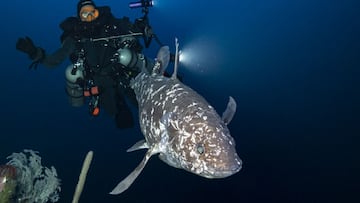
In October 2024, French divers Alexis Chappuis and Julien Leblond made an extraordinary discovery in the deep ocean off Indonesia’s Moluccas archipelago. During a highly demanding technical dive, the pair came face to face with a live Indonesian coelacanth (Latimeria menadoensis) – a marine species so elusive that it has rarely been seen alive in its natural habitat.
“When I heard Julien shouting underwater, I thought it was a joke,” Chappuis admitted afterward. Hidden behind a rock formation at a depth of 475 feet, the fish stayed in view long enough for the divers to film and observe it for nearly five minutes before beginning their ascent.
The hidden location of the coelacanth
Even more astonishing, the very next day the same divers encountered the coelacanth again, in the exact same spot. Its distinctive pattern of white markings made it easy to identify, suggesting this might be a resident individual. The precise location is being kept confidential to protect both the animal and its potential surrounding ecosystem.
This was no stroke of luck. Chappuis had spent years researching the environmental conditions favored by the species – depths of 330 to 1,300 feet, temperatures below 68°F, and complex seabeds with caves and rocky overhangs. Using bathymetric maps, he pinpointed promising areas for exploration. Since 2022, he has completed more than 50 dives, each lasting between four and five hours – a painstaking effort that finally paid off.
An international project with scientific backing
The expedition was organized by the French association UNSEEN and France’s National Museum of Natural History, in partnership with several Indonesian institutions and sponsored by the Blancpain Ocean Commitment program. Its goal: to locate coelacanth populations in underexplored regions of Southeast Asia.
The significance of the find is such that its details have already been published in the journal Scientific Reports, marking a milestone in the study of this species.
Not a living fossil – but a relic of evolution
The coelacanth’s evolutionary history stretches back more than 400 million years. Though popularly dubbed a “living fossil,” scientists argue this label is misleading. While the fish retains many primitive traits – lobed fins resembling limbs, a two-part mobile skull, and remnants of a primitive lung – it has continued to evolve, albeit slowly.
These unique characteristics make the coelacanth a vital model for understanding how aquatic vertebrates may have transitioned to life on land.
The Indonesian coelacanth was officially discovered in 1997 and has since been classified as “vulnerable” by the International Union for Conservation of Nature (IUCN). Its longevity – it can live up to 100 years – late sexual maturity (around age 55), and long gestation period (almost five years) make it particularly sensitive to environmental changes and human activity.
Pollution, climate change, and accidental fishing are real threats to its survival. That’s why identifying and protecting its natural habitat is so critical.
This encounter opens the door to future expeditions and the possible creation of marine protected areas in the Moluccas. “We still know very little about the coelacanth – and even less about the Indonesian species. These observations will help us better understand its distribution. We’ve got more dives planned before the end of the year,” Chappuis said optimistically.
Related stories
Get your game on! Whether you’re into NFL touchdowns, NBA buzzer-beaters, world-class soccer goals, or MLB home runs, our app has it all.
Dive into live coverage, expert insights, breaking news, exclusive videos, and more – plus, stay updated on the latest in current affairs and entertainment. Download now for all-access coverage, right at your fingertips – anytime, anywhere.
Complete your personal details to comment