


Valentín Fuster, cardiologist: “Nobody achieves happiness without the four Ts”
The expert points out the importance of working on well-being from within, and then externalizing it and putting it at the service of others.
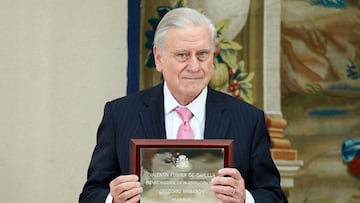

In a present that seems to spin faster than the planet itself, overloaded with stimuli and devoid of moments for oneself, the search for happiness has become essential. Eudaimonism has been a widely held stance since the dawn of time, but perhaps today it is harder than ever to put into practice, given the near impossibility of fully disconnecting. If one wants to find happiness, the first step, according to Valentín Fuster, is to make time for reflection.
These are not idle words. The 82-year-old cardiologist, internationally renowned and currently director of both the CNIC and Mount Sinai, insists that well-being is not achieved through divine methods. Instead, it comes from building a stable inner structure capable of holding you up when everything else falls apart. And to build such a wall, he says, one need only embrace a single rule: “No one achieves happiness without the four ‘Ts’: time, talent, tutoring, and transmitting positivity.”
“If you’re not clear about it, you move like a weather vane”
Valentín Fuster, cardiologist
From Fuster’s perspective, maturity grows out of a non-negotiable internal foundation that defines a person’s attitude toward any stimulus and operates through those four pillars. “If you don’t have these four ideas clear,” he says, “you move like a weather vane.” This philosophy connects directly to his medical specialty through prevention: positive psychology helps prevent heart problems. In other words, a healthy body requires a clear, focused mind that prioritizes the positive over the negative.
Fuster’s 4 Ts
To reach that essential state, he turns again to the four “Ts.” “Time” refers to the time each person devotes to reflection. “Fifteen minutes a day, I think, is the priority,” he explains. The second, “talent,” points to how one directs their life toward what they do best. “There’s nothing more important,” he adds. When it comes to “transmitting positivity,” he says it improves social relationships and, as a result, strengthens emotional balance. And of “tutoring,” which he links closely to the previous point, he stresses that it is vital for the others to work: it is the support provided by certain people who act as mentors and restore confidence in those who must carry out an action.
From this approach emerges the importance of being constantly aware of one’s own behavior and, above all, maintaining an attitude oriented toward the positive in order to attract what is best. That is, building well-being internally so it can be expressed outwardly and placed at the service of others who, in theory, should be doing the same. And in that way, the present might become a little easier to embrace.
Related stories
Get your game on! Whether you’re into NFL touchdowns, NBA buzzer-beaters, world-class soccer goals, or MLB home runs, our app has it all.
Dive into live coverage, expert insights, breaking news, exclusive videos, and more – plus, stay updated on the latest in current affairs and entertainment. Download now for all-access coverage, right at your fingertips – anytime, anywhere.
Complete your personal details to comment