


Like something out of a nightmare: the five most terrifying species of the deep sea
The deep sea is home to true horrors.
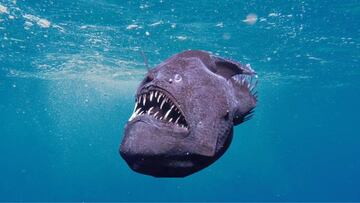
Many scientists claim that we know as little, if not less, about the depths of the sea as we do about outer space. Extreme conditions, such as extremely high pressure, low temperatures, and total absence of light—the sun does not reach depths greater than 3,280 feet—make exploring this environment more than just an adventure; it is reckless. However, there are species that have managed to adapt to this habitat, thanks to the composition of their bodies, the size of their eyes, or even the ability to generate their own light.
All these characteristics make many of them look more like something out of a horror movie than the adorable creatures we are more accustomed to. These are some of the most terrifying animals that inhabit the depths of the sea.
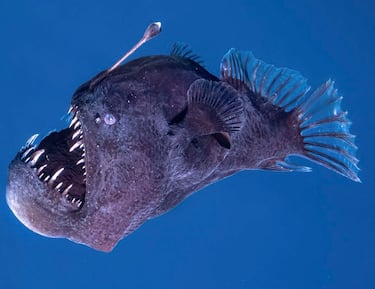
The black devil fish
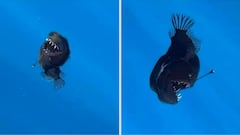
Particularly popular thanks to its appearance in the film ‘Finding Nemo’, also known as the deep-sea monkfish, it does not exactly look like a fish that anyone would want to keep in a fish tank. Completely black in color with tiny eyes, what makes it look so terrifying is a row of pointed, translucent teeth that give it the appearance of a sea monster. Interestingly, females are considerably larger than males, reaching up to 20 cm, while males can be as small as a few millimeters. In addition, females have an extension on their head with a bioluminescent light at the tip.
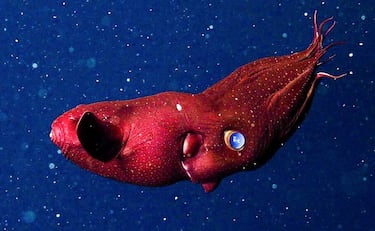
The vampire squid
Although it is not a very visually appealing species, it is not as terrifying as others we will see. In fact, it is not a squid, much less one that feeds on the blood of others. It is a distant relative of these cephalopod mollusks, but it belongs to its own order: Vampyromorphida. The “vampiric” part probably comes from its color, which can be a very dark red, similar to blood, or a very intense black. Some of its most distinctive features are the considerable size of its eyes, the membrane that connects its tentacles, and its ability to generate its own light.
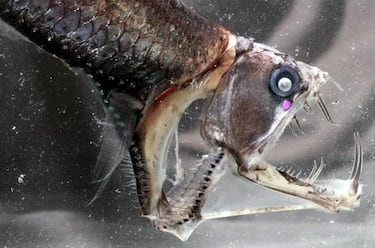
The snakefish
The snakefish could easily star in a movie, if it weren’t for its size, although it can grow to a respectable 60 centimeters. Like other deep-sea species, it has photophores to produce light, but what makes it special is its jaw. Like sharks, it is extremely versatile and has a much wider bite than it appears at first glance. Unlike many underwater species, many of which feed simply on organic waste—such as the vampire squid—the snakefish is a particularly voracious and aggressive predator.
Sea spiders
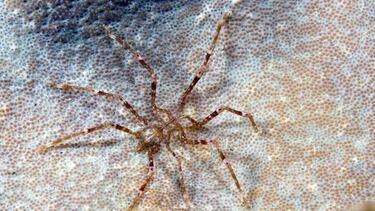
Despite their appearance and name, they are not exactly arachnids, and there are no fewer than 1,300 different species. At first glance, what is most striking is the disproportionate size of their bodies compared to their legs, which can reach up to 27 inches in length. In fact, their small size is the reason why their digestive and reproductive systems extend through their limbs. Like many underwater species, some have trunk-like appendages, although not to generate light, but to suck food from their prey.
The pelican eel
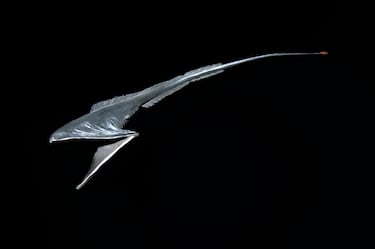
It is obvious that its name comes from the size and shape of its mouth, and like its namesakes on the surface, it can extend its lower jaw to hold a large amount of food. Its mouth can be considerably larger than its body—which can reach 1 meter in length—allowing it to capture prey even larger than itself, swallowing its prey almost whole and then digesting it inside. They can live at depths of up to 9,842 feet, but some specimens have been caught by fishermen using deep trawl nets.
Related stories
Follow MeriStation USA on X (formerly known as Twitter). Your video game and entertainment website for all the news, updates, and breaking news from the world of video games, movies, series, manga, and anime. Previews, reviews, interviews, trailers, gameplay, podcasts and more! Follow us now!
Complete your personal details to comment