

The spectacular “firefall” that appears in the United States once a year
Every February, climbers’ favorite monolith transforms into an erupting volcano.


It can barely be seen 10 days a year, and only for 10 minutes a day. That’s the window of time to witness one of nature’s most beautiful phenomena. It’s called Firefall and is located in Yosemite National Park in the United States. Specifically, it’s found on the area’s most famous rock formation, El Capitan, the monolith that stars in every climbing documentary ever made (such as 'Free Solo,' the Oscar-winning must-see film available on Disney+).
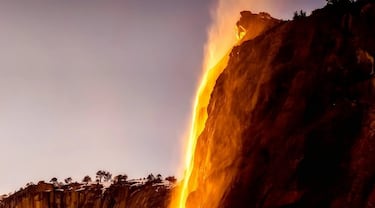
The explanation is simple. In late February, the snow that has accumulated high on the mountain melts and cascades down one of its slopes. This creates a spectacular 480-meter-high waterfall. Known as Horsetail Falls, magic happens when the sun sets over this waterfall. At sunset, if the skies are clear and the sun’s rays illuminate the waterfall, for a few brief moments its waters seem to turn to fire, and El Capitan transforms into an erupting volcano.
The man-made Firefall
According to the park’s own website, there’s a reason it’s called “the Firefall” and not “Yosemite’s Firefall.” More than 100 years ago, a similar phenomenon already existed, albeit an artificial one. In 1872, the owners of a local hotel, the Mountain House, decided to create a spectacle that involved setting off several bonfires from the edge of the cliff to watch the embers fall. From below, it looked like a cascade of bright lights and was so spectacular that for years it attracted thousands of tourists.
That spectacle was known as “Yosemite’s Firefall” and was banned in 1968 by the then-director of the U.S. National Park Service, George Hartzog. The reasons were the environmental damage caused by large crowds of tourists, the stripping of spruce bark (the favorite material for lighting bonfires), and, of course, the risk of fire. Miraculously, less than five years later, an observant photographer stumbled upon the natural version of the Firefall during one of his walks through the park.
The person in question was Galen Rowell, who stumbled upon it by chance in 1973. The photographs he took went viral and attracted many curious onlookers who refused to believe them. At first, he was even accused of having manipulated the photos to give the waterfall those red and orange hues it displayed. However, everyone who arrived was amazed by a spectacle that was even more impressive in person.
Instructions for Viewing the Firefall
Yosemite Park informs visitors that Horsetail Fall is one of the smallest waterfalls in the entire park. It plunges from a great height, but the stream from which it originates does not have the necessary flow to be impressive or visible from a distance, and it even dries up and disappears during the summer months. It is only in February that it has the necessary water flow and the sun is in the ideal position. In fact, it doesn’t even happen every year, as it is sometimes cloudy and the weather and skies don’t cooperate. There is even a live camera feed of the waterfall so people can check the area when planning their trip.
If all conditions are met, the phenomenon occurs between 5 and 15 minutes before sunset, but it’s recommended to arrive well in advance if you want to find the perfect spot to view it in all its glory and take photos. “People visit Yosemite National Park from all over the country for the natural Firefall event. That means that they are finding their spot and setting up their tripods earlier and earlier in the day to get just the angle they want. In order to navigate the parking situation and have enough time to walk out to a place where you can see the Firefall, plan to arrive in the valley in the late morning or early afternoon.” There are even instructions and tips for visitors, including a list of things to bring:
- Flashlight or headlamp (with red cellophane covers so as not to disturb others).
- Folding chairs and/or portable camping chairs with insulation for cold temperatures.
- Food and water.
- Hiking boots and a jacket for cooler temperatures after sunset.
- Photography equipment optimized for low-light conditions and telephoto lenses (over 200 mm).
- Tripods and remote controls.
- A friendly and respectful attitude.
- Do not trample the vegetation or leave trash behind.
Related stories
https://youtu.be/oyoa-QfeGho
Follow MeriStation USA on X (formerly known as Twitter). Your video game and entertainment website for all the news, updates, and breaking news from the world of video games, movies, series, manga, and anime. Previews, reviews, interviews, trailers, gameplay, podcasts and more! Follow us now!
Complete your personal details to comment