


Analysing the failed Oklahoma City Thunder project
The Harden, Westbrook, and Durant-led Thunder project went from hope to failure. Years later, the Oklahoma franchise has claimed a championship.
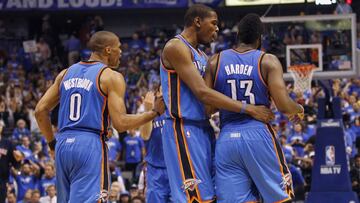
They were going to take on the world. They were meant to be the next great NBA dynasty. To dominate the skies. But each chose a different path, and now, they are under scrutiny from anyone who watches basketball.
Many years ago, Kevin Durant, Russell Westbrook, and James Harden arrived in Oklahoma City in search of greatness—drafted in 2007, 2008, and 2009, respectively, at picks No. 2, 4, and 3. It was a rebuild orchestrated by Sam Presti, a bold attempt to chase a championship.
A generational talent in Durant, arguably better than anyone in the league, paired with Westbrook, a point guard of raw, explosive power, and Harden, a scorer whose points seemed to fall from the sky. The core was surrounded by solid role players—Serge Ibaka, Kendrick Perkins, Derek Fisher—and coached by Scott Brooks. But they fell short of the one goal that defines all success in the NBA: the ring.
The Thunder slowly dissolved. The 2012 Finals may have come too soon for the young core, but that was, in hindsight, their peak. Harden lingered in Miami nightlife after a 4-1 Finals loss, the scapegoat in a story of missed opportunity. Durant and Westbrook pushed on until 2016. That year’s Western Conference Finals—up 3-1 against the Warriors—was their second and final real chance. But Game 6 happened: Klay Thompson drained ten threes, and the window slammed shut. A Game 7 loss followed, and Durant left for the very team that broke them. He won two titles in three seasons with the Warriors, the only championships any of the trio has won. And they came not with the Thunder, but with the last true NBA dynasty.
The rest of their journeys have been a sequence of missteps, disappointments, and the growing consensus that winning alongside any of these three is nearly impossible.
Kevin Durant on his time with the Thunder: "We were ahead of our time. Everything happened too quickly."
— Clemente Almanza (@CAlmanza1007) July 1, 2025
pic.twitter.com/uls8xKbK4c
All great projects hang by delicate threads. One shift in dynamic, one broken pattern, and everything can fall apart. The Thunder’s loss in the 2012 Finals was excusable due to youth. But by 2016, the failure stung more—it was no longer premature, just final. And the problem, increasingly, seemed internal. Not in the franchise, but within its stars. Each has enjoyed glittering individual careers, won awards, and filled stat sheets. Yet wherever they’ve gone, things have ended badly. For all their brilliance, they’ve struggled to translate historic numbers into cohesive, winning basketball. Except for Durant, none has managed to turn that production into titles. And over time, it has become clear: the dysfunction travels with them.
Neither at the Rockets nor at the Thunder
When Harden left Oklahoma City, it was to fulfill his destiny as one of the game’s premier scorers. And he did, at a cost. In Houston, he became a singular offensive force, won the 2018 MVP, and posted three consecutive seasons averaging 30+, 36.1, and 34 points. But he left a trail of failed partnerships—Jeremy Lin, Dwight Howard, Chris Paul, Westbrook—all of whom exited under tension, particularly Paul, with whom Harden came closest to the Finals. That moment came in 2018, Game 7 against Golden State. Paul was injured. Houston missed 27 straight threes. D’Antoni’s rigid system, obsessed with threes and paint shots, collapsed under pressure, exposing the flaws of analytics taken to the extreme.
Harden was brilliant, but flawed—an unparalleled scorer, yes, but defensively disengaged, emotionally distant, and resistant to adaptation. He was infamously out of shape to start seasons, frequented strip clubs, and rarely looked after his body. The Rockets saga ended in a trade demand. So did his brief stint in Brooklyn, where his reunion with Durant and Kyrie Irving ended in chaos. He’s now with the Clippers, sharing the court—again—with Westbrook, in their third incarnation together. After forcing his way out of Philadelphia, he’s now with his fourth team in three years. A gifted but polarizing figure, Harden’s commitment has always trailed his talent. And while he’s still effective, and always in the playoffs, the ring seems forever out of reach.
Westbrook was the last to leave Oklahoma City. After Durant’s departure, he became the face of the franchise and built a system entirely around his intensity. He won the 2017 MVP, posted triple-double seasons, and produced jaw-dropping stat lines. But the exits kept coming—early and often. With Paul George and Carmelo Anthony, the results didn’t improve. Later, he did it again in Washington. And with Harden in Houston. The pattern repeated: huge production, but little success. Personalities clashed. Chemistry faded. Results dwindled.
Westbrook is now 36. After a failed experiment with the Lakers—who struggled to move his contract—he joined the Clippers, where he’s again searching for purpose. Once a titan, he now feels like a relic. Ten years removed from the 2012 Finals, neither he nor Harden has returned. They chased glory without Durant and came up short. Accolades abound—MVPs, scoring titles, assist crowns, All-Star nods. But the missing ring casts a long shadow. And history judges harshly.
Russell Westbrook showing the Thunder some love on IG: pic.twitter.com/yBDCBpR4rr
— Clemente Almanza (@CAlmanza1007) June 24, 2025
Durant, the crown jewel—and the wildcard
Durant was the crown jewel, the smoothest scorer in modern history. He glided across the court, dropped 30-point games with ease, and made the extraordinary look casual. But his career has been shaped as much by his talent as by his temperament. His exit from OKC—abandoning Westbrook—felt like betrayal to Thunder fans. The two rings with the Warriors? Unquestionably earned, but followed by feuds, notably with Draymond Green, and another exit, this time post-Achilles tear.
He landed in Brooklyn to lead his own team but never made it past the second round. The dysfunction with Kyrie, the coach firings, the instability—it all bore Durant’s fingerprints. He never seemed content: not with the Thunder, not with the Warriors, not even with a team built entirely around his preferences. And his silence during Kyrie’s off-court controversies only added to the growing perception of aloofness.
Now nearing 36, he’s with the Suns, alongside Devin Booker and Bradley Beal, in another attempt to chase a title. But nothing has clicked, and another messy exit feels inevitable. Durant remains the most successful of the trio, but his legacy still falls short of the legends he once aimed to surpass. It’s a case of brilliance overshadowed by restlessness.
The lost legacy
Together, the original Thunder trio amassed staggering numbers: 34 All-Star selections, three MVPs, eight scoring titles, four assist titles, over 70,000 points, 15,000 rebounds, 15,000 assists, 279 triple-doubles, nearly 3,000 games, and close to a billion dollars in contracts. They brought two titles—both from Durant—but also left behind fractured relationships, poor leadership reputations, and a legacy defined more by what could’ve been than by what was.
Now, as they fade from contention, they remain active, still chasing that elusive ring. But public opinion—the true battleground where reputations are made—has already passed judgment. Kevin Durant, James Harden, and Russell Westbrook have lost that war. And how.
Russell Westbrook.
— THUNDER MANIA 🏆 (@ThunderManiaBR) July 5, 2025
James Harden.
Serge Ibaka.
Shaun Livingston.
Simplesmente o Oklahoma City Thunder da Summer League de 2009. 🤯🤯🤯 pic.twitter.com/wIXQUDSHjI
A new Thunder storm rolls in
Years later, the Thunder have reemerged. After enduring cold seasons and losing streaks, Sam Presti collected draft picks like a doomsday prepper, and it paid off. Following 22 and 24-win seasons, they cracked the play-in, found a spark, and then exploded. They won 56 games last season—16 more than the year before, and 32 more than two years prior. It was their first winning record since Westbrook left. They finished atop the Western Conference for the first time since 2012–13. This year, they’ve repeated—with 68 wins. And they’re in the Finals.
Back in 2011–12 and 2013–14, they finished second. In 2015–16, third. This is their first podium finish since the peak of the original trio. And they did it with the youngest roster in the league last season (23.2 years), tied with San Antonio. The difference? The Spurs finished last. OKC finished first. Just like in the Durant days. This year, they’re still the seventh-youngest team, with the league’s third-best defense and an offense averaging over 120 points per game.
Chet Holmgren, after missing last season, has arrived as a rookie unicorn: 17.1 points, 7.7 rebounds, 2.6 blocks, court-altering presence on defense, and a versatile weapon on offense. Around him: Jalen Williams and Luguentz Dort bring speed and physicality. At the helm is coach Mark Daigneault, in his fourth season, now reaping the rewards of his patience and development.
But the beating heart of the team is Shai Gilgeous-Alexander, the reigning MVP—joining Durant and Westbrook as the only Thunder players to win it. Shai edged out Nikola Jokić behind averages of 32.7 points, 5 rebounds, and 6.4 assists, shooting 52% from the field, 38% from three, and 89% from the line. Harden-like in his ability to draw fouls, but far more efficient. He’s the new face of the franchise. It’s no longer Durant or Westbrook’s team. It’s Shai’s.
SGA wins the @ESPYS Best Male Athlete and NBA Player of the Year awards 🏆 pic.twitter.com/7uXMb7K1IZ
— OKC THUNDER (@okcthunder) July 17, 2025
Related stories

Now, four wins from their first-ever championship, the Thunder have returned. Not with noise or drama. But with discipline, youth, and talent. After years of wandering the desert, they’ve found their oasis. And the ring that eluded their past might finally belong to their future.
Get your game on! Whether you’re into NFL touchdowns, NBA buzzer-beaters, world-class soccer goals, or MLB home runs, our app has it all. Dive into live coverage, expert insights, breaking news, exclusive videos, and more – plus, stay updated on the latest in current affairs and entertainment. Download now for all-access coverage, right at your fingertips – anytime, anywhere.
Complete your personal details to comment