


Lebron James: the star collector
Saying that the King has won because he has been surrounded by the best is like saying that the best have only won with the King.
On July 8, 2010, in an infamous broadcast managed by journalist Jim Gray and orchestrated by LeBron James' entourage, a still-uncrowned King announced in prime time that he was trading Cleveland’s challenge for the sunny beaches of Florida.
That day, the legendary basketball player pioneered the creation of a player-driven project, marking the beginning of the era of empowered athletes. But that famous The Decision—the television special in which the news was revealed—also had severe consequences for its protagonist.
LeBron became the most hated athlete on the planet and embarked on a brutal personal struggle that didn’t end until he secured the 2016 championship. That struggle had actually begun long before. The destruction preceding his redemption made the decision feel like nothing less than a betrayal, and his figure was greatly affected by the backlash, enduring boos wherever he went—especially on his return to Cleveland, where the pain of his departure was felt most intensely.
LeBron James been in the league so long that my man recorded prime Stone Cold Steve Austin with a FLIP PHONE. pic.twitter.com/UU9DLGOTIC
— 90s WWE (@90sWWE) February 23, 2025
Arguably, LeBron’s greatest achievement is how he managed to turn public opinion around, transforming from one of the most despised figures into one of the most beloved. Many sports and personal challenges shaped him into the icon he is today.
His 2011 Finals defeat marked his biggest setback, but it was later overshadowed by a triumphant Game 6 against the Celtics in the 2012 Eastern Conference Finals. With the series tied at 2-2, LeBron stepped up with 45 points, 15 rebounds, and 5 assists, propelling his team to the Finals and, eventually, his first championship. Since then, he has earned 10 Finals appearances (8 consecutive) and 4 championships. His rivalry with the Warriors, particularly their record-setting 73-win season and the 3-1 playoff lead they held before LeBron orchestrated an unforgettable comeback, further cemented his legacy. By 2023, playing for the Lakers, LeBron had already outlasted the Warriors' dynasty, leaving only remnants of his former rivals.
Despite his overwhelming success and near-consensus as one of the greatest players in history—arguably surpassing Michael Jordan—there will always be a small faction of critics who attempt to diminish his achievements. One of their primary arguments is that LeBron has only succeeded because he’s played on great teams alongside other stars.
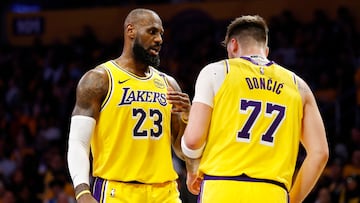
This critique traces back to the formation of his first “superteam” in Miami, with Dwyane Wade and Chris Bosh. This concept of the “Big Three” reshaped the league, though it has been poorly executed by many teams since, with LeBron’s teams being the notable exception. The argument is often recycled, especially now that the Lakers have signed Luka Dončić, one of the biggest and most incredible transfers in NBA history. Sure, LeBron has played alongside stars, but what does that diminish about his vast legacy?
The question of whether LeBron has only thrived because of his teammates isn’t simple. Yes, many notable players have played alongside him, but how do we define a “star”? Does it depend on a player’s entire career, or just their peak moments?
LEBRON JAMES GAME WINNER. 🔥🔥🔥 pic.twitter.com/NpMrzD86Iv
— NBACentel (@TheNBACentel) December 7, 2024
There’s no doubt that Wade and Bosh were in their primes during their time in Miami. Similarly, Kyrie Irving and Kevin Love were vital to the Cavs’ success, though Love’s impact was less pronounced. However, there are more nuanced cases—players like Žydrūnas Ilgauskas, who was a loyal companion early in LeBron’s career and made two All-Star appearances, or Ben Wallace and Shaquille O’Neal, who joined later in their careers. Then there’s Ray Allen, a veteran who helped secure a championship in Miami. But how do we categorize them?
Ultimately, it’s all a matter of perspective. None of the Cavs rosters from LeBron’s second stint were superior to the Warriors' teams, particularly the 2016 squad. In fact, the Cavs' defeat to the Warriors led to Golden State acquiring Kevin Durant, which formed one of the greatest teams in NBA history. LeBron’s arrival in Los Angeles saw him win another championship in 2020 alongside another star, Anthony Davis.
But most of LeBron’s rosters have featured two stars, and by 2020, LeBron’s veteran status was well established, despite the wear and tear of his career. Yet, even as other great players teamed up with one another, the coveted championship ring remained elusive for LeBron since 2020—until now. With Doncic now joining the Lakers, fresh horizons open up. Yes, Luka is another star, but so what?
In the end, arguing that LeBron has won because of his teammates is akin to saying that the best have only won because of him. Doncic is undoubtedly a jewel in LeBron’s illustrious career, but it’s not just about playing with stars—it’s about being the star others want to play with. Many great players have sought to join LeBron over the years, a testament to his ability to manage the narrative and build his legend.
His longevity is his final argument against critics who remain, and his continued dominance makes him an ever-present figure in the debate about the greatest player of all time. Ultimately, such discussions depend on the collective opinions of the majority, which shows the power of the people. LeBron’s journey from villain to hero—something virtually impossible in the world of sports media—reminds us why he is truly the King.
To dismiss the historical importance of other great players and claim they “played alone” is an oversimplification that ignores the legendary teams they were part of. Just as Michael Jordan had a dynasty of legendary teammates like Scottie Pippen, Dennis Rodman, and Toni Kukoc, LeBron has had his share of greats.
While some might point out his 6 losses in 10 Finals appearances, they often overlook the fact that Jordan never faced the type of opponents LeBron did—such as the final Spurs teams or the Warriors dynasty—or that Jordan never came back from a 3-1 deficit to win a Finals. Every argument can be made to serve an agenda, and all opinions hold weight in a world where perspectives differ. The truth is, every all-time great had incredible teammates and played on legendary teams. Whether it was Magic Johnson, Larry Bird, or Bill Russell, no one won titles alone. Even Wilt Chamberlain and Jerry West, despite their immense talent, struggled to win championships. Elgin Baylor never did.
LEBRON JAMES. POSTER. pic.twitter.com/V827iiohwo
— Los Angeles Lakers (@Lakers) November 22, 2024
One can focus on the few shortcomings of LeBron’s career to undermine him, or highlight his many successes to align with his greatness. In a world full of nuanced opinions, the truth is simple: LeBron has played alongside stars, and so have many other greats before him. But his legend was also shaped by those teammates, and his legacy continues to be built with every passing season. As he embraces his latest chapter alongside Luka Dončić, it’s clear: LeBron James is not just a star—he is the star, forever and always.
Related stories


Get your game on! Whether you’re into NFL touchdowns, NBA buzzer-beaters, world-class soccer goals, or MLB home runs, our app has it all.
Dive into live coverage, expert insights, breaking news, exclusive videos, and more – plus, stay updated on the latest in current affairs and entertainment. Download now for all-access coverage, right at your fingertips – anytime, anywhere.
Complete your personal details to comment