


Lakers ideas dry up as Doncic deadline creeps closer
The first ten days of the market have been a disappointment for those expecting major moves in a team with little activity.
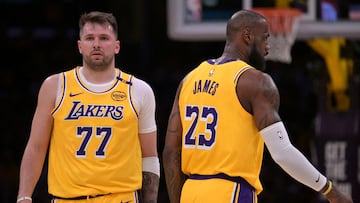
It’s not July 1st anymore. The NBA market is still active—major moves could still happen, and any judgments now are inevitably incomplete. We’ll see. But again, it’s not July 1st, and many things (read: teams) will look very similar when the next regular season begins. Are the Lakers one of them? Who knows.
There’s still potential for a bombshell involving LeBron James. As has often been the case during his L.A. tenure, a flurry of rumors and movement is followed by stretches of absolute calm. The main issue remains: LeBron still wants to chase a fifth ring—but he wasn’t willing to give up his $52.6 million player option. So, he picked it up, locking in his salary for next season—his 23rd in the league—and, through his longtime agent and confidant Rich Paul, announced that he’d be monitoring the situation. What would the Lakers do? What did the landscape look like for an all-in push in 2025–26?
So far, the answer is: not much. The Lakers have made only a handful of moves and now have few viable options left, short of a trade—likely for a defensive forward, a glaring need. If nothing more happens, we’ll see whether LeBron really forces the issue. That would mean figuring out which contender would be willing—and able—to take on a 41-year-old superstar earning over $52 million in what could be his final season. That includes the weight of leaving L.A., with all its significance for his personal life and business interests, and walking away from playing alongside Bronny—unless, of course, Bronny is included in a hypothetical trade.
What LeBron has likely realized—perhaps for the first time in his illustrious career (the greatest ever? second?)—is that he’s no longer the franchise’s strategic centerpiece. This is now Luka Doncic’s team. And the rest of the league is watching not just what the Lakers do, but what they fail to do.
Welcome home, Deandre and Jake 💜 pic.twitter.com/V2U56EnrFX
— Los Angeles Lakers (@Lakers) July 9, 2025
August 2 is a key date: it’s the deadline for Doncic to sign his extension with the Lakers. He’s expected to do it—there are multiple paths for the contract, which we break down in this article—but what if he doesn’t? The pressure would skyrocket. Doncic could become a free agent in the summer of 2026. Logic suggests a deal will get done in the coming weeks, with open lines of communication between both parties. Because if not, the Lakers would be asking a lot of patience from a player who went from paradise (an NBA Finals run, MVP buzz) to purgatory last season—injuries, a mid-season trade, missing the All-Star Game and All-NBA teams. At 26, with a near-title run just 18 months ago, a slow rebuild could be a tough pill to swallow. But it might be the only realistic plan if, as seems clear, he wants to establish roots in L.A.—something he never got to do in Dallas.
So far, the Lakers have lost Dorian Finney-Smith—a valuable 3-and-D veteran, close friend of Doncic, and someone they gave up three second-rounders for last winter. In return, they’ve added Deandre Ayton, Jack LaRavia, and rookie Adou Thiero. And that’s it. Not exactly a summer of aggressive ambition—especially after a brutal 1–4 playoff exit to the Timberwolves that cut short any late-season dreams of a deep run.
Right after the Doncic trade, the Lakers briefly pursued Mark Williams, the Hornets’ center who seemed like an ideal fit: a lob target, rim protector, and vertical spacer for Doncic. But the cost was too high—most of their remaining assets—and Williams’ injury history didn’t help. They inquired about Nic Claxton, Onyeka Okongwu, and made several calls on Walker Kessler. All solid but flawed options. When nothing fit, Ayton emerged.
Ayton is a gamble. Once a No. 1 pick (ahead of Doncic, ironically), his career has been disappointing—but he still has talent. Theoretically, his game meshes well with Luka’s. At the very least, he seems excited: “It’s like a video game,” he said. “Luka is one of those once-in-a-generation guys. It’s huge for me to play with him. I’ve heard he’s in great shape. I want to be next to him—not in front of him.”
Ayton and LaRavia were brought in with the mid-level exception (~$14.1M), space freed up by Finney-Smith’s departure. Viewed purely as a two-for-one exchange, it’s not terrible—but it doesn’t shift the Lakers’ ceiling. Thiero, picked 36th, has long-term defensive potential but is unlikely to matter right away.
The rest? Nothing. Al Horford was floated as a veteran Plan B big—smart, skilled, playoff-tested—but he’s more likely headed to Golden State or Denver, especially if Jonas Valanciunas takes the Greek route. De’Anthony Melton was another rumored target—great defense, limited offense, injury-prone—and he also seems bound for the Warriors.
Lots of chatter. Very little action.
Nothing like a comeback win 😮💨 pic.twitter.com/nMspRJTGv6
— Los Angeles Lakers (@Lakers) July 9, 2025
Even Jaxson Hayes is back, despite being so ineffective that L.A. essentially went centerless in the playoffs rather than play him. He’ll earn just above the minimum—likely only re-signed because he waived his no-trade clause, making his $3.4M salary tradable filler.
So, where does that leave the Lakers?
They haven’t made the leap forward you’d expect from a team with Luka Doncic and LeBron James. Instead, they’ve leaked that their real priority is financial flexibility for 2027—when Giannis Antetokounmpo or Nikola Jokic might hit the market. That’s years away, and a lot must happen first—starting with Doncic committing long-term.
With limited cap space, trades are the only real path forward. They still have their 2031 first-round pick, a few more tradable assets, some young talent (Dalton Knecht), and expiring contracts like Rui Hachimura, Gabe Vincent, and Maxi Kleber. Austin Reaves’ future is also unclear—he’s headed for restricted free agency in 2026 and may command a tough-to-match offer.
All that said, the Lakers did finish third in the West last season. Between the Doncic trade and the regular season finale, there were stretches where they looked like one of the best teams in the conference. Doncic will have a full offseason, and early reports suggest he’s getting into top shape. LeBron, barring surprises, is still capable of All-NBA-level play. Reaves was excellent alongside Luka and LeBron until a toe injury derailed him. Hachimura is solid, Ayton could be serviceable, and Knecht and LaRavia might surprise.
But that’s for the regular season. This moment is about vision, planning, and commitment—and unless a surprise move is in the works, the Lakers’ offseason so far has been underwhelming. Perhaps they’re caught between the contradictions of Luka’s prime and LeBron’s twilight—a tough balance of short-term urgency and long-term planning. Perhaps they’re waiting to see what opportunities arise midseason. Perhaps they really are all-in on 2027.
Whatever the reason, right now the Lakers are doing more math than winning. Patience may be the smart play—but it’s also a dangerous one in a league where windows close fast.
And yes, if Luka returns to form—his best form—anything is possible. But it would be a lot more possible with a defensive-minded guard, and a pair of forwards who can switch, run, and shoot. That’s what every contender wants. Getting it takes bold, creative management.
NBA Cup Groups are official, let's go 👏 pic.twitter.com/zDgrKNZ3Dm
— Los Angeles Lakers (@Lakers) July 9, 2025
Related stories

The new owner, who’s expected to modernize the Lakers’ front office and spend big, is surely taking notes.
Get your game on! Whether you’re into NFL touchdowns, NBA buzzer-beaters, world-class soccer goals, or MLB home runs, our app has it all. Dive into live coverage, expert insights, breaking news, exclusive videos, and more – plus, stay updated on the latest in current affairs and entertainment. Download now for all-access coverage, right at your fingertips – anytime, anywhere.
Complete your personal details to comment