


Carlos Alcaraz: “You have to see the mountains even if nobody else understands you”
The Spaniard speaks to AS after being crowned champion for the first time in Australia, completing his career Grand Slam aged 22.
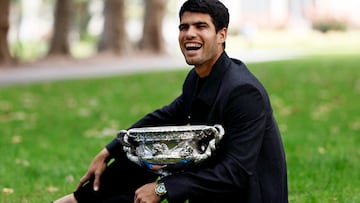
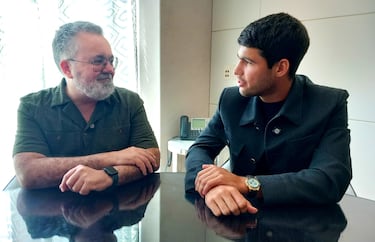
Dressed in a retro, elegant yet effortlessly cool black outfit straight out of the 1970s, Carlos Alcaraz strolls through the gardens next to the Royal Exhibition Building, beside Melbourne Museum, just minutes from downtown. Running on little sleep – understandable after winning the only Grand Slam missing from his résumé, the Australian Open – the 22-year-old from Murcia cradles the Norman Brookes Challenge Cup in his arms as a crowd of photographers, TV crews and fans trails behind him. After answering a handful of questions, he hops into a tournament car bound for the Crown Hotel, where he has been staying, to speak one by one, exclusively, with the media who have traveled to the antipodes, including AS. Rafael Nadal had been sleeping in the same hotel in recent days (the Mallorcan later greeted reporters in one of the lobbies), and by chance the conversation begins with him.
“We’re successful to the point of punishment, Carlos.” “Yes. When I see tweets like… damn! Wow! People! Nadal retires and suddenly this guy shows up… And they say we’re unbearable. They must hate us (Spaniards), right?” he jokes. And so the interview begins...
For you, is what starts now with this title a new chapter, or simply a continuation?
“I feel it’s a continuation. I’m obviously thrilled about this title, for everything it means – completing all four, being the youngest – but above all because of how I’ve seen myself improve over these weeks, and coming off last season too. I think I’ve taken a step forward mentally, in mental strength, and that’s what I really like: seeing myself in this position. That’s why I say it’s continuity, because from here I believe I’ll keep moving forward."
“I was incredibly happy, because I know Samuel has been working toward this moment his entire life.”
Best coach prize
The image of Samuel López lifting his own “trophy” was beautiful. What did you feel when you saw him come out and raise that tray?
"The tournament does that very well. I didn’t know – it was my first time at a trophy ceremony in Australia, and I didn’t know they did that. I think it’s a great initiative, because it recognizes the champion’s coach; it’s not just the player’s work. It’s very special, and when I saw him there I was incredibly happy, because I know Samuel has been working toward this moment his entire life. For me he’s one of the best coaches – if not the best – you can have in tennis today. Hugging him after the last point, and then seeing him there with everyone recognizing what he deserves, was magical and super special."
Does it get tiring always having to prove that the decisions you make are the right ones – with the documentary, the changes, and so on?
"I don’t think I have to prove anything to anyone, even when I do things people might not agree with. Take the documentary: there was a lot of talk about how it wasn’t professional, about me enjoying myself, going out. But one thing doesn’t cancel out the other. In the end, you don’t need to show the obvious. The obvious is that to be world No. 1, to win seven Grand Slams, to be where I am, you need work, discipline, showing up every day. That should be taken for granted: I work incredibly hard every single day to be here. I try not to think about what people say. I play for myself, for my family, for my team. What I love is being on a tennis court, making people enjoy themselves and enjoying myself too. That’s the main thing."
After last year’s stumble in Miami – losing early to David Goffin – your run has been incredible: just five losses (63–5), almost all finals, eight titles. How important was that break, going on vacation to Mexico with your family?
“Yes. Everyone is different, every player is different; everyone knows what they need, what they do well and what they don’t. As time goes by, I get to know myself better. At that moment, I needed to stop. Once again, when I said I was taking a week off without touching a racket, people jumped on me: ‘How can you not go back to training?’ But mentally, being fresh is far more important for me so I can perform better later on court. As I said in the documentary A mi manera, I want to do things my way, even if people don’t agree. And now with the whole penguin thing – being the penguin, seeing the mountains even if no one else understands you – I think it’s a really beautiful metaphor."
“As time goes by, I get to know myself better.”
Decisions
You make good decisions off the court, and on it too. In the final, after that first set with Djokovic playing imperiously, where does that reaction come from? How do you flip the switch?
“I’ve got a pretty wide repertoire of things I can do, and that’s both good and bad. It’s good because when plan A doesn’t work and I’m getting overwhelmed, I can do other things and change the dynamic. It’s bad because sometimes my head thinks of seven different things in less than a second and I have to choose one – and often I choose the wrong one. But it’s a good problem to have. That’s where my team comes in, calming me down from the outside, telling me that level won’t last forever, that I have to stay mentally strong and tweak a couple of things they can see better. In that moment, I realized how much I’ve improved mentally.”
Rafa was in the stands yesterday. Early in your career you were constantly compared to him, but you always said: “I’m Carlos.” Do you feel that’s been achieved now?
“Yes, I think so. I don’t see as many comparisons as before. But with what we’re achieving, now they compare me not just to Rafa but to the Big Three – which I don’t know if that’s worse (he laughs). Comparisons will always be there when you’re young; probably until you’re 26 or 27. But I think it’s been achieved that I’m myself, going my own way, writing my own story. It’s really nice that the focus is now on my own path.”
if this penguin doesn't penetrate your psyche so deeply that you are compelled to finally drop everything & chase your dreams.
— oscay (@oscaytrades) January 23, 2026
then you're doomed forever bro. pic.twitter.com/RoErFNmyGT
Still, it’s striking to match the numbers of historic names like John McEnroe, isn’t it?
“Absolutely. In tennis it’s very hard to stop and realize what you’re achieving. But last night, looking at messages and social media, I saw that I’d tied John McEnroe’s number of Grand Slams. And it was like… okay, this is huge. Matching someone like McEnroe is a big deal. It’s crazy and wonderful to be there, with my name next to his – someone I admire and respect enormously.”
You’ve now checked off the Australian Open. If you had to pick a specific goal right now, what would it be?
“Just one? Well… or several.Grand Slams are always there. The ATP Finals and the Davis Cup are the main ones. And the Olympics? But we’re talking about this year, right? Well then, the Olympics too, Davis Cup, Finals – and that’s about it."
One last curiosity: what was your tournament soundtrack? Before the final you were dancing… what were you listening to?
“It depended on the mood (he pulls out his phone to check his playlists). Before matches I’d put on some Bad Bunny or Don Omar. Then a bit of techno house, good-vibe stuff. For example, It Goes Like (Na-Na-Na) by Peggy – I played that a lot; it gave me good energy and kept me active. Then I’d just put on Spotify radio and whatever similar tracks came up."
“Now they compare me not just to Rafa but to the Big Three – which I don’t know if that’s worse.”
Comparisons
Finally: Djokovic’s words about you yesterday were incredibly classy. He said you’re a great player with the full package, but emphasized that you’re a very good person and come from a wonderful family. What does that mean to you?
“That’s what really makes me happy and fills me with pride. For someone like Novak – not just the athlete he is, but also a wonderful person – to say that…He’s dealt with millions of people and knows how to handle all kinds of personalities. He has a great eye. For him to say that about you and your family is what I take with me, what really matters. That’s my family’s style, the values they’ve instilled in me and my brothers. I always say that at the end of the day, you’re a person first; the athlete comes second. And what people remember is how you treat them. That’s what’s important."
Related stories
Get your game on! Whether you’re into NFL touchdowns, NBA buzzer-beaters, world-class soccer goals, or MLB home runs, our app has it all.
Dive into live coverage, expert insights, breaking news, exclusive videos, and more – plus, stay updated on the latest in current affairs and entertainment. Download now for all-access coverage, right at your fingertips – anytime, anywhere.
Complete your personal details to comment