


Soccer rocked by Trump’s tariff war: “It will affect how much we can invest in our teams”
Following the measures announced by the US president, we look at how football will be affected.
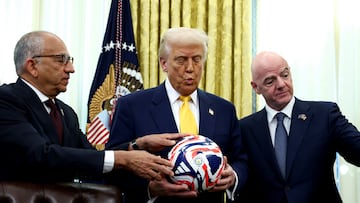
Donald Trump has triggered what appears to be a paradigm shift in international trade. His sweeping tariffs on imported goods—one of the defining policies at the start of his second term—are sending shockwaves through businesses worldwide. No sector is spared, not even football. The measure, set to take effect on April 5th with a base tax rate of 10%, will vary by country or regional bloc, including the European Union.
“They charge us, we charge them. How can anyone get upset?” Trump defended his policy while brandishing a large board featuring the U.S. presidential seal and a list of countries, each flanked by two columns. In blue: the tariffs and taxes those nations impose on American goods. In yellow: Trump’s retaliatory measures, detailing new taxes on their exports.
The list begins with China, his primary rival in this trade war, followed by the European Union (with a 20% tariff), and a wide array of smaller Asian economies with strong textile industries, such as Vietnam and Taiwan. In total, up to 60 countries are being penalized—nations Trump accuses of “decades of trade abuse” against the U.S. On April 9th, just days after the base tariff takes effect, the country-specific rates will be implemented.
To understand what these protectionist policies could mean for sports, AS spoke with industry analysts and stakeholders—players, clubs, agencies, and companies—about the potential fallout.
Trump provides an update on his recent tariffs pic.twitter.com/vsX224eBWf
— Saturday Night Live - SNL (@nbcsnl) April 6, 2025
‘Tariffs could lead to Europhobia or Americanophobia’
José Bonal, professor of Global Sport Management at the European University, believes these tariffs may spark a broader backlash. “Europe will likely retaliate, and we’ll see markets becoming increasingly local. This could lead to a kind of ‘Europhobia’ or ‘Americanophobia,’ where certain brands are rejected for ideological reasons,” he explains. “In the short term, economic effects may be limited, but medium-term identity issues could emerge. If the U.S. public begins to feel that ‘Europe doesn’t want us,’ global brands may favour Asian or North American partners over European ones.”
The reverse could also be true, Bonal warns, with European clubs hesitant to work with partners from a country enacting measures that harm their local economies. “There will be two opposing camps—brands will choose sides. Trump polarizes opinions, and this will spill into brand positioning.”
As an example, Bonal cites the 13% dip in Tesla sales and attacks on its vehicles after Elon Musk began visibly aligning himself with Trump. Still, he doesn’t foresee major sponsorships, like those involving Real Madrid or FC Barcelona, being in immediate danger. “Barça’s markets in the U.S. and Asia are too important. It’s all about numbers. Yes, there will be an impact, but it might not be a drastic one,” he concludes.
‘Tariffs on steel and aluminium could drive up expenses for new stadiums’
Revenue and reputation aren’t the only areas under threat. Infrastructure could also take a hit. Gabriel San Miguel, Director of Science and Wellbeing at beBartlet, points to potential cost surges. “Tariffs on steel and aluminium could drive up expenses for new stadiums or renovation projects, which might delay timelines or stretch budgets,” he warns.
This is particularly relevant with the 2026 World Cup and 2028 Olympics on the horizon in the U.S. In Spain, Camp Nou and Nou Mestalla are both undergoing major renovations.
Valencia CF, however, is ahead of the curve. As AS exclusively reported, the club is accelerating purchases—especially plastic, which is likely to rise in price due to energy costs—for its 70,000 new stadium seats. Most critical construction materials, including steel, were already procured. Sources close to the project confirm that orders are “primarily European” and none originate from the U.S., thus shielding the club from Trump’s trade war.
Deportivo already feeling the pinch
In contrast, Deportivo de La Coruña is already taking a hit. Paulo Dinis, the club’s director of strategy, revenue, and control, described March as “a disaster” due to losses on investments the club had made using surplus cash. “We were seeing steady returns, but March saw us dip nearly 1% into the red. Fortunately, we’re a financially healthy club, but we felt the sting,” he said.
The club’s Sports City project is also at risk. Construction suppliers are requesting inflation clauses and budget cushions due to skyrocketing material prices. “Uncertainty is already creeping in,” Dinis noted, especially in the context of CVC’s investment plan and planned improvements ahead of the 2030 World Cup.
Perhaps most concerning is the potential long-term impact on TV rights. “A big chunk of our income from broadcast rights comes from the U.S. If Trump is still around when contracts are renegotiated, it’s unclear how this will play out,” Dinis warns.
Soccer jersey prices likely to rise
Global giants Nike and Adidas, whose factories are heavily concentrated in Asia, have already seen their stocks tumble. Vietnam, hit with a 46% tariff, is a key hub. Nike’s stock fell 11% and Adidas lost 9% following Trump’s announcement, with Nike estimating $12 billion in market losses.
Spanish companies tied to U.S. sponsorship deals are keeping quiet, preferring to wait and watch. According to AS, most are bracing for medium-term effects rather than immediate shocks. LaLiga and its clubs have yet to take concrete action but share the general sense of unease.
Interestingly, this situation could pave the way for a resurgence of local brands in Europe—if the economics make sense.
Clubs are also weighing how rising production costs could affect fans. “Jerseys might get more expensive,” Dinis admitted. “If suppliers raise prices, we might need to renegotiate deals or pass those costs to fans. That’s not ideal, but it’s possible. And ultimately, it could shrink our profit margins and affect how much we can invest in our squads.”
Fans may pay the price of Trump’s tariffs
While clubs are still assessing the full scope of these tariffs, internal sources at other LaLiga teams note that rising prices in the supply chain could be passed on to consumers. Jerseys, equipment, and official merchandise may all become more expensive, depending on how much of the financial burden clubs and manufacturers are willing to absorb.
This cautious approach doesn’t mean indifference. According to a Cluster17 survey, 70% of Spaniards are concerned about the potential impact of U.S. tariffs on national companies. Some sports businesses have already put U.S. expansion plans on hold in response.
Unlike clubs, FIFA and UEFA are mostly shielded. FIFA, in particular, enjoys a strong relationship with Trump, with President Gianni Infantino attending Trump’s inauguration and part of the federation’s operations now based in Florida. With the 2026 World Cup co-hosted by the U.S., Canada, and Mexico, FIFA feels confident any issues can be resolved.
UEFA’s only major link to the U.S. is the sale of its broadcast rights, managed by Relevent, a U.S.-based intermediary. No direct dealings mean minimal exposure—for now.
‘We haven’t seen this kind of volatility since World War II’
Player agents and representation firms are keeping a close eye on developments. “It’s not just a sports issue—it’s global trade,” one agency source said. “We haven’t seen this kind of volatility since World War II.”
Still, the consensus is that major athletes won’t suffer. “The big stars will keep earning. If one brand pulls out, another will step in,” they noted. The greater risk lies with mid-tier professionals—those who already saw sponsorships decline during the COVID-19 pandemic.
TO OUR TRADING PARTNERS AROUND THE GLOBE — California is here and ready to talk.
— Gavin Newsom (@GavinNewsom) April 4, 2025
We will not sit idly by during Trump’s tariff war.
We make up 14% of the US GDP. We're the 5th largest economy in the world.
We’re not scared to use our market power to fight back against the… pic.twitter.com/yTfbcWW1sO
Related stories

In every corner of the football world—and across other sports too—uncertainty reigns. Trump sees his tariffs as a bold counterattack. For everyone else, it’s time to regroup, control the ball, and look for the next play. The opening minutes of this game call for defence. What happens next is still up in the air.
Get your game on! Whether you’re into NFL touchdowns, NBA buzzer-beaters, world-class soccer goals, or MLB home runs, our app has it all. Dive into live coverage, expert insights, breaking news, exclusive videos, and more – plus, stay updated on the latest in current affairs and entertainment. Download now for all-access coverage, right at your fingertips – anytime, anywhere.
Complete your personal details to comment