


The Premier League bubble that is always about to burst... and the U.S. comparison
English soccer’s financial boom keeps accelerating, but beneath the surface, warning signs are beginning to emerge.

“The Premier League will burst at some point, somehow” is a familiar refrain. A well-worn line, especially when comparing English soccer to its Spanish counterpart. Yet the reality is that the billions upon billions spent – particularly on transfers – by Premier League clubs show no sign of slowing. Quite the opposite: they continue to rise. Just look at the $4.36 billion (€4 billion) spent by English clubs on signings across the 2025–26 summer and winter windows.
More than 400 arrivals – a scale only a league as financially powerful as the Premier League can sustain. Deals such as Alexander Isak ($163 million), Florian Wirtz ($148 million), or Hugo Ekitiké ($104 million) far exceed what clubs in Spain’s LaLiga can realistically contemplate. And if no one has yet managed to prick the so-called bubble of English soccer – despite seasons of record spending and mounting losses – there must be a reason.

As we at AS reported months ago, the English league is not competing with Spain, Germany, or Italy. Not even with the Champions League. The real rivals, in revenue terms, are the NFL, NBA, and MLB. While no global league matches the NFL in broadcasting income, the Premier League remains the top-earning soccer competition in media rights worldwide.
The league generated between $9.8 billion and $10.9 billion in revenue during the 2024–25 season – nearly double that of many of Europe’s major leagues. Only American football, basketball, and baseball surpass it. This imbalance has been building for years. According to KPMG Football Benchmark, the Premier League earned around $3.83 billion (€3.52 billion) in broadcasting rights in 2022, compared to $2.23 billion for LaLiga and $1.59 billion for the Bundesliga.
Back in 2014–15, twelve seasons ago, English clubs surpassed $1 billion in transfer spending for the first time. Only the COVID-19 pandemic briefly slowed that exponential rise, and even then, spending still reached $3.6 billion (€3.31 billion) between 2020 and 2022. Such enormous TV revenues underpin the ability to sign the world’s best players for eye-watering fees and salaries.

Some of those stars are also major contributors to the UK economy. The Sunday Times tax list shows that Erling Haaland and Mohamed Salah rank among the top 100 taxpayers in the country. The Norwegian striker sits 72nd, paying $21.3 million (£16.9 million) annually, while the Egyptian forward ranks 81st with $18.2 million (£14.5 million) in yearly taxes.
Revealed: Premier League clubs including Arsenal and Manchester United were told this week that it could generate an extra £750m in annual commercial revenue by expanding its roster of commercial partners and centralising perimeter advertising sales. https://t.co/vppVCFGjAZ
— Mark Kleinman (@MarkKleinmanSky) February 13, 2026
Still, the financial machine may have more fuel yet. Sky Sports reported weeks ago that the Premier League could increase annual revenue by $945 million (£750 million) by centralizing perimeter advertising sales and expanding its roster of top-tier commercial partners. That would represent a major injection of funds, further strengthening clubs and widening the gap in the global market.
Although no firm plans have been approved – and such a move would represent a shift toward a more “Americanized” commercial structure – the league already boasts major partners including Barclays, Microsoft, EA, and Guinness, alongside licensing agreements with companies such as Topps, Football Manager, and Sorare.
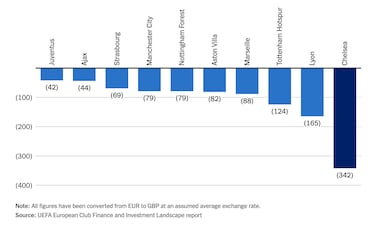
Even so, the Premier League’s boom is a double-edged sword. Growth brings risks. UEFA’s recentEuropean Club Finance and Investment Landscapereport revealed that, among the ten clubs with the highest losses in 2024–25, five were English: Chelsea – by far the worst – along with Tottenham, Aston Villa, Nottingham Forest, and Manchester City. Chelsea alone recorded losses of $444 million (€407 million) last season. Even Arsenal and Liverpool, despite posting record revenues ($858 million and $873 million respectively), only managed marginal profits.
“The English system will generate more inflation”
Javier Tebas, LaLiga president
Javier Tebas has repeatedly sounded the alarm. Speaking at the Financial Times’ Business Football Summit in London last February, the LaLiga president warned: “The English system, with 85% more transfers, will generate more inflation. For sure. It’s madness.” He argued that current financial regulations in England risk inflating the market artificially, as they fail to properly account for spending. “Transfers and market values create a false expectation,” he said, adding that many operations lack “economic rationality.”
Tebas has also acknowledged, however, that even with stricter financial rules, the Premier League will always have roughly double the spending power of other leagues. And while ongoing investigations into Manchester City and Chelsea – along with sanctions imposed on Everton and Nottingham Forest, plus others involving Sheffield Wednesday and Leicester City – suggest not everything is as stable as it appears, the English game’s financial dominance shows no immediate signs of collapse.
Related stories
Get closer to the game! Whether you like your soccer of the European variety or that on this side of the pond, our AS USA app has it all. Dive into live coverage, expert insights, breaking news, exclusive videos, and more. Plus, stay updated on NFL, NBA and all other big sports stories as well as the latest in current affairs and entertainment. Download now for all-access coverage, right at your fingertips – anytime, anywhere.
And there’s more: check out our TikTok and Instagram reels for bite-sized visual takes on all the biggest soccer news and insights.
Complete your personal details to comment