



ICE and the World Cup: The federal rules looming over Miami’s matches
Miami Stadium will host seven World Cup matches, including a semifinal and third-place game, as Miami Gardens welcomes some of soccer’s biggest nations this summer.

Miami Stadium, home of the NFL’s Miami Dolphins and better known as Hard Rock Stadium outside FIFA competitions, will host seven matches at the 2026 World Cup, including the third-place game. FIFA requires commercial stadium names to be removed during its tournaments, leading to the temporary rebranding.
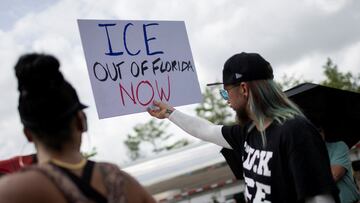
As thousands of international fans descend on South Florida for the tournament, questions over whether Immigration and Customs Enforcement (ICE) officers could be present at matches have sparked debate among politicians, organizers, immigrant-rights groups and some fans planning to attend games in South Florida.
Initial assurances from organizers
Earlier this year, Miami World Cup organizers sought to reassure fans that immigration enforcement would not be part of the matchday experience.
Rodney Barreto, co-chair of the Miami host committee, told The Athletic in May that he had received assurances from Secretary of State Marco Rubio that Immigration and Customs Enforcement (ICE) would not be operating at stadiums as part of immigration enforcement efforts during the tournament.
Barreto said the focus would instead be on ensuring fans could enter the United States smoothly and safely, while local, state and federal agencies coordinated security for one of the largest sporting events ever staged in North America.
The comments came as organizers were already working to avoid a repeat of the crowd-control failures seen at the 2024 Copa América final between Argentina and Colombia at the same stadium, when thousands of fans breached security perimeters before kickoff.
Why the ICE issue has returned to the spotlight
The discussion has resurfaced in recent weeks following comments by U.S. Senator Markwayne Mullin and growing public debate over the role federal agencies will play during the tournament.
According to reporting by CBS News Miami, activists and immigrant-rights groups have expressed concern that the visible presence of ICE personnel at World Cup venues could discourage attendance among some immigrant communities, even if those agents are not conducting immigration enforcement operations.
Mullin told CBS News that ICE officers are routinely deployed at major sporting events because the agency’s responsibilities extend beyond immigration matters.
Among the issues ICE agents may investigate at large public events are counterfeit tickets, counterfeit merchandise and other forms of criminal activity. Mullin also noted that the agency works on cases involving drug trafficking, human trafficking and individuals wanted for serious crimes.
The senator stressed that ICE’s presence at World Cup matches should not be interpreted as a dedicated immigration-enforcement operation.
“When they’re at these sporting events, we’re not doing immigration enforcement,” Mullin told CBS News.
At the same time, he acknowledged that immigration enforcement remains part of the agency’s broader responsibilities, leading some advocacy groups to argue that concerns among immigrant communities are unlikely to disappear entirely.
DHS: legal visitors have “nothing to worry about”
The U.S. Department of Homeland Security has also sought to reassure international visitors planning to attend World Cup matches.
In a statement provided to CBS News Miami, the department said: “International visitors who legally come to the United States for the World Cup have nothing to worry about.”
The agency added that visitors should ensure they have the correct travel documentation and complete travel arrangements well in advance of the tournament.
The comments come amid broader scrutiny of U.S. entry procedures after reports that some players, officials and referees experienced visa-related difficulties before the World Cup.
What fans attending matches in Miami should know
As things stand, there has been no announcement that ICE will conduct immigration-enforcement operations at World Cup stadiums.
Organizers, elected officials and federal agencies have consistently described the role of federal personnel as part of the wider security operation that accompanies major international events.
However, statements from government officials have also made clear that federal law-enforcement agencies, including ICE, may be present around World Cup activities as part of their broader responsibilities.
For fans attending matches in Miami Gardens, the practical message from organizers remains largely unchanged: arrive with valid tickets, carry the necessary travel documentation if visiting from abroad, and expect security procedures similar to those seen at other major international sporting events.
With Saudi Arabia, Uruguay, Scotland, Brazil, Colombia and Portugal all set to play group-stage matches in Miami, and a quarter-final still to come, the city is expected to welcome hundreds of thousands of visitors during the tournament. Whether the debate surrounding ICE’s role fades or continues will likely depend on how visible federal agencies are as the World Cup proceeds.
Miami stadium information
Miami stadium, which opened in 1987 and has a capacity of 64,478, will stage four group-stage matches, a Round of 32 game, a quarterfinal and the third-place match.

Miami’s World Cup schedule
Saudi Arabia vs. Uruguay (June 15, 6 p.m. ET)
Uruguay vs. Cape Verde (June 21, 6 p.m. ET)
Scotland vs. Brazil (June 24, 6 p.m. ET)
Colombia vs. Portugal (June 27, 7:30 p.m. ET)
Group J winner vs. Group H runner-up, Round of 32 (July 3, 6 p.m. ET)
Quarterfinal (July 11, 5 p.m. ET)
Third-place match (July 18, 5 p.m. ET)
Related stories
Get closer to the game! Whether you like your soccer of the European variety or that on this side of the pond, our AS USA app has it all. Dive into live coverage, expert insights, breaking news, exclusive videos, and more. Plus, stay updated on NFL, NBA and all other big sports stories as well as the latest in current affairs and entertainment. Download now for all-access coverage, right at your fingertips – anytime, anywhere.
And there’s more: check out our TikTok and Instagram reels for bite-sized visual takes on all the biggest soccer news and insights.
Complete your personal details to comment