



World Cup dark horses come in the form of Lions
After decades of near-misses, a national football boom has carried the country back to potential continental glory.
Morocco are in an Africa Cup of Nations final for the first time in 22 years and have their first continental title since 1976 within reach, at a moment when Moroccan football is showing its strength like never before. Global indicators – not only African ones – back up the country’s sustained bet on the world’s most popular sport.
The résumé is striking. Morocco finished third at the 2022 World Cup in Qatar, won bronze at the 2024 Olympics, lifted the Under-20 World Cup last year and reached the quarterfinals of the Under-17 World Cup. The women’s game has followed the same upward curve – runners-up at the Africa Cup of Nations and, for the first time, qualified for both the Under-20 and Under-17 World Cups.
There is little doubt that the project led for the past decade by the federation president, Fouzi Lekjaa, with the backing of the authorities and, in particular, King Mohammed VI, has been a success. Its real starting point can be traced to 2019, when the federation opened its lavish new training complex, named after the monarch and regarded as one of the most advanced of its kind.
It was there that a plan was drawn up whose rewards are now becoming visible. The complex offers elite facilities, coaches with European experience have been recruited – including the current head coach, Walid Regragui – and a strict policy is in place to identify Moroccan players or those of Moroccan origin across Europe’s major leagues. That is how, for example, Achraf Hakimi and Brahim Díaz, the team’s two biggest stars, were integrated.
“We have a diaspora spread all over the world, unlike other countries. We have Moroccans from Spain, France, Belgium, the Netherlands, Germany and Italy. And at youth level we are even starting to have Moroccans coming from England. We also have Sahrawis from Norway. All this dual culture is a strength, but at the same time everyone has their own culture,” Regragui told So Foot. The blend is bringing Morocco closer to a dream once considered unreachable – becoming the first African nation to win a World Cup.
Beyond the senior national team’s coaching staff, an Expert Committee oversees long-term planning. It recently brought in Abián Perdomo from Real Madrid to focus on developing local talent, while another Spaniard, Óscar Garro, also sits on the committee. Spanish voices are heard in the women’s setup too, with Jorge Vilda as national coach.
Rabat’s stadium, the latest jewel
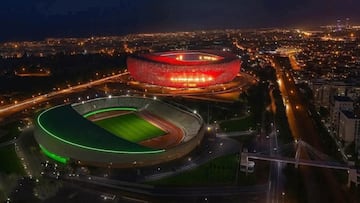
The Prince Moulay Abdellah Stadium in Rabat, with a capacity of 68,700, is the latest jewel in the crown. Morocco have played all their games in the tournament there. Designed by Populous, one of the world’s leading sports architecture firms, it opened in September 2025. Its exterior features a parametric façade with an integrated lighting system that creates striking visual displays, while the interior prioritizes acoustics and atmosphere to amplify crowd passion. Work is also under way on a stadium in Casablanca with a capacity of more than 100,000, part of Morocco’s ambition to wrest the 2030 World Cup final from Spain.
Related stories
Get your game on! Whether you’re into NFL touchdowns, NBA buzzer-beaters, world-class soccer goals, or MLB home runs, our app has it all.
Dive into live coverage, expert insights, breaking news, exclusive videos, and more – plus, stay updated on the latest in current affairs and entertainment. Download now for all-access coverage, right at your fingertips – anytime, anywhere.
Complete your personal details to comment