


Here’s a look at Iran’s military strength after a month of war: How many soldiers, aircraft, tanks, and ships does it have left?
A detailed look at the true state of Iran’s military: its actual troop strength, tanks, fighter aircraft, ships, and missiles; its ability to endure a prolonged conflict; and the challenges it faces under an assault like the one launched by the United States and Israel.
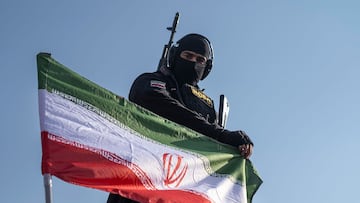
Iran entered 2026 as a major military power on the world stage. That was not just propaganda; global rankings backed it up. The Global Firepower Index placed it 16th in the world, ahead of most of Europe. GlobalMilitary ranked it as high as 13th. Its main strengths were the size of the population it could mobilize, a difficult-to-conquer geography, and an industrial base capable of sustaining a long war of attrition.
Then came February 28, the day the United States and Israel began striking the country. Since then, the air campaign has reached staggering proportions. In less than two weeks, reports were already claiming that more than 6,000 targets had been destroyed.
By the end of March, that number had reportedly exceeded 10,000 targets hit, according to U.S. commanders themselves. At a pace of 300 to 500 strikes per day, large parts of Iran’s military infrastructure have been reduced to a chain of craters. That makes this a good moment to assess what remains of Iran’s military power today, and what has vanished beneath the smoke of cruise missile attacks.
Ground forces have been left relatively unscathed
If we look at Iran’s ground forces, it appears that relatively little has changed. They are, by far, the least damaged branch. The reason is demographic: the regime has a population of more than 90 million people at its disposal. More than 20 million of them are military-age men.
It can field and sustain an army of 610,000 active personnel, 350,000 reservists, and as many as 1 million Basij volunteers if the United States were ever to make the reckless decision to launch a ground invasion.
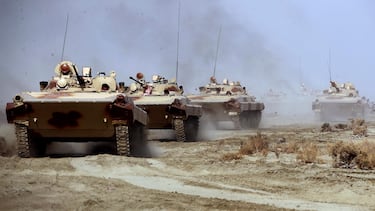
Before the first bomb fell, Tehran had 1,713 tanks in its garages, a mixed collection ranging from aging Soviet-designed T-62s and T-72s to domestically built Zulfiqar tanks. On top of that, it had 6,676 armored vehicles for transport and support.
While coalition air operations have been highly effective in the air and at sea, they appear to have been less decisive on land. Iranian forces are dispersed, and destroying a single Iranian tank 186 miles from the border would be a Pyrrhic victory, far too costly for what it achieves.
Where Iran has suffered the most losses
Although the infantry and armored units have come through with relatively little physical damage, the war has hit where it hurts most: the top leadership. On the first day of bombing, the strikes fell like a guillotine on the upper ranks of power.
More than 40 senior commanders were killed within hours. Since then, the losses have continued. The military chain of command has not only been disrupted, but a political vacuum has also opened up, one Tehran is scrambling to fill.
The most devastating blow may have come in the air. Israel and the United States say they have had complete control of Iranian airspace almost from day one. On paper, Iran had a fleet of 627 aircraft before the war, including fighters, transports, and helicopters, but that figure was misleading. It was closer to a giant repair shop than a modern air force.
Iranian engineers have spent decades working miracles. Through the Owj program, they managed to replicate spare parts that the original manufacturers stopped producing 40 years ago.
It was industrial archaeology, keeping half-century-old aircraft in the sky, including F-14 Tomcats inherited from the Shah, along with F-4 Phantoms and F-5s. According to analysts, an Iranian F-14 required more maintenance hours per flight hour than almost any other aircraft in the world. Parts cannibalization was routine in its hangars.
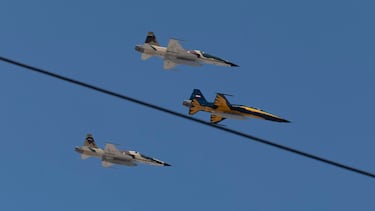
That fragile ecosystem of repairs and improvisation has now collapsed. During the first month of the campaign, Iran lost at least 51 aircraft: seven were shot down in aerial combat, and another 44 were destroyed on the ground. Losses include 10 F-7 fighters, eight F-14s, six Il-76 transport aircraft, five C-130s, several Su-22s, three Boeing 747s, and two Boeing 707s.
What has happened at sea is much the same. Before the war, Iran projected naval power as far as the Indian Ocean through its two navies: the regular navy and the Islamic Revolutionary Guard Corps Navy. Together, they operated roughly 97 vessels, including six submarines — three Russian-built Kilo-class boats, several Ghadir mini-submarines, and their only truly modern gem, the Fateh — along with dozens of missile-armed fast attack craft and six Jamaran-class frigates.
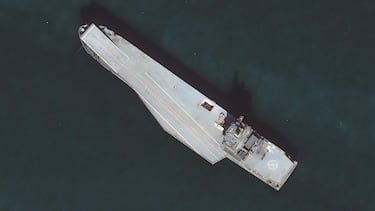
Iran also possessed two technological showpieces: the massive Makran, a forward base ship displacing more than 110,000 tons, and the Shahid Bagheri, its newly commissioned drone carrier.
Damage reports confirm the loss of at least 27 ships in a single month: 14 have been sunk in combat or by precision strikes, 11 have been destroyed in their own ports, and two have been captured. The Shahid Bagheri was reduced to a smoking shell within minutes, and the Makran is still burning at its pier in Bandar Abbas. Of the six Jamaran-class frigates, two have been destroyed and another two or three have been heavily damaged. The Fateh, the only modern submarine of its class, has also been destroyed.
Despite heavy loses Iran still has deadly cards to play
But even with its navy reduced to scrap, Iran has not lost its most dangerous maritime threat: mines. Tehran possesses the densest naval mine arsenal in the Persian Gulf, with thousands of devices — from older contact mines to acoustic EM-52 mines — capable of shutting down the Strait of Hormuz without the need for a conventional fleet. Its mine-laying capability remains intact, and that alone is enough to keep global oil shipping on edge.
That kind of imaginative, low-cost solution to serious problems defines the regime’s true nature: Iran becomes more dangerous the more wounded it is.
It is the world’s most cost-effective drone producer, and that is not something a 30-day air campaign can easily erase. It manufactures everything from larger systems such as the Shahed-129 and Mohajer-6 to the breakout star of modern irregular warfare: the Shahed-136. Tehran is still believed to be capable of producing between 200 and 300 drones per month, thanks to the simplicity of their components and the dispersion of its production sites.
Alongside drones, Israel’s greatest concern remains Iran’s ballistic missile arsenal. Before the war, Iran had between 3,000 and 4,000 missiles of various types, from Shahab-3s and Emads to the more precise Zolfaghar and Fateh-110 systems, the largest missile stockpile in the Middle East.
Even though the United States has struck silos, factories, and command centers, Iran’s network of underground “missile cities” has protected a significant portion of that arsenal. Current estimates suggest Iran still retains about 60 to 75 percent of its original missile force: somewhere between 1,800 and 3,000 operational missiles, with accuracy reportedly within about 33 feet of their targets. Proof of that is its continued ability to launch salvos of 10 missiles in a single night, as it demonstrated in early April, while Israel is finding it increasingly difficult to destroy them before impact.
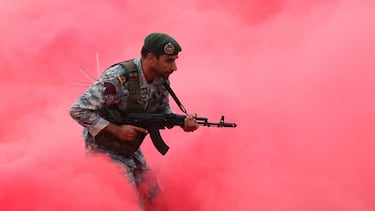
Then there is the Islamic Revolutionary Guard Corps (IRGC), the political and military backbone of the regime. Its bases have taken heavy punishment, and many of its facilities have suffered severe damage, but its network of allies — the so-called Axis of Resistance in Lebanon, Iraq, Syria, and Yemen — remains active.
Finally, there is cyberspace. Iran is considered one of the world’s four leading cyber powers, behind only the United States, China, and Russia. Its cyberattack units continue to strike back at critical infrastructure in Israel and the United States, from electrical grids to water treatment facilities. Tehran does not need a runway to keep inflicting damage.
Iran’s strategy is to be the last one standing
The result of the first month of war is an Iran with two faces. One, visible and conventional, has been gravely wounded: its navy crippled, its air force battered, and its factories under constant threat. The other, deeper and more resilient, remains a formidable adversary. That duality explains why Tehran has not yet begun to buckle. Sometimes winning a fight is not about landing the hardest punch. It is about being the one who can stay standing in the ring the longest.
Related stories
Get closer to the game! Whether you like your soccer of the European variety or that on this side of the pond, our AS USA app has it all. Dive into live coverage, expert insights, breaking news, exclusive videos, and more. Plus, stay updated on NFL, NBA and all other big sports stories as well as the latest in current affairs and entertainment. Download now for all-access coverage, right at your fingertips – anytime, anywhere.
And there’s more: check out our TikTok and Instagram reels for bite-sized visual takes on all the biggest soccer news and insights.
Complete your personal details to comment