


Marie Curie, scientist: “The best life is not the longest, but the richest in good deeds”
A pioneering physicist and chemist born in Warsaw, she carried out groundbreaking research on radioactivity, discovered new elements, and became the first person to win two Nobel Prizes in different scientific disciplines.
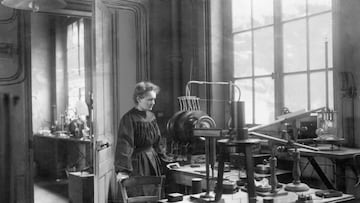
Marie Curie was born on November 7, 1867, in Warsaw, Poland. She was a pioneering physicist, mathematician, and chemist whose work transformed the field of radioactivity. She won the Nobel Prize in Physics in 1903, alongside her husband Pierre Curie, and the Nobel Prize in Chemistry in 1911 for her research on radium and polonium.
From a very young age, she showed remarkable intellectual ability and a deep passion for learning. She dreamed of attending university, which was still uncommon for women in Poland at that time. Determined to pursue her education, she moved to Paris, where she studied physics and mathematics at the Sorbonne and graduated at the top of her class.
It was there that she met Pierre Curie, who became not only her life partner but also her research partner. Together, they conducted pioneering studies on radioactivity, a term Marie herself coined. They also discovered two new chemical elements, polonium and radium, and concluded that radioactivity originates within atoms.
Marie Curie died from aplastic anemia in 1934, at age 66, after years of radiation exposure required by her work.
— Massimo (@Rainmaker1973) March 24, 2026
A few of her notebooks are still so radioactive (and they will be for other 1500 years) that they are stored in lead boxes until today. pic.twitter.com/YfUlVOH0iU
The development of radiation therapy
After her husband’s death, Curie continued her scientific work and made major contributions to the development of radiation therapy, a crucial advance in the treatment of cancer. In recognition of these achievements, she received her second Nobel Prize, this time in Chemistry, in 1911.
During World War I (1914-1918), she played a vital role in advancing the use of mobile X-ray units. She helped create the well-known “radiological ambulances,” which saved countless lives by bringing diagnostic imaging closer to wounded soldiers on the battlefield.
Among her most memorable quotes is: “The best life is not the longest, but the richest in good deeds.” This statement reflects her philosophy of life, grounded in generosity and in contributing to the well-being of others. For Curie, what truly mattered was not how long a person lived, but the positive impact they left behind and the actions they took for the benefit of society.
After the war, she became a member of several scientific institutions, including the French National Academy of Medicine in 1922. Due to prolonged exposure to radiation throughout her life, she died on July 4, 1934. In 1995, her remains were transferred with honors to the Panthéon in Paris, where she was laid to rest alongside her husband.
Related stories
Get closer to the game! Whether you like your soccer of the European variety or that on this side of the pond, our AS USA app has it all. Dive into live coverage, expert insights, breaking news, exclusive videos, and more. Plus, stay updated on NFL, NBA and all other big sports stories as well as the latest in current affairs and entertainment. Download now for all-access coverage, right at your fingertips – anytime, anywhere.
And there’s more: check out our TikTok and Instagram reels for bite-sized visual takes on all the biggest soccer news and insights.
Complete your personal details to comment