


These are the components of a nuclear bomb and that is why it is so dangerous
Here’s what is actually inside a nuclear bomb.

Donald Trump’s attack on Iran has raised serious concerns about potential retaliation from the threatened nation. Guided by Israel, which continues its genocide of the Palestinian people, the United States military carried out Trump’s orders—actions that have significantly escalated global tensions.
At the heart of the crisis is one major question: Iran’s nuclear capability. We know that the Middle Eastern nation is enriching uranium, which they claim is for energy purposes. However, Benjamin Netanyahu continues to push the unfounded narrative that Iran’s nuclear bomb is just around the corner—but what would they actually need to do to build one?
To understand nuclear weapons, we need to grasp two fundamental processes: fission and fusion. Both are types of nuclear reactions. The atomic bomb harnessed the power of fission, while the hydrogen bomb (H-bomb) utilises fusion.
Put simply, it all comes down to the atoms of certain elements and their isotopes (variations). When the nuclei of these atoms are either split apart (fission) or fused together (fusion), they release massive amounts of energy—energy that can be harnessed to create devastating explosions.
How do nuclear weapons work?
Anyway, let’s get into the science. Nuclear fission is the process by which the atomic nuclei of certain heavy atoms (where neutrons and protons are tightly bound) split into smaller nuclei, releasing energy in the process.
This can occur naturally or be artificially induced. For instance, firing a neutron at a nucleus can cause it to absorb the neutron, initiating the fission process.
As explained by the Union of Concerned Scientists: “In some elements—such as certain isotopes of radioactive uranium and plutonium—the fission process also releases excess neutrons, which can trigger a chain reaction" inside the bomb.
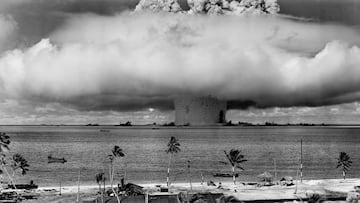
In a fission explosion, the energy released forms a fireball that reaches tens of millions of degrees and vaporises everything in its path.
Nuclear fusion, by contrast, is essentially the opposite: “When exposed to extremely high temperatures and pressures, some lightweight nuclei can fuse together to form heavier nuclei, releasing energy in the process.” This is the same reaction that powers the Sun.
Modern nuclear bombs often combine both processes, with a primary (chemical and fission explosion) and a secondary (fusion blast) stage, resulting in an immensely powerful weapon.
Looping back to Iran: as mentioned earlier, Iran is enriching uranium. That means increasing the concentration of the fissile isotope uranium-235. To be weapons-grade, uranium must be enriched to about 90%. This is done by converting uranium into gas and spinning it in machines called centrifuges—a complex, expensive, and delicate process.
Related stories


So far, no international body has found concrete evidence that Iran has produced uranium enriched to weapons-grade levels (90% U-235). But that hasn’t stopped Trump and his close ally—sorry, friend—Bibi Netanyahu, from insisting otherwise.
Get your game on! Whether you’re into NFL touchdowns, NBA buzzer-beaters, world-class soccer goals, or MLB home runs, our app has it all. Dive into live coverage, expert insights, breaking news, exclusive videos, and more – plus, stay updated on the latest in current affairs and entertainment. Download now for all-access coverage, right at your fingertips – anytime, anywhere.
Complete your personal details to comment