


A detailed analysis of the Cuban army: real figures for troops, tanks, fighter jets and ships, its capacity to resist in a prolonged conflict and the challenges it faces in the face of an attack like the one from the United States.

All eyes are on Cuba: This is the military power on the island | Soldiers, planes, tanks and ships
Cuba is a country that spent 60 years waiting for an invasion that never came. An island that has turned paranoia into doctrine. In official manuals, everything is epic, resistance, and flags waving in the wind. But if you look under the hood of the Revolutionary Armed Forces (FAR) in 2026, what you find is not an army, but a miracle of improvised engineering.
Today, Cuba is a military power held together with duct tape, cannibalized parts, and a blind hope that the enemy does not notice what is obvious: the giant is hospitalized and in intensive care.
There was a time when Havana walked proudly across the world stage. In the 1980s, Cuban pilots ruled the skies over Africa, and their tanks shook the balance of power from Angola to Ethiopia.
That time has passed. Today, if you visit the San Antonio de los Baños base, what you see resembles a graveyard. The MiG-29s that once formed part of the most powerful air force in Latin America have had their wheels stuck to the tarmac for years. The MiG-23s have become organ donors so that a Mi-8 or Mi-17 helicopter might manage to lift off the ground.
Barely twenty aircraft remain operational. Helicopters, a few L-39 trainers for cadets, and the ever-present Antonov transports. In 2026, Cuba has an air force without wings. Its pilots were once among the best in the world, but now they can only fly in simulators or in dreams.
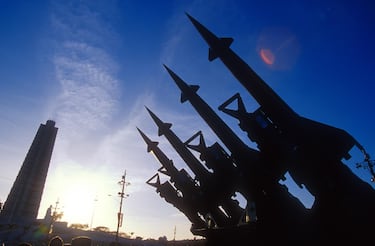
The last line of air defense is not much younger. Cuba relies on S-125 Pechora systems, Soviet-era missiles from the 1950s that Belarus hastily upgraded in 2025. There are around 144 launchers which, on paper, can strike aircraft, ships, or ground targets.
Beyond these refurbished veterans, the rest consists of traditional anti-aircraft artillery and shoulder-fired missiles that depend more on the soldier’s eyesight than on technology. On top of that, they still lack combat drones. In an era of swarm warfare and satellites, the island is still fighting with its grandparents’ binoculars.
At sea, the picture closely mirrors the air domain: nostalgia with a salty edge. The Cuban Navy maintains 33 vessels, all intended for coastal use. There are no modern frigates, no ocean-going corvettes, and no submarines capable of operating in deep waters.
Cuba once developed Delfín-class midget submarines designed for coastal ambushes, but they do not appear in current inventories, and their operational status in 2026 is unknown. According to independent analysts, the prototype has remained docked in Cabañas for years without signs of activity.
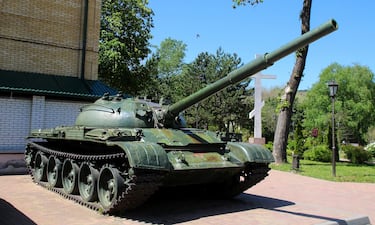
On land, the situation does not improve much, although at least there is some mass. Cuba has more than 300 T-54, T-55, and T-62 tanks, along with over 1,200 light armored and transport vehicles.
It is essentially a rolling Soviet museum that would be scrap metal almost anywhere else in the world, yet in Cuba it forms the backbone of national defense. Cuban mechanics keep them running with cannibalized parts, tropical ingenuity, and a generous dose of miracle. The T-62Ms that still move carry more layers of weld than original paint, but they can still fire when needed.
Another distinctive feature of Cuba’s military is hybridization. Since they cannot purchase new weapons, they invent them. Anti-aircraft guns mounted on KAMAZ trucks, heavy artillery grafted onto civilian platforms, armored vehicles combining the chassis of one model, the turret of another, and the electronics of a third.
Cuban technicians can turn a BTR-60 into a Frankenstein machine and make it run. It does not matter if the armor dates from 1968, the optics from 1972, and the radio from 1988. What matters is that it works.
In theory, the regime’s ace in the hole is its manpower. The Bastión 2024 and Bastión 2025 exercises updated defense plans, tested decentralized command structures, and trained thousands of militia members under realistic threat conditions.
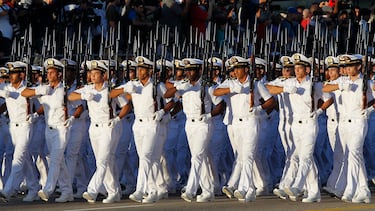
The FAR maintains around 50,000 active soldiers, about 39,000 reservists, and nearly 90,000 paramilitary personnel, including Territorial Troops and Defense Committees. It is not a massive army, but it is deep. The official doctrine, known as the “War of All the People,” is simple: if anyone invades Cuba, the entire island becomes a battlefield. The theoretical mobilization capacity exceeds one million people. Feeding, moving, and sustaining that number is another matter entirely.
The problem is that the internal crisis could make that plan impossible. The five electrical collapses of 2025, along with the sixth total blackout suffered just this week, a complete shutdown of the island’s power system, did not just darken homes. They halted training, crippled military communications, and left mechanized units literally immobilized. They also cast serious doubt on the morale of a population that has little left to defend.
What still functions is the economic structure of the armed forces. While generals in other countries command tanks, in Cuba they run luxury hotels, retail chains, airports, banks, and strategic ports. The military-controlled conglomerate GAESA is effectively the country’s cash register. In Cuba, uniforms manage the economy. Even if the MiGs do not fly and the tanks move in fits and starts, the FAR remain the most powerful institution on the island.
In January 2026, they received a harsh wake-up call from Caracas. The lightning capture of Nicolás Maduro stunned Cuban strategists. Cuba acknowledged the loss of 32 intelligence agents in Venezuela after the operation, with U.S. sources suggesting more than double that number. It was a severe blow for a country that has long relied on its intelligence networks as an extension of its external power.
The lesson was immediate: if Venezuela, with operational fighter jets, S-300 systems, modern radar, and Russian support, fell in three hours, what chance does an island have that goes dark every time the wind blows? It was a sobering reality that triggered heightened alert levels and a renewed public emphasis on total resistance.
Cuba would not last a single night against an attack involving drones and satellites. Its navy is a relic, and its air force is a memory. Yet it has spent six decades training for disaster. The regime is betting that stubbornness will outweigh technology. It is a clash between manuals filled with heroic narratives and a country exhausted by blackouts and decades of waiting for an invasion that, if it comes, will find its tanks without fuel and its soldiers thinking more about their next meal than about revolutionary glory.
Welcome to the Caribbean, Nimitz Carrier Strike Group!
— U.S. Southern Command (@Southcom) May 20, 2026
The aircraft carrier USS Nimitz (CVN 68), the embarked Carrier Air Wing 17 (CVW-17), USS Gridley (DDG 101) and USNS Patuxent (T-AO 201) are the epitome of readiness and presence, unmatched reach and lethality, and strategic… pic.twitter.com/83mfzSIKzd
Cuba is no longer the giant that once inspired fear. It is an aging warrior hiding a rusted knife behind its back, hoping no one realizes it no longer has the strength to lift it. Chances are we’ll see soon what their defense capability is with the U.S. fleet in the Caribbean at the moment.
Related stories


Get closer to the game! Whether you like your soccer of the European variety or that on this side of the pond, our AS USA app has it all. Dive into live coverage, expert insights, breaking news, exclusive videos, and more. Plus, stay updated on NFL, NBA and all other big sports stories as well as the latest in current affairs and entertainment. Download now for all-access coverage, right at your fingertips – anytime, anywhere.
And there’s more: check out our TikTok and Instagram reels for bite-sized visual takes on all the biggest soccer news and insights.
Complete your personal details to comment