


What next for the Knicks?
After the earthquake caused by the firing of Thibodeau, the Knicks are entering a period of reflection in which they are risking the loss of the culture.
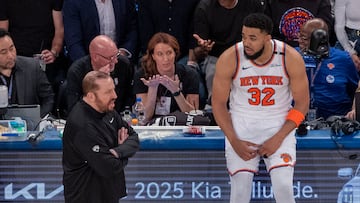
The bombshell went off in New York with the firing of Tom Thibodeau, and now the Knicks find themselves in a period of reflection, forced to decide what path to take moving forward. The 67-year-old coach spent five seasons in the Big Apple and now leaves empty-handed, becoming the latest name in a long list of coaches dismissed after achieving either resounding or moderate success.
Of course, the man who famously sacrificed marriage to devote himself entirely to basketball will still walk away with the guaranteed $30 million from the extension he signed in 2024, which had tied him to the team through 2028. A cold consolation for someone whose life seems to have meaning only when he’s pacing the sidelines of an NBA bench.
It’s a decision with many layers—one that not everyone has understood. Thibodeau led the Knicks to the playoffs in four of his five seasons, posting 50 and 51 wins in the last two and reaching the Eastern Conference Finals this year. They ultimately lost 4–2 to the Pacers—a disappointing result on paper, but more understandable given Indiana’s brilliant postseason run.
Under Thibodeau, the Knicks advanced past the first round in back-to-back seasons for the first time since 2000. It’s been a long wait to rebuild the culture that once made them contenders—one rooted in the grit and grind that defined their glory days in the ’90s, even if it didn’t result in rings. Madison Square Garden had, once again, become the center of the basketball universe.
That’s what’s at stake now: not losing that essence. Under Thibodeau, an old-school coach, the Knicks played the kind of basketball beloved in New York—tough, physical, relentless. Pure Eastern Conference basketball, marked by intense regular-season battles and memorable playoff showdowns. But with that came the familiar baggage: Thibodeau’s tendency to overwork his players, rely on short rotations, and demand an almost military level of conditioning. He’s also notoriously hands-on, wanting control over every possession, every decision. That intensity revived the Knicks’ relevance—but didn’t bring a title.
The verdict depends on perspective. On one hand, claiming the current Knicks roster is championship-caliber may be a stretch. On the other, this is a wild NBA era—seven different champions in seven years—ever since the end of the Warriors’ dynasty. With no true juggernaut, teams that once wouldn’t have made a dent are suddenly seizing their moment.
The Raptors and Nuggets won their first titles. The Bucks got their first in half a century. The Celtics finally lifted a banner again after 16 years. Meanwhile, the Knicks remain stuck on two—1970 and 1973. A lot of water has flowed under the bridge since then.
In a league where it’s now “evolve or die,” the landscape has shifted. LeBron James and the Lakers won in 2020. The Warriors had one last hurrah in 2022. But recent postseason flameouts by traditional builds and aging stars suggest that the old ways are fading. Success no longer comes from isolated supernova performances or assembling clusters of elite talent. Instead, teams win through balance, depth, and cohesion—or, in some cases, by building around a single transcendent star.
Thank you, Coach Thibodeau. pic.twitter.com/bInhvWtxPI
— NEW YORK KNICKS (@nyknicks) June 3, 2025
Gone are the days of superteams: Durant’s Suns, LeBron and Doncic in LA, Butler with the Warriors... these teams haven’t replicated the dominance of the Warriors’ heyday or the success of LeBron’s partnerships with Kyrie, Wade, or Bosh. Today, assembling multiple stars means juggling massive contracts, which restrict flexibility. With the new collective bargaining agreement widening the gap between big spenders and small, and with the NBA’s “middle class” nearly extinct in salary terms, adapting to this economic reality is essential. The Knicks, caught between eras, need to fully commit to one.
Over these chaotic seven seasons, one common thread unites many champions: a singular talent surrounded by smart, adaptable role players. Giannis in Milwaukee, Jokic in Denver, Kawhi with the Raptors, LeBron (even with AD) in LA, and Curry with a supporting cast after Durant’s exit. The only team that truly won through depth alone was Boston. The age of the Big Three, the dominant duos, the iconic starting fives—that’s over. Teams win differently now. And the Knicks must catch up. One way or another.
The Knicks stand at a crossroads: potential contenders—or candidates for a reset. They don’t have an iconic owner or a dynastic foundation. Jalen Brunson is a brilliant point guard (28.7 points last year, 26 this season), given freedom and responsibility. Josh Hart was tailor-made for Thibodeau’s system, and it remains to be seen what his role will be now. OG Anunoby was a smart acquisition. Mikal Bridges can be used more flexibly. Mitchell Robinson, though talented, hasn’t been consistently healthy, and the interior presence New York once relied on has evolved in form and function.
.@nyknicks Announce Coaching Change pic.twitter.com/XhWOUSwWvn
— NY Knicks PR (@NY_KnicksPR) June 3, 2025
Then there’s Karl-Anthony Towns. The Knicks effectively resolved the Julius Randle conundrum—financially and on the court—with the swap that sent one to Minnesota and brought the other to New York. Ironic, then, that both men lost in the Conference Finals with their new teams. Towns had a strong season (24.4 points, 12.8 rebounds) but was criticized for his lack of defensive intensity—especially late, when it mattered most.
It’s also ironic that Towns was partly responsible for Thibodeau’s departure from Minnesota... and now, once again, his name is connected to Thibs’ exit. A coach who, despite supposedly having the support of Brunson and team president Leon Rose, exits through the back door after orchestrating the most successful Knicks run of the 21st century.
Now, the next decision awaits. Mike Malone, another recently fired coach, is already being floated as a possibility. Even Steve Nash’s name has surfaced—a stark contrast to Thibodeau’s intense, controlling style. Nash is more laid-back, more player-friendly. Thibs, for all his effectiveness, was never one to compromise. He’ll likely find work again soon. But with his departure, only three active NBA coaches have longer tenure with their current teams: Erik Spoelstra, Steve Kerr, and... Billy Donovan. That alone speaks volumes. Long-term coaching security is all but extinct in today’s NBA.
The Knicks have rediscovered their pride. But now comes the hard part: defining the future. Every decision from here on out could bring them closer to a long-awaited title—or plunge them back into irrelevance. Time will tell.
Related stories

Get your game on! Whether you’re into NFL touchdowns, NBA buzzer-beaters, world-class soccer goals, or MLB home runs, our app has it all.
Dive into live coverage, expert insights, breaking news, exclusive videos, and more – plus, stay updated on the latest in current affairs and entertainment. Download now for all-access coverage, right at your fingertips – anytime, anywhere.
Complete your personal details to comment