


The secret of the shroud of Turin: Between the greatest hoax and the greatest miracle in history
A medieval masterpiece or the physical testimony of the Resurrection? The Shroud of Turin continues to challenge science, history, and faith, raising questions that no one has been able to answer with certainty.
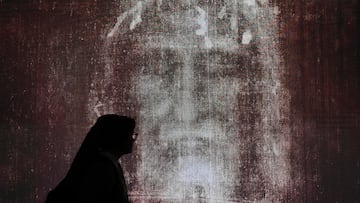
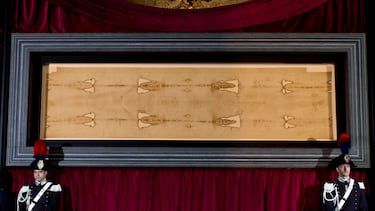
Some relics inspire devotion. Others provoke skepticism. But few ignite debate as fiercely as the Shroud of Turin, a linen cloth measuring about 14 feet 5 inches long and 3 feet 7 inches wide. Imprinted on it, in photographic negative, is the front and back image of a naked man who was crucified, tortured, and killed.
The figure appears to be between 5 feet 10 inches and 6 feet tall, bearing more than 120 scourge marks, wounds on the head consistent with a crown of thorns, punctures in the wrists and feet, and a wound in the right side, like one that could have been caused by a Roman spear. Is it the burial cloth that wrapped the body of Jesus after His death on the cross? Or is it a medieval forgery so ingenious that it has deceived generations of scientists?
The history of the Shroud reads like a thriller, full of impossible twists, hidden documents, fires, hesitant popes, and scientists locked in fierce disagreement. And like any great mystery, it has two irreconcilable camps: those who believe it is the greatest physical miracle in history, and those who insist it is the most sophisticated fraud of medieval Christianity.
The origin of the enigma
The first documented appearance of the Shroud dates to 1355, in the collegiate church of Lirey, France, where it was displayed by the family of Geoffroy de Charny. From the beginning, the Church had its suspicions. In 1389, Bishop Pierre d’Arcis denounced it as a painting and claimed that the artist who created it was even known. But Pope Clement VII allowed it to be displayed, though only as a “representation of the shroud of Christ,” not as an authentic relic.
More recently, a rediscovered document by the philosopher Nicole Oresme, written sometime between 1370 and 1382, denounced the cloth as a clerical fraud designed to attract offerings: “Many clerics deceive others in this way in order to obtain offerings for their churches.”
The carbon-14 test
In 1988, three independent laboratories carried out the famous radiocarbon dating test. The result was devastating: the cloth was dated to somewhere between 1260 and 1390, precisely the period when it first appeared in France. For many, that was the end of the debate. Case closed. Or was it?
Since then, numerous scientists have challenged the validity of that test. Among other objections, they argue that the sample came from a section repaired after the 1532 fire, where newer cloth had been sewn in.
In 2022, Italian researcher Liberato De Caro applied a newer technique known as WAXS (Wide-Angle X-ray Scattering) to measure the natural aging of the linen’s cellulose. The result was striking: the fabric, he argued, could be around 2,000 years old, making it compatible with the time of Jesus.
The impossible image
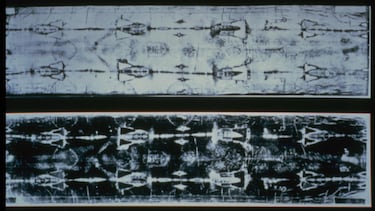
But the most unsettling mystery is not the age of the cloth. It is the image itself. There are no pigments, brushstrokes, or applied substances. The figure is imprinted only on the surface, without penetrating the fibers. It resembles a photographic negative, and it contains three-dimensional properties that allow researchers to reconstruct the contours of the face and body.
In 1976, analysis associated with NASA image processing technology reportedly showed that the intensity of the image varies according to the distance between the body and the cloth, something no medieval painting should be able to reproduce. Even more curious, researchers have argued that the body image formed after the bloodstains. In other words, the body appears to have been wrapped first, and the image emerged afterward.
The blood that speaks
If the Shroud were a medieval forgery, then its creator would have needed to understand not only the anatomy of a tortured body, but also the botany of the Near East. Embedded in its fibers, invisible to the naked eye, are traces of a landscape that does not appear European.
Swiss criminologist and pollen expert Max Frei was the first to analyze pollen grains found on the cloth. He identified more than thirty plant species, roughly three-quarters of them associated with Palestine. After his death, Israeli botanists Avinoam Danin and Uri Baruch continued the work and confirmed the unusual findings.
Among the pollens identified were Zygophyllum dumosum and Gundelia tournefortii, two species that, although more broadly distributed across parts of the Middle East, naturally coexist only in a very narrow corridor between Jerusalem and Hebron. The latter has also been associated by some researchers with thorny plants that may have been used in mock coronation rituals.
Researchers have also claimed to detect traces of oils and funerary ointments used in the first century in Asia Minor. One of the most notable is Helichrysum, an aromatic plant that, when mixed with myrrh and aloe, was reportedly used to help preserve bodies. According to this theory, it may help explain why the linen has survived for centuries without rotting or disintegrating.
The fabric that does not fit and the dust of Jerusalem
Even the linen itself raises questions. If someone forged the Shroud in the Middle Ages, they made an extraordinarily unusual choice of fabric. The weave, a herringbone-patterned linen, was virtually unknown in 14th-century Europe. Yet similar textiles have been found at Masada, the Jewish fortress that resisted the Romans until A.D. 73.
Traces of aragonite have also reportedly been found in areas such as the feet and nose of the crucified figure. This mineral is characteristic of the Jerusalem area but relatively uncommon in Europe. How could a medieval forger have replicated that without any knowledge of the geology of the Holy Land?
Letters no one can see
Then there are the invisible inscriptions. They cannot be seen with the naked eye. They are not painted. No pigments have been found. Yet some researchers insist they are there.
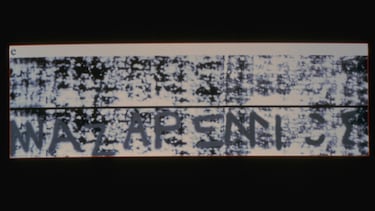
In 1997, researchers André Marion and Anne Laure Courage of the Institut d’Optique Théorique et Appliquée in Orsay, France, digitally processed high-resolution images of the Shroud. What they reported was astonishing: letters distributed around the face, in a mixture of Greek, Latin, and Aramaic, forming phrases such as “Jesus the Nazarene” and “INRI.”
According to this interpretation, these inscriptions are integrated into the fabric rather than superimposed on it. No detectable ink has been identified. Their calligraphic style has also been argued to resemble manuscripts from the first or second century, not medieval European writing. Just as striking, there is no evidence that medieval artisans possessed techniques capable of creating invisible inscriptions that would only become visible through spectroscopy or ultraviolet light.
Could they have been added as part of a hoax? In theory, yes. But one fact complicates that theory: no one mentioned them in the Middle Ages. There are no documents, testimonies, or references. The inscriptions were only reported centuries later, once technology made it possible to see what the human eye could not.
The Mandylion of Edessa
The way the cloth may have been folded for centuries also challenges the idea that its story began in 1355. Historian Ian Wilson has argued that it was folded into eight layers so that only the face remained visible. That method of display matches the tradition of the Mandylion of Edessa, an Eastern relic that showed only the face of Christ. According to this theory, the Shroud may actually have been the Mandylion, concealed under that identity until it was transferred to Constantinople in A.D. 944.
Visible fold lines in the cloth, specifically two parallel lines above and below the head, are said to support this theory. Byzantine documents also describe a cloth with similar characteristics being displayed in Hagia Sophia every Friday. After the sack of Constantinople in 1204, the trail goes cold until the cloth resurfaces in France in the 14th century.
Miracle or masterpiece?
The Shroud of Turin remains an enigma. To some, it is a masterpiece of medieval Christian art, created to inspire devotion. To others, it is evidence of the Resurrection. Even today, science has not been able to reproduce the image or fully explain how it was formed. And in the 21st century, that remains deeply unsettling.
The Shroud was described as “a challenge to the intelligence” by Pope John Paul II, and like every great mystery, the more it is investigated, the deeper it becomes.
Related stories
Get closer to the game! Whether you like your soccer of the European variety or that on this side of the pond, our AS USA app has it all. Dive into live coverage, expert insights, breaking news, exclusive videos, and more. Plus, stay updated on NFL, NBA and all other big sports stories as well as the latest in current affairs and entertainment. Download now for all-access coverage, right at your fingertips – anytime, anywhere.
And there’s more: check out our TikTok and Instagram reels for bite-sized visual takes on all the biggest soccer news and insights.
Complete your personal details to comment