


If the Brendan Sorsby case stands, college sports could change forever
The NCAA’s punishment for the TTU QB after he admitted to gambling has been overruled by a Texas judge, causing concern for the future of college sports.
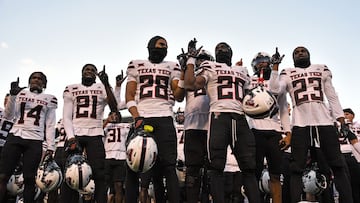

In professional leagues, what Brendan Sorsby did would have him being investigated by federal officers. But in college football, he is being passed off as having a mental health issue.
The Texas Tech quarterback admitted to placing more than 9,000 bets totaling at least $90,000. Not only was he gambling as a player in the NCAA, but he was placing bets on his own team when he played for Indiana.
Sorsby appeared to be facing the kind of punishment the NCAA has historically treated as non-negotiable: a lengthy suspension, if not the end of his career. Instead, a judge stepped in.
Sorsby case calls all NCAA rules into question
A district court in Texas granted Sorsby an injunction that effectively clears the way for him to play in the 2026 season after what is expected to be just a two-game suspension. The decision didn’t argue that what Sorsby did was acceptable. They argued instead that enforcing the NCAA’s punishment could cause irreparable harm to his career.
Brendan Sorsby admitted to wagering at least $90,000 across more than 9,000 bets during his college career, including bets involving Indiana football while he was a member of the Hoosiers in 2022.
— Ari Meirov (@MySportsUpdate) June 8, 2026
For the current outlook to be that he'll play in 2026 after serving just a… https://t.co/BnM5ifoaLB
Yes, I do believe that was the point.
If this stands, which I am not entirely convinced it will, but if a player can admit to betting on games involving his own team and still return to the field through legal intervention, it raises a much larger question: what rules can the NCAA actually enforce anymore?
"The problem is, no one is in charge of college football."@cbfowler reacts to Brendan Sorsby being granted a temporary injunction against the NCAA.
— ESPN College Football (@ESPNCFB) June 8, 2026
(via @RichEisenShow) pic.twitter.com/UxdiBUUwq7
The organization has already spent years losing ground in courtrooms across the country. Legal challenges have reshaped everything from athlete compensation to transfer rules, steadily chipping away at the NCAA’s authority. But gambling has long been viewed as a bright line, one of the few areas where enforcement remained strict and largely unquestioned due to its connection to the integrity of the game.
The Sorsby ruling challenges the foundation of how the NCAA’s punishments are judged. If courts are willing to weigh the career impact of penalties more heavily than the violations themselves, the entire enforcement model begins to change. It becomes less about whether a rule was broken and more about whether the consequences are considered too severe. That’s a difficult standard for any governing body to operate under, especially one already navigating constant legal pressure.
And the reaction around college football suggests people understand what’s at stake. Reports have indicated that some programs are uneasy with the precedent this could set, with concerns extending beyond competitive balance to the general credibility of the sport. Gambling, more than almost any other issue, touches directly on public trust. Once that line begins to blur, it’s not easily redrawn.
"This is an unprecedented day in the history of college sports..
— Pat McAfee (@PatMcAfeeShow) June 8, 2026
Gambling has always been a thick red line and Brendan Sorsby admitted to placing thousands of bets..
Those bets include 40 placed on his own team while he was at Indiana..
He has been legally cleared to play for… https://t.co/QKUuK7UUyf pic.twitter.com/7LFyhhuUEJ
None of this guarantees that Sorsby’s case will permanently reshape the system. The NCAA could still pursue further legal action, and future rulings may clarify or limit the impact of this decision.
But if this precedent holds, or even if it simply opens the door to more challenges, it forces a new reality for college sports. Enforcement may no longer depend solely on the rulebook. It may depend on whether those rules can survive in court.
For years, the NCAA has tried to adapt to a rapidly changing landscape. This time, it may not be adapting fast enough. And if a case involving betting on your own team can be successfully challenged, the question is whether anything is truly off-limits anymore.
Related stories

Get closer to the game! Whether you like your soccer of the European variety or that on this side of the pond, our AS USA app has it all. Dive into live coverage, expert insights, breaking news, exclusive videos, and more. Plus, stay updated on NFL, NBA and all other big sports stories as well as the latest in current affairs and entertainment. Download now for all-access coverage, right at your fingertips – anytime, anywhere.
And there’s more: check out our TikTok and Instagram reels for bite-sized visual takes on all the biggest soccer news and insights.
Complete your personal details to comment