


Elon Musk is looking for the secrets of Ancient Rome and has paid for it: his goal is the Herculaneum papyri
A groundbreaking project seeks to unlock the secrets of ancient Roman philosophy with the help of cutting-edge technology and a $3 million donation.

The Herculaneum Papyri are a collection of ancient manuscripts discovered in the Roman city of Herculaneum, Italy, which was both destroyed and preserved by the eruption of Mount Vesuvius in 79 AD. These documents, primarily philosophical and literary in nature, form the only surviving library from antiquity.
They were found in the Villa of the Papyri, a lavish residence believed to have belonged to Lucius Calpurnius Piso Caesoninus, father-in-law of Julius Caesar. The discovery took place in the mid-18th century during archaeological excavations. Most of the texts are written in Greek and include works by Epicurean philosophers, such as Philodemus of Gadara, along with some texts by Epicurus himself. A few Latin manuscripts have also been identified.
The Musk Foundation is dedicating $3 million to ancient Roman culture.
— Dima Zeniuk (@DimaZeniuk) January 28, 2025
One million will support archaeological and conservation projects through the American Institute for Roman Culture.
Two million will fund efforts to decode 79 AD documents through the Vesuvius Challenge. pic.twitter.com/r98mJlBxDk
Due to the intense heat and volcanic gases, the scrolls were carbonized, turning into a fragile, coal-like material. This has made their study and deciphering extremely challenging. Over the years, various techniques have been developed to unroll and read these manuscripts without destroying them, ranging from mechanical methods to advanced imaging technologies like computed tomography (CT scans) and X-rays.
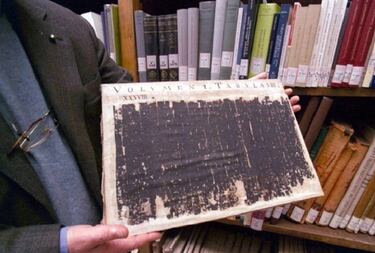
These scrolls offer a unique glimpse into Roman intellectual life before the eruption of Vesuvius. They have significantly contributed to the understanding of Epicurean philosophy and other contemporary schools of thought. In recent years, cutting-edge technological projects have enabled scholars to read the scrolls without physically unrolling them, leading to new discoveries and a deeper understanding of previously known texts. And now, Elon Musk has set his sights on them.
A $3 million donation
The Musk Foundation has allocated $3 million for studies on Ancient Rome, according to Andrea Stroppa, the billionaire’s representative in Italy. The funding includes $1 million for archaeological projects and the conservation of Roman cultural heritage, distributed through an agreement with the American Institute for Roman Culture, which will channel the funds directly to students, researchers, archaeologists, historians, and restoration experts.
Iconic photo of Elon Musk at the Colosseum in Rome pic.twitter.com/z6DLUpWOLj
— Dima Zeniuk (@DimaZeniuk) January 25, 2025
Musk’s donation will be used to decipher newly discovered Herculaneum Papyri. Next March, around ten scrolls will be transferred from the University of Naples to the University of Oxford, where they will be scanned using a particle accelerator. The data will then be processed in the United States in an attempt to unlock their contents, explained Gianluca Del Mastro, a papyrologist at Vanvitelli University, in an interview.
Related stories
Get your game on! Whether you’re into NFL touchdowns, NBA buzzer-beaters, world-class soccer goals, or MLB home runs, our app has it all.
Dive into live coverage, expert insights, breaking news, exclusive videos, and more – plus, stay updated on the latest in current affairs and entertainment. Download now for all-access coverage, right at your fingertips – anytime, anywhere.
Complete your personal details to comment