


How far can Iran’s arsenal of ballistic and cruise missiles reach, according to CSIS?
The Islamic Republic has responded to U.S. and Israeli air strikes with a barrage of missiles and drone strikes across the Middle East even into Europe.
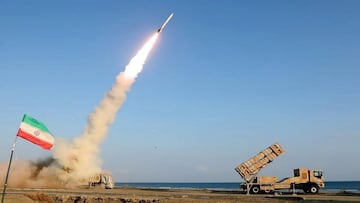
The Islamic Revolutionary Guard Corps (IRGC) maintains one of the largest and most diverse ballistic missile arsenals in the Middle East. Its structure combines short, medium, and long range ballistic missiles, cruise missiles, and attack drones.
These systems are used both for strategic deterrence and for direct retaliation against Israel and U.S. bases, as seen in the current exchange of attacks between the United States, Israel, and Iran, as well as Iran’s strikes on various U.S. bases across the Middle East.
Depending on the launch point, these systems would enable Iran to reach targets in Israel, Saudi Arabia, the United Arab Emirates, Qatar, Bahrain, and potentially southeastern Europe, along with parts of Africa. The Missile Defense Project at the Center for Strategic and International Studies (CSIS) has mapped Iran’s ballistic and cruise missile arsenal and their respective ranges.
As we begin to see Iran's response to Operation Epic Fury, just how far can the state project power with its current missile arsenal?
— CSIS Missile Defense (@Missile_Defense) March 2, 2026
To answer that question, the CSIS Missile Defense Project mapped Iran's arsenal of ballistic and cruise missiles and their ranges. pic.twitter.com/5p4FC0NpiQ
How Iran has used its missile arsenal
Iran is also a major hub for weapons proliferation, supplying allied groups such as Hezbollah and the former Syrian regime of Bashir al-Assad. Since 2015, Iran has provided Yemen’s Houthi rebels with increasingly advanced ballistic and cruise missiles, as well as long range unmanned aerial vehicles. More recently, Iran has equipped Shiite militias in Iraq with rockets and other small projectiles for use against Iraqi and U.S. military and diplomatic facilities.
In June 2017, Iran launched six missiles into eastern Syria, targeting positions held by the Islamic State near Deir ez Zor, in retaliation for Islamic State attacks in Tehran. Iran carried out a similar strike against the Islamic State a year later, in October 2018.
NEW MAP UPDATE - IRAN - MIDDLE EAST 🇮🇷🇮🇱🇺🇸 DAY 4
— Clément Molin (@clement_molin) March 3, 2026
As day 4 of the war between Israel and the USA against Iran is starting, here is a new map update. The US and Israeli air forces continued to gain total air control above Iran yesterday, alowing them to bomb tens of missile… pic.twitter.com/j0SLko9d0x
In September 2018, Iran fired seven Fateh-110 missiles at what it described as the headquarters of the Kurdistan Democratic Party of Iran and the Democratic Party of Iranian Kurdistan in Koya, Iraq.
In September 2019, Iran carried out coordinated attacks using drones and cruise missiles against Saudi oil facilities in Abqaiq and Khurais. With a high degree of precision, the strikes temporarily halted production at the Abqaiq oil processing facility, which supplies between 5 percent and 7 percent of the world’s daily oil output.
In January 2020, Iran bombarded U.S. troops in Iraq for several hours with up to 22 ballistic missiles in retaliation for the U.S. killing of Qasem Soleimani. The attacks damaged U.S. facilities at Al Asad Air Base, west of Baghdad, and injured more than 100 American service members to varying degrees.
Selected Iranian missile systems and ranges
| Missile | Class | Range | State |
|---|---|---|---|
| Emad (Shahab-3 variant) | MRBM | 1,700 km | In development |
| Fateh-110 | SRBM | 200-300 km | Operational |
| Fateh-313 | SRBM | 500 km | Operational |
| Ghadr-1 (Shahab-3 variant) | MRBM | 1,950 km | In development |
| Jorramshahr | MRBM | 2,000 km | In development |
| Koksan M1978 | Artillery | 40-60 km | Operational |
| Qiam-1 | SRBM | 700-800 km | Operational |
| Ra’ad | Anti-ship cruise missile | 350 km | Operational |
| Safir | SLV | 350 km altitude | Operational |
| Sejjil | MRBM | 2,000 km | Operational |
| Shahab-1 | SRBM | 285-330 km | Operational |
| Shahab-2 | SRBM | 500 km | Operational |
| Shahab-3 | MRBM | 1,300 km | Operational |
| Simorgh | SLV | 500 km altitude | In development |
| Soumar | Cruise missile | 2,000-3,000 km | Reportedly operational |
| Tondar 69 | SRBM | 150 km | Operational |
| Ya-Ali | Land-attack cruise missile | 700 km | Operational |
| Zolfaghar | SRBM | 700 km | Operational |
Tehran operates a sophisticated offensive ecosystem capable of projecting power beyond 2,000 kilometers (over 1,200 miles) and sustaining multiple consecutive waves of combined fire. Iran integrates long range ballistic missiles, precision munitions, and swarms of drones to maintain a flexible and highly mobile retaliatory capability.
According to the IRGC, “60 strategic locations” and as many as 500 to 560 targets were struck as part of its reprisals.
Related stories
Get closer to the game! Whether you like your soccer of the European variety or that on this side of the pond, our AS USA app has it all. Dive into live coverage, expert insights, breaking news, exclusive videos, and more. Plus, stay updated on NFL, NBA and all other big sports stories as well as the latest in current affairs and entertainment. Download now for all-access coverage, right at your fingertips – anytime, anywhere.
And there’s more: check out our TikTok and Instagram reels for bite-sized visual takes on all the biggest soccer news and insights.
Complete your personal details to comment