


Who are the Kurds? The broken, disposable ‘nation’ that could break up the Middle East: “Its only friends are the mountains”
They banned their lyrics, burned their books, and used them as shields against ISIS, only to later turn their backs on them. A journey to the heart of Kurdistan.
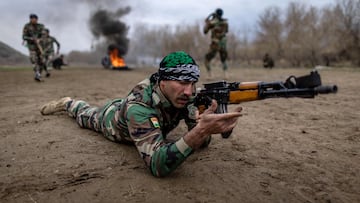
Imagine waking up tomorrow and finding out that Spain no longer exists. France takes the north, Morocco the south, and Portugal the center. The language is banned, all the books are burned, and people are told that they are not Spanish but “French from the mountains,” in the case of that region.
That is what it means to be Kurdish. There are about 35 million Kurds, roughly the population of Canada, spread across Turkey, Iran, Iraq, and Syria. An entire nation divided among four countries, all because of a miscalculation that more than a century later still reverberates.
The disaster has a date and signatures. In 1916, diplomats Sykes and Picot divided the Middle East with a ruler. In 1920, the Treaty of Sèvres promised the Kurds their own country. But the promise collapsed as soon as Atatürk’s new Turkey became indispensable to the West.
This map gives a good idea of Kurdish regions. Eastern Kurdistan is relevant here. pic.twitter.com/NvqbATXT3Y
— Prediction Theory (@predictheory) March 7, 2026
In 1923, the Treaty of Lausanne erased the word “Kurdistan” from the maps, a diplomatic U-turn disguised as an international treaty. In practice it was a swindle.
The agreement was broken, the country that had never actually been delivered was dismantled, and the Kurds were left as suspect minorities inside four states that wanted their land but not their people. Since then, Kurdish children learn a sentence before they even master the alphabet, a phrase that weighs like a tombstone: “The only friends of the Kurds are the mountains.”
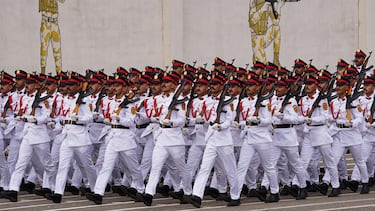
Iraqi Kurdistan: autonomy and oil
If Kurdistan were a family business, the Iraqi branch would be the one that managed to go public. There is a Regional Government there, the KRG, with a legal flag and an army respected around the world: the Peshmerga, a name that literally means “those who face death.”
For decades Iraqi Kurds lived under the terror of Saddam Hussein. In Halabja, 5,000 civilians were killed with chemical weapons in a single afternoon in 1988. And yet Erbil, their capital, has turned into a kind of Kurdish Dubai, with gleaming skyscrapers and shopping malls where thirty years ago there were only ruins.
Iraqi Kurds have one strategic advantage: oil. So much of it that they could be a global energy power. But Turkey controls the key pipeline and can open or close the tap whenever it wants.
In that environment operates Masoud Barzani, the historic leader of Iraqi Kurdistan and president of the KRG for a decade. He once summarized the situation with surgical precision: “We do not want to be part of a failed Iraq. We want to be neighbors with a stable Iraq.”
In 2017 they held an independence referendum. Ninety-two percent voted yes. What happened next? The world looked away and, within 48 hours, the Iraqi army seized Kirkuk, the crown jewel of Kurdish oil.
No one seemed to remember that the Peshmerga were the ones who stopped ISIS with rifles from the 1970s while the official Iraqi army, the one the United States had trained with millions of dollars, fled and left the keys in the Humvees. International gratitude, it seems, has an expiration date.
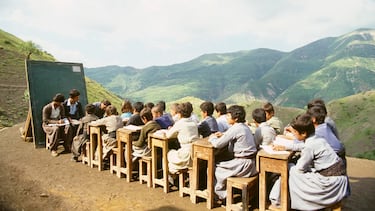
Iranian Kurdistan: a latent threat
Between 7 and 15 million Kurds live in Iran, depending on who is counting. They once had a state of their own: the Republic of Mahabad in 1946. It lasted eleven months. When the Soviets withdrew their support, the Shah crushed the city and hanged its leaders in the marketplace.
Since then Tehran has viewed the Kurds as a national security problem: a large, cohesive, armed minority living along the country’s most porous border. They have no autonomy like in Iraq and no legal political parties capable of making real decisions. But they live in the Zagros Mountains, which function as a natural fortress. From there operate groups such as the PDKI and Komala, which the state labels terrorist organizations but which function in practice like a resistance army.
Their geographic position is the key. Iranian Kurdistan is the natural bridge to Erbil and Sulaymaniyah, the two Kurdish capitals in Iraq. If the region ever erupts, that border could become a political and military corridor.
Would Iraqi Kurdistan support them? That is the central dilemma. The government in Erbil depends on Turkey to export oil and cannot afford a break with Ankara, which sees any Kurdish advance as an existential threat.
Even so, borders among Kurds are not quite as rigid as they appear. Training, refuge, logistics. All of that already exists on a small scale. If the Iranian regime were to weaken, it could expand dramatically.
That is why, when Operation Rising Lion began in June 2025, Tehran did not launch its first missiles at Tel Aviv. The first strike targeted Kurdish camps in northern Iraq. That is how seriously they take the threat.
Behind that move lies a certainty: the day Tehran begins to wobble, the Kurds could be the first to declare independence. They would open a new front in the mountains that would become a deadly trap for the Revolutionary Guard, no matter how many drones it has.
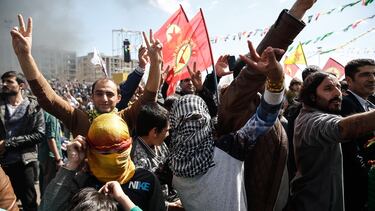
Turkish Kurdistan: the endless war
Turkish Kurdistan is not just one piece of the puzzle. It is nearly half the board. Between 15 and 20 million Kurds live in Turkey, the largest Kurdish population in the world, concentrated in the east and southeast of the country. This region covers more than a quarter of Turkish territory.
Ankara has always treated it almost like an internal border zone: rebellions crushed since the 1920s, forced displacement of villages, entire towns destroyed, and for decades a ban on any expression of Kurdish culture.
Turkey even prohibited the letters Q, W, and X because they existed in the Kurdish alphabet but not in Turkish. The state denied Kurdish existence entirely until 1991 and officially referred to them as “Mountain Turks.”
Here the conflict has a specific name: the PKK, the Marxist guerrilla movement founded by Abdullah Öcalan in 1978. In 1984 it launched a low-intensity war against the Turkish state.
Since then the conflict has claimed more than 40,000 lives. Southeastern Turkey is heavily militarized, filled with checkpoints, bases, exclusion zones, and cities like Diyarbakir, where cycles of urban uprisings have been followed by massive repression.
Then there is the Turkish-American labyrinth, a geopolitical contradiction between the two largest armies in NATO. Turkey is a key ally of Washington. But in Syria, the United States supports Kurdish militias such as the YPG and the Syrian Democratic Forces because they have been the only actors capable of stopping ISIS.
For Ankara these militias are terrorists. For Washington they are indispensable partners. The result is a three-way alliance in which everyone smiles for the official photos while, under the table, each side keeps a loaded gun pointed at the others.
Syrian Kurdistan: a feminist experiment
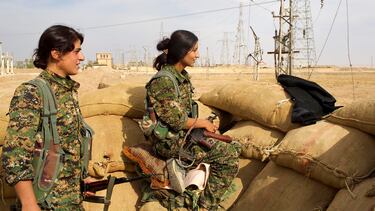
Amid the chaos of the Syrian civil war, the Kurds created an anomaly: Rojava. It is an unusual political experiment built on local assemblies, community self-defense, and a militant feminism that turned equality into doctrine.
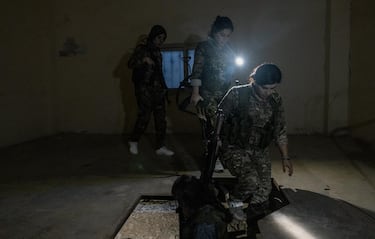
This is where the YPJ emerged, the women’s brigades that did something no Arab or Western army had managed to do. They humiliated ISIS in Kobane.
The jihadists did not fear cruise missiles nearly as much as they feared the women of Rojava. They believed that if they were killed by them, the gates of paradise would close forever. It was accidental propaganda, but it worked better than any Pentagon campaign.
When the Kurds finished the dirty work and the caliphate was reduced to ashes, the latest betrayal arrived. In 2019, Donald Trump decided he no longer needed his “heroes” and withdrew U.S. troops from the border, opening the door to a Turkish invasion.
Once again, the Kurds had been useful tools for the West. When the decisive moment came, they were abandoned.
Why Kurdistan could shape the current war
In 2026 Kurdistan is once again the uncomfortable key that could tip the balance of conflict in the region. It forms a perfect pincer against Iran.
If Israel or any international coalition wanted to destabilize Tehran from within, the Kurds are exactly where they would need them: on the border, armed, motivated, and carrying a century of unresolved grievances.
Today, with Iran shaken by war and Turkey rising in influence, the Kurds are living through their most dangerous moment. It may also be their most hopeful.
In the Zagros Mountains they do not bury their dead. They plant them. They believe those graves are seeds, and that sooner or later the map drawn by Sykes and Picot will finally explode.
Related stories
Get closer to the game! Whether you like your soccer of the European variety or that on this side of the pond, our AS USA app has it all. Dive into live coverage, expert insights, breaking news, exclusive videos, and more. Plus, stay updated on NFL, NBA and all other big sports stories as well as the latest in current affairs and entertainment. Download now for all-access coverage, right at your fingertips – anytime, anywhere.
And there’s more: check out our TikTok and Instagram reels for bite-sized visual takes on all the biggest soccer news and insights.
Complete your personal details to comment