



Why is the Spanish flag red and yellow and what are the origins and meaning of the coat of arms?
The product of a contest, Spain’s national flag has nearly 200 years of history and has undergone several changes over that time.
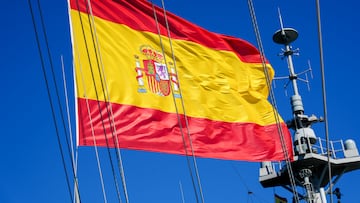
Spain’s national flag has more than 175 years of history. It began as a naval ensign, later became the merchant flag, and eventually was adopted as the official flag of the nation and all state institutions.
Its origins date back to the reign of King Charles III, who wanted a flag that would be easily distinguishable during naval battles. To find the best design, he organized a competition that attracted 12 proposed designs.
The color red was selected because it was one of the easiest and most practical dyes to produce at the time. Yellow was chosen for its high visibility at sea. Likewise, the horizontal stripes were designed so the flag could be quickly recognized from a distance while ships were underway.
Why is Spain’s flag called the “Rojigualda”?
Spain’s flag is commonly referred to as the rojigualda, a nickname derived from the historical term gualda, a yellow dye obtained from the weld plant. The term is more informal and widely used than the official designation of the national flag.
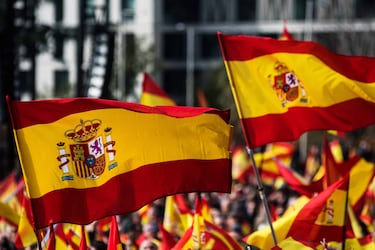
Historical changes to the Spanish flag
After Queen Isabella II officially adopted the red-and-yellow flag as Spain’s national emblem in 1843, its design underwent several notable changes over the following decades.
The First Spanish Republic (1873-1874)
The flag remained essentially the same as the 1785 design, except that the royal crown was removed.
The Second Spanish Republic (1931-1939)
The Second Republic introduced significant changes. The previous coat of arms was replaced with a simplified version featuring only the lion and the castle as its principal symbols.
A purple stripe was also added because the new republican government wanted a flag that clearly distinguished the new political era from the monarchy. According to traditional accounts, purple was intended to represent the Comuneros of Castile, while supporters of the change viewed the existing red and yellow colors as being more closely associated with the Crown of Aragon and Catalonia. Historians, however, have debated the historical basis for linking the Comuneros with the color purple.
The flag during Franco’s dictatorship and the democratic transition (1945-1977)
Following the Spanish Civil War (1936-1939), Spain returned to the traditional red and yellow colors. The coat of arms was redesigned, replacing earlier republican elements with a royal crown and incorporating the Eagle of Saint John, a symbol associated with the Catholic Monarchs, particularly Queen Isabella I.
During the reign of King Juan Carlos I, the lion in the coat of arms was depicted in a fuchsia shade rather than purple, reportedly because the king preferred to avoid the republican associations of the traditional purple color.
The current Spanish flag (1981 to the reign of King Felipe VI)
In 1981, Spain adopted its current coat of arms, which represents the historic kingdoms of the Iberian Peninsula: the Kingdom of Castile, the Kingdom of León, the Crown of Aragon, the Kingdom of Navarre, and the Kingdom of Granada. At its center is the coat of arms of the House of Bourbon. The shield is topped by the royal crown and flanked by the Pillars of Hercules, which support Spain’s national motto, Plus Ultra (“Further Beyond”).
The modern design also includes the imperial crown above the Pillars of Hercules, making Spain’s flag distinctive in combining both a royal crown and an imperial crown within its heraldic composition.
During the reign of King Felipe VI, the lion in the coat of arms returned to its traditional purple color, restoring the original heraldic design.
Related stories
Get closer to the game! Whether you like your soccer of the European variety or that on this side of the pond, our AS USA app has it all. Dive into live coverage, expert insights, breaking news, exclusive videos, and more. Plus, stay updated on NFL, NBA and all other big sports stories as well as the latest in current affairs and entertainment. Download now for all-access coverage, right at your fingertips – anytime, anywhere.
And there’s more: check out our TikTok and Instagram reels for bite-sized visual takes on all the biggest soccer news and insights.
Complete your personal details to comment