


Why was the U.S. flag moving? Science responds to those who deny the moon landing
Astrophysicist Rodrigo González Peinado explains to AS why man did reach the Moon with the Apollo missions and debunks the theories that deny it.

NASA’s Artemis II mission, which also involves the European Space Agency (ESA), has brought renewed attention to the Moon. This time, the goal is to establish a base at the Moon’s south pole and create the conditions necessary for humans to stay there for weeks or even months.
Bringing the Moon back into public discussion has also revived conspiracy theories claiming that the earlier Apollo missions never actually landed there. According to these claims, the landings were staged by the United States to win the space race against the Soviet Union. Rodrigo González Peinado, an astrophysicist and science communicator, explains the main denialist theories and counters them with scientific reasoning.
“Humans did not go to the Moon just once, as is often believed. In total, twelve people walked on the lunar surface between 1969 and 1972. The Apollo program cannot be understood without considering the geopolitical context in which it took place. This was the height of the Cold War, with the Soviet Union also competing for dominance in space. Once the United States demonstrated its superiority by achieving something the USSR never could replicate, it considered the space race won.”
Theory 1: The flag appears to wave. Without an atmosphere, it shouldn’t move
It is true that the lack of a significant atmosphere on the Moon would cause flags to hang limp rather than appear extended, as seen in photos and videos. However, the apparent “waving” of the flag can be explained by three factors.
First, the flags look extended because the flagpoles had a horizontal support rod at the top that held the fabric out.
Second, the movement seen in videos comes from the astronauts handling the flag while planting it in the ground. The motion is caused by their actions. Once they stop, the flag quickly becomes still, exactly as expected in a near-vacuum environment.
Third, the flags appear to ripple because they are wrinkled. Under certain lighting conditions, these wrinkles can give the illusion of motion. The wrinkles exist simply because the flags were folded during transport to the Moon.

Theory 2: No stars appear in the photos, even though there is no atmosphere to block them
This is a weak argument. All Moon landings took place during the lunar daytime, meaning the Sun was visible from the surface. As a result, the lunar ground was brightly lit, giving it the distinctive appearance seen in photos.
In photography, when a very bright subject, like the sunlit lunar surface, dominates the scene, much dimmer objects, like stars, do not appear in the image. The camera exposure is set for the bright foreground, effectively washing out the faint background.
The same effect happens when you take a photo inside a brightly lit football stadium at night. You can see the lights and the field, but not the stars. That does not mean the photo is fake. It is simply basic photographic optics.

Theory 3: The lunar module didn’t create a crater, even though it weighed about 17 tons
This question is more interesting and involves understanding mass and pressure.
The lunar module had a mass of about 17 tons at launch, though “tons” measure mass, not weight. Around 65 to 70 percent of that mass was fuel. By the time it landed, most of that fuel had been burned, reducing its mass to roughly 6 tons.
Additionally, gravity on the Moon is about one-sixth of Earth’s, so the effective weight is much lower. This means the module exerted a force equivalent to roughly 1.3 tons on Earth, far less than its initial mass might suggest.
That force was distributed across four landing legs, each with wide, circular pads. A larger contact area reduces pressure. In contrast, an astronaut’s boot concentrates force into a much smaller area.
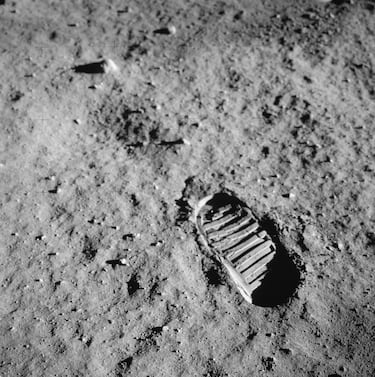
Calculations show that the pressure exerted by Buzz Aldrin’s boot, whose footprint is seen in the famous photo, was actually greater than the pressure exerted by the lunar module. That is why footprints are visible while no large crater formed.
Theory 4: Shadows are not parallel, suggesting multiple light sources
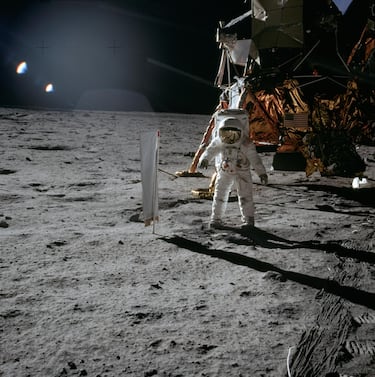
Shadows that appear to converge do not necessarily indicate multiple light sources. This is a matter of perspective, geometry, and uneven terrain.
A classic example is railroad tracks. They are parallel, but when viewed from a certain angle, they appear to converge in the distance. The same effect occurs with shadows in photographs.
This is partly due to projecting a three-dimensional scene onto a two-dimensional image from a specific viewpoint.
Additionally, the Moon’s surface is not perfectly flat. It contains rocks, slopes, and small depressions. These irregularities can distort shadows, making them appear bent or angled differently.
If there were multiple light sources, each object would cast multiple shadows. In the Apollo photos, each object clearly casts only one shadow, consistent with a single light source, the Sun.
Theory 5: Flames cannot exist in a vacuum, yet flames are visible from the Apollo engine
This lesser-known claim is also incorrect. It involves basic chemistry and rocket propulsion.
The lunar module’s ascent engine worked through a chemical reaction between Aerozine 50 and nitrogen tetroxide, known as a hypergolic reaction. These substances ignite upon contact and produce a nearly transparent exhaust.
The engine did not require external oxygen because all necessary components for combustion were stored within the spacecraft.
The “flames” sometimes seen in images are not actually flames. They are small particles or debris illuminated by sunlight, or byproducts of combustion that appear bright. These are simply brief flashes, not true flames.
This can be seen in the video above starting at minute 9:50.
Related stories
Get closer to the game! Whether you like your soccer of the European variety or that on this side of the pond, our AS USA app has it all. Dive into live coverage, expert insights, breaking news, exclusive videos, and more. Plus, stay updated on NFL, NBA and all other big sports stories as well as the latest in current affairs and entertainment. Download now for all-access coverage, right at your fingertips – anytime, anywhere.
And there’s more: check out our TikTok and Instagram reels for bite-sized visual takes on all the biggest soccer news and insights.
Complete your personal details to comment