


Flashback to when Florentino Pérez resigned from Real Madrid in 2006
A defeat-heavy week against Arsenal and Mallorca sparked the end of the Galácticos era and Pérez’s stunning resignation.

Florentino Pérez did not wait for the second leg. He stepped down as Real Madrid president in the middle of the Champions League tie against Arsenal, in the eye of a storm that had become unbearable and uncontrollable.
Follow live Florentino Perez’s press conference, here
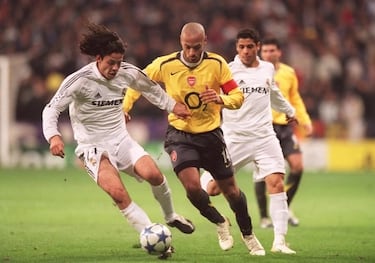
Six days earlier, Thierry Henry had silenced the Santiago Bernabéu with a decisive 1-0 win for Arsenal. The mood was already grim, bordering on the belief that the Galácticos era was coming to an end. It felt like the chronicle of a death foretold.
There was still a second leg to play, and hope remained. But Henry’s goal proved to be the tipping point. The situation fully unraveled in the next league match, a 2-1 defeat away to Mallorca. That was the moment Pérez made his decision. It was final, even if it ultimately became something more complicated than that.
On Feb. 27, 2006, he officially resigned as Real Madrid president.
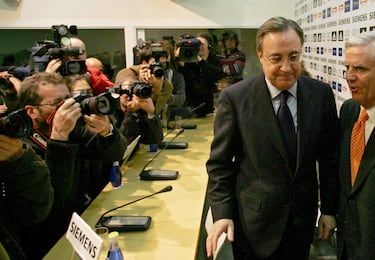
Florentino Pérez delivers blistering exit speech
In his farewell address, Pérez was brutally direct with the squad. He criticized what he described as an egocentric and selfish mentality among the players, admitting that he had, in his own words, “spoiled” them.
He also pointed to a lack of ambition and a breakdown in team unity, using an incident involving Sergio Ramos the previous day as an example.
“Ramos said it, what happened is not normal,” Pérez noted.
The incident referred to the reaction after Ramos scored against Mallorca. Instead of being celebrated by his teammates, he was largely ignored. Ramos later explained the moment on Cadena SER.
“When I scored, it felt like Mallorca had scored instead of me. Unity makes you stronger, and that is something that really matters. Everything would be different if the relationship between players was closer,” Ramos said.
“I take responsibility for everything”
Pérez did not spare himself.
“After telling them so many times they were the best in the world, they ended up confused,” he said. “I recognize that I have been heavily involved in this project that is now ending. And perhaps I have had too many commitments with players when it came to renewals. Others who come after me will have freer hands.”
He insisted his resignation was irreversible.
“The club needed a change, a shake-up, a new impulse. We have changed many coaches, and now it is my turn to go. I am a blockage that needed to be removed.”
He concluded with full accountability.
“I have not known how to guide them. What happened in Mallorca is proof. For the sake of consistency, I have to admit I did something wrong. I take the blame.”
It was a historic speech, and it marked the end of his first spell as president.
A club in chaos
On the pitch, Real Madrid were in free fall.
Off it, the club had recovered financially from near-bankruptcy to being named the richest club in the world in 2006 by Deloitte. But sporting success had collapsed.
The team was heading toward a third straight season without a major trophy, with only a Spanish Super Cup to show between 2003 and 2006. Coaching instability defined the era.
Vicente del Bosque’s abrupt departure was followed by a revolving door of managers: Carlos Queiroz (333 days), José Antonio Camacho, who resigned quickly, Mariano García Remón, dismissed at Christmas, Vanderlei Luxemburgo, and later López Caro from the reserve team.
Even the sporting structure was unstable, with Arrigo Sacchi arriving as sporting director and Jorge Valdano also exiting during the chaos.
Institutional upheaval
The instability was not limited to the dugout.
Pérez proposed Fernando Martín, a real estate executive and then vice president, as interim president until the 2008 elections. The board approved the move, but it quickly collapsed.
Within weeks, Martín was forced to resign, and veteran board member Luis Gómez-Montejano took over on an interim basis.
That turbulence mirrored the sporting crisis, and eventually led to Ramón Calderón winning the presidency in a tightly contested election with 29.81 percent of the vote, narrowly beating Juan Palacios.
Arsenal survives at Highbury
The first Florentino Pérez era ended in 2006, the same year Real Madrid faced Arsenal for the first and only time in Champions League history.
The second leg at Highbury ended 0-0. Real Madrid came close, with Raúl hitting the post and missing the rebound after a brilliant save from Jens Lehmann. Arsenal survived despite being outplayed that night.
Zinedine Zidane would never play in European competition again, retiring that summer. A new cycle began under Fabio Capello.
Real Madrid finished second in La Liga and reached the Copa del Rey semifinals, where they were eliminated by Zaragoza, still under Pérez’s presidency at that stage.
But the decision had already been made.
Florentino Pérez resigned in one of the most dramatic exits in modern football administration, pointing fingers at the squad while also taking responsibility himself.
Related stories
Get closer to the game! Whether you like your soccer of the European variety or that of this side of the pond, our AS USA app has it all. Dive into live coverage, expert insights, breaking news, exclusive videos, and more. Plus, stay updated on NFL, NBA and all other big sports stories as well as the latest in current affairs and entertainment. Download now for all-access coverage, right at your fingertips – anytime, anywhere.
And there’s more: check out our TikTok and Instagram reels for bite-sized visual takes on all the biggest soccer news and insights.
Complete your personal details to comment